Students Design Backstage Catering Menu for BST Hyde Park
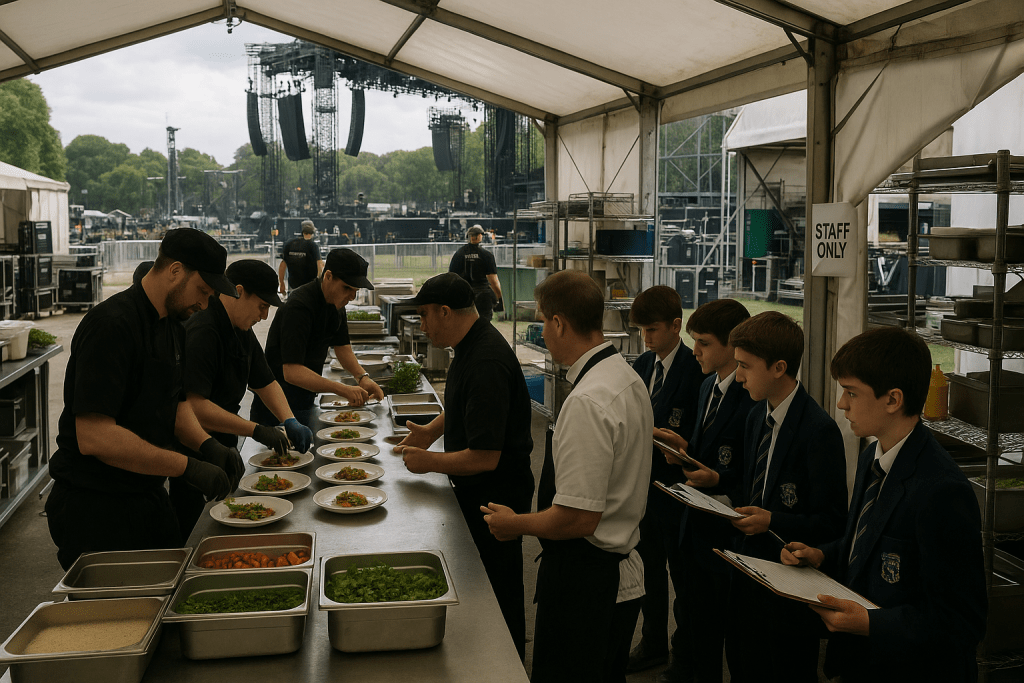
Backstage catering at one of London’s largest summer concert series is doubling as a live classroom this year, as Global Infusion Group’s catering brands Eat to the Beat and GIG turn a student-designed menu into a working service at BST Hyde Park.
A group of Year 9 pupils from Sir Thomas Fremantle School in Buckinghamshire have seen their culinary concept, which won a regional schools challenge, adapted and deployed for crews and staff behind the scenes at the festival. The initiative offers a rare first-hand look at how large-scale event catering operates under real production conditions.
Background and education context
The students secured the opportunity through Buckinghamshire Business First’s Menu Masters challenge, a schools programme that encourages young people to develop practical skills linked to hospitality, business and entrepreneurship. Working in teams, pupils are tasked with developing menu ideas that balance creativity with nutritional and commercial considerations.
As winners, the Sir Thomas Fremantle School team progressed from classroom planning to an applied environment: a working backstage kitchen at BST Hyde Park, one of the UK’s flagship outdoor concert events. The partnership with Eat to the Beat and GIG connects the competition’s learning objectives with the operational realities of live event catering, from menu viability at scale to service logistics.
For the catering teams, the project also serves as a talent and skills outreach exercise, supporting a wider industry focus on attracting younger generations into event-related careers at a time when hospitality, production and technical roles face ongoing recruitment challenges.
Key elements of the backstage collaboration
Under the collaboration, the students’ winning menu is being incorporated into the backstage catering programme at BST Hyde Park, which serves artists’ teams, production crew and support staff. While professional chefs from Eat to the Beat and GIG retain responsibility for food safety, production and delivery, the core concepts and dishes originate from the students’ competition entry.
The project involves several practical steps designed to mirror the development process used for major tours and festivals:
- Menu refinement: The student-created menu is reviewed with culinary and operations teams to ensure it can be produced at volume, within budget and in line with nutritional requirements for working crew.
- Back-of-house planning: The dishes are integrated into existing kitchen workflows, factoring in prep times, ingredient sourcing, dietary accommodations and service windows aligned to show schedules.
- On-site experience: Students are invited to visit BST Hyde Park, meet catering staff and see their menu being prepared and served backstage, offering a direct view of how food moves from concept to plate in a live production environment.
- Professional feedback: Event catering teams provide structured feedback to the pupils, covering flavour, presentation, practicality and how the menu performs under festival conditions.
While the students are not responsible for cooking during live service, they gain insight into the technical and logistical considerations that distinguish event catering from traditional restaurant environments, including food safety protocols, time-critical service and the need to support teams working long shifts on-site.
Industry impact and skills pipeline
The collaboration exemplifies how event suppliers are beginning to treat skills development as part of their operational agenda, not only an HR function. By opening up backstage operations to structured educational programmes, suppliers can showcase the variety of roles that underpin large-scale live events.
Back-of-house food operations for festivals and touring productions typically involve menu development, procurement, logistics management, refrigeration and storage planning, dietary compliance, and close coordination with production timelines. Exposing students to these components helps demystify less-visible parts of the event economy and may broaden interest beyond high-profile front-of-house roles.
The project also highlights the intersection between hospitality and event technology. Modern large-scale catering environments rely on digital systems for stock control, scheduling, compliance recording and crew communication. Even if the initiative is primarily culinary, it offers a gateway for young people to understand how software and data support on-site decision-making.
For regional business networks such as Buckinghamshire Business First, initiatives of this kind support local skills strategies by providing concrete examples of career pathways and facilitating relationships between schools and employers active in touring and festival markets.
Why this matters for event professionals and technology providers
For organisers, production companies and venue operators, the project underscores the value of structured partnerships with schools and training providers to address workforce shortages across technical, catering and operations roles. Early exposure to real-world environments can create more informed entrants to the labour market, reducing onboarding time and skills gaps.
From a technology perspective, initiatives like this also provide an opportunity to:
- Showcase how catering management platforms, crew apps and resource-planning tools function in live settings.
- Demonstrate the integration between scheduling, accreditation and catering entitlement systems for artists and staff.
- Gather feedback from younger users on interfaces and workflows, informing future product design.
Vendors supplying catering, workforce management or operations software to festivals and large-scale events may find that educational collaborations strengthen their position as long-term partners to both organisers and local skills initiatives.
For event professionals tasked with sustainability and community engagement, this type of project offers a model that combines social value, education and operational delivery. By anchoring the student experience to a live, commercially significant event, partners can demonstrate tangible outcomes without creating parallel or symbolic programmes detached from core business activity.
Conclusion
The decision by Eat to the Beat and GIG to bring a student-designed menu into the backstage operations of BST Hyde Park signals a practical approach to industry education: embedding learning in real events rather than simulated environments. For the Year 9 students involved, it offers a rare vantage point into one of the most complex areas of live event production.
For the wider sector, the project illustrates how catering suppliers and organisers can contribute to the future talent pipeline while enhancing their operational story to clients, local authorities and partners. As festivals and large-scale concerts continue to refine their backstage ecosystems, similar collaborations may become an increasingly common feature of how the industry connects with the next generation of workers, entrepreneurs and technology adopters.