Beyond the Smartwatch: Haptic Feedback Wearables for Visually Impaired Attendees
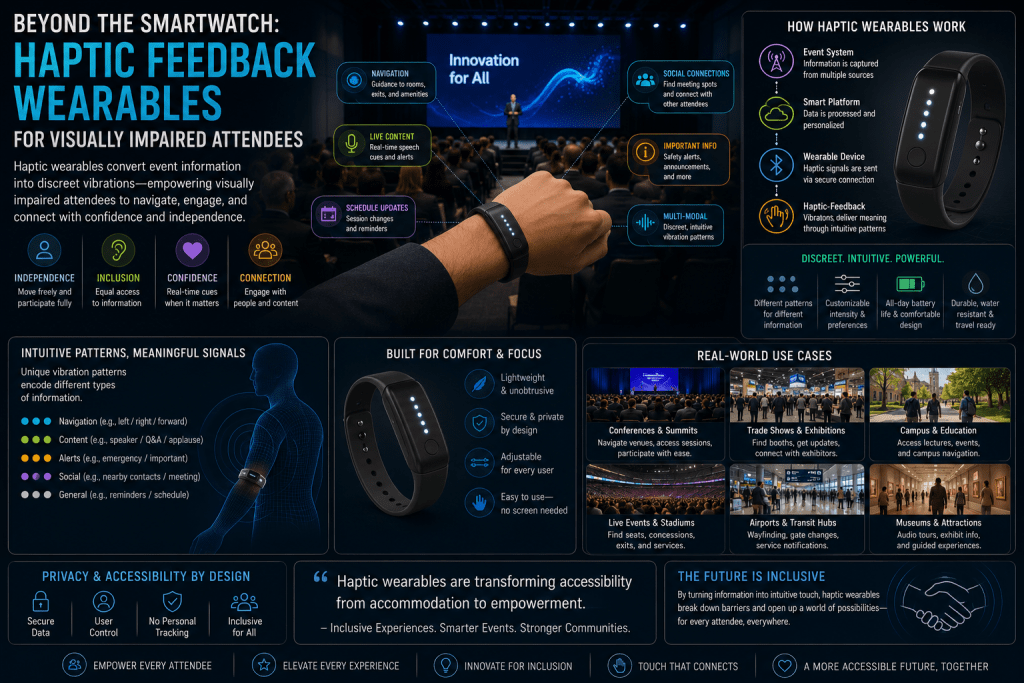
Accessibility has become a defining priority for the modern event industry. Conferences, trade shows, exhibitions, sporting events, festivals, and corporate gatherings are increasingly expected to provide experiences that are inclusive for attendees of all abilities. While significant progress has been made in physical accessibility through ramps, elevators, tactile flooring, and assistive listening systems, digital accessibility is emerging as the next frontier of event technology.
Among the most promising innovations are haptic feedback wearables. Unlike traditional smartwatches that primarily deliver notifications and health metrics, next-generation haptic devices use sophisticated vibration patterns and tactile cues to communicate information without relying on visual or audio prompts. These wearables are enabling visually impaired attendees to navigate venues independently, receive real-time event updates, locate sessions, identify points of interest, and interact more confidently with the event environment.
As artificial intelligence, indoor positioning systems, Bluetooth Low Energy (BLE), ultra-wideband (UWB), and wearable computing continue to evolve, haptic technology is becoming a powerful accessibility solution that enhances independence while reducing reliance on human assistance.
For event organizers, these devices represent more than assistive technology—they represent a shift toward universally designed experiences that improve navigation, communication, and engagement for every attendee.
Why Traditional Accessibility Tools Have Limitations
Large event venues present numerous challenges for attendees with visual impairments.
Convention centers often feature:
- Complex floor layouts
- Multiple session rooms
- Temporary exhibit structures
- Changing traffic patterns
- Dynamic schedules
- Crowded walkways
Traditional accessibility methods such as printed Braille materials or static tactile maps provide valuable support but cannot adapt to constantly changing event environments.
Similarly, audio guidance systems may become difficult to hear in noisy exhibition halls or keynote sessions and can reduce privacy by broadcasting information publicly.
Haptic wearables overcome many of these limitations by delivering private, real-time information directly through touch.
What Are Haptic Feedback Wearables?
Haptic wearables are electronic devices that communicate information through precisely controlled vibrations and tactile sensations.
Unlike conventional wearable devices that primarily display visual notifications, haptic systems translate digital information into touch-based signals.
These devices may be worn as:
- Wristbands
- Smart bracelets
- Arm bands
- Rings
- Belts
- Smart clothing
- Shoe inserts
Each device delivers distinct vibration patterns that correspond to specific instructions or notifications.
Because users interpret information through touch, they can remain focused on their surroundings rather than looking at a screen.
How Haptic Navigation Works
Navigation is one of the most valuable applications for haptic wearables at live events.
Indoor Positioning Systems
Modern venues increasingly deploy indoor positioning technologies using:
- Bluetooth Low Energy beacons
- Ultra-wideband sensors
- Wi-Fi positioning
- Computer vision
- Digital twins
These systems continuously determine attendee location throughout the venue.
AI-Powered Route Guidance
Navigation platforms combine positioning data with AI-powered routing engines.
Instead of displaying directions visually, wearable devices communicate navigation through vibration patterns.
Examples include:
- Left turn
- Right turn
- Continue straight
- Stop
- Destination reached
This enables attendees to move independently through unfamiliar venues.
Dynamic Rerouting
If an area becomes crowded or inaccessible, AI systems can calculate alternative routes instantly.
Updated directions are delivered through new haptic cues without requiring manual interaction.
Real-Time Event Communication
Navigation is only one component of the attendee experience.
Haptic devices also provide timely event information.
Session Notifications
Wearables can notify attendees about:
- Upcoming sessions
- Schedule changes
- Room relocations
- Speaker updates
- Session reminders
Different vibration patterns distinguish each type of notification.
Safety Alerts
Emergency communication becomes more effective through tactile feedback.
Critical alerts such as:
- Evacuation notices
- Severe weather
- Security instructions
- Medical emergencies
can be delivered instantly without relying solely on audible announcements.
Personalized Information
Artificial intelligence allows notifications to be customized based on attendee preferences, schedules, and accessibility needs.
This reduces unnecessary interruptions while increasing relevance.
Supporting Independent Social Interaction
Networking remains one of the primary reasons people attend events.
Haptic wearables are beginning to support more inclusive networking experiences.
Meeting Guidance
Devices can guide attendees toward:
- Scheduled meetings
- Networking lounges
- Exhibitor booths
- Hospitality areas
without requiring visual maps.
Contact Identification
Some experimental systems integrate wearable technology with attendee profiles.
When approaching a scheduled contact, the device can provide discreet vibration alerts indicating proximity.
Private Communication
Unlike loudspeaker announcements or verbal assistance, haptic communication remains completely private.
This preserves attendee independence and dignity.
Integration with Smart Venue Infrastructure
The effectiveness of haptic systems depends on broader event technology ecosystems.
Internet of Things Connectivity
Smart venues increasingly incorporate connected infrastructure including:
- Occupancy sensors
- Digital signage
- Smart lighting
- Environmental monitoring
- Access control systems
Haptic devices can interact with these systems to provide context-aware guidance.
Digital Twin Integration
Digital twins provide continuously updated virtual models of venues.
AI routing engines use these models to calculate optimal navigation paths based on:
- Crowd density
- Temporary closures
- Room availability
- Traffic flow
Wearables receive updated instructions automatically.
Event Apps and Cloud Platforms
Most haptic systems integrate with existing event management platforms.
This enables synchronization with:
- Personal agendas
- Registration systems
- Session schedules
- Networking tools
creating a unified attendee experience.
Benefits for Event Organizers
Although designed primarily for accessibility, haptic wearables deliver broader operational value.
Greater Event Inclusivity
Providing advanced navigation technology demonstrates a commitment to accessible event design.
This supports diversity, equity, and inclusion initiatives.
Reduced Staff Demand
Attendees who navigate independently require less wayfinding assistance from event staff.
This allows personnel to focus on higher-value attendee services.
Improved Crowd Management
Navigation systems can distribute attendees more efficiently throughout venues, reducing congestion in high-traffic areas.
Better Attendee Satisfaction
Personalized guidance improves confidence, comfort, and overall event experience.
This often contributes to higher satisfaction scores.
Challenges and Considerations
Despite their promise, haptic systems require careful implementation.
Infrastructure Investment
Effective deployment depends on reliable positioning technology throughout the venue.
Organizers may need to invest in:
- BLE beacon networks
- UWB infrastructure
- AI navigation platforms
- Cloud services
Device Management
When organizers provide wearables, they must address:
- Charging
- Sanitization
- Distribution
- Collection
- Inventory tracking
Some events are exploring BYOD-compatible wearable ecosystems to reduce hardware requirements.
User Training
Although haptic communication is intuitive, attendees should receive brief orientation sessions explaining vibration patterns and device functionality.
Emerging Innovations
The future of haptic accessibility extends well beyond navigation.
Emerging technologies include:
- AI-generated tactile guidance
- Context-aware vibration personalization
- Smart glasses paired with haptic wearables
- Gesture recognition
- Wearable digital assistants
- Spatial audio and haptic synchronization
- Brain-computer interface research
As these innovations mature, wearable accessibility will become increasingly seamless and adaptive.
The Future of Inclusive Event Experiences
Haptic wearables illustrate an important shift in accessibility philosophy.
Rather than creating separate accommodations, modern event technology increasingly emphasizes universal design—developing solutions that benefit everyone while removing barriers for those with disabilities.
Navigation assistance, discreet notifications, crowd-aware routing, and personalized communication have value beyond accessibility alone.
Many attendees may eventually choose haptic guidance simply because it offers a more efficient and less distracting way to interact with complex event environments.
Conclusion
Haptic feedback wearables are redefining accessibility for visually impaired attendees by transforming digital information into intuitive tactile experiences. Through AI-powered navigation, indoor positioning systems, real-time notifications, and seamless integration with smart venue infrastructure, these devices enable greater independence, confidence, and participation throughout live events.
For organizers, the technology delivers benefits that extend beyond compliance. It enhances attendee satisfaction, supports inclusive event design, improves operational efficiency, and contributes to more intelligent venue management.
As wearable technology, artificial intelligence, and connected event ecosystems continue advancing, haptic feedback devices are poised to become an essential component of the next generation of accessible event experiences. The future of event accessibility is not simply about removing barriers—it is about creating environments where every attendee can navigate, engage, and participate with equal confidence.