Mixed Reality in Events: Converging Physical and Digital into Shared Environments
Introduction: Beyond Overlay and Immersion
Event technology has explored both ends of the spectrum—Augmented Reality enhancing the physical world, and Virtual Reality replacing it entirely. Mixed Reality (MR) represents the convergence of these paradigms. It does not merely overlay information or simulate environments; it enables digital and physical elements to coexist, interact, and respond to each other in real time.
In event contexts, this creates a fundamentally new model of experience. Attendees are not just observing digital content layered onto reality—they are engaging with persistent, spatially aware digital objects that behave as if they exist within the physical environment. This shift introduces new possibilities for interaction, collaboration, and orchestration.
Defining Mixed Reality in Event Contexts
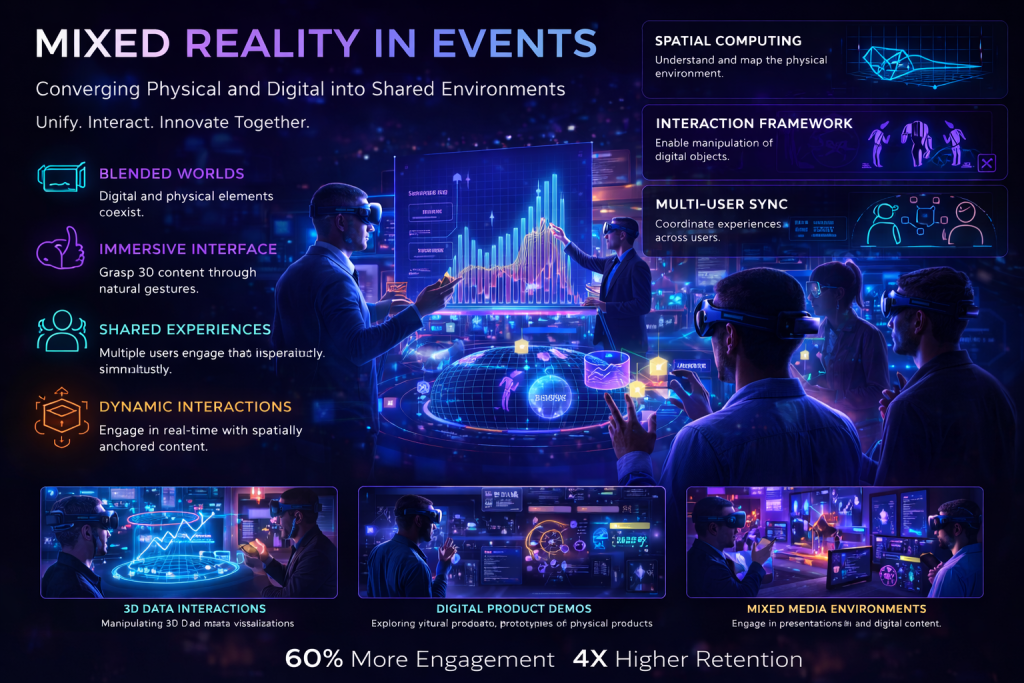
Mixed Reality refers to environments where physical and digital objects coexist and interact in a shared spatial context. Unlike AR, where overlays are primarily visual, MR introduces environmental understanding and interaction fidelity.
Key characteristics include:
- Digital objects anchored to physical space with persistent positioning
- Real-time interaction between users and digital elements
- Environmental awareness, including surfaces, depth, and occlusion
- Multi-user synchronization within shared environments
In events, MR enables experiences where digital content is not just seen, but experienced as part of the environment.
System Architecture: Spatial Intelligence and Interaction
Delivering MR experiences requires a sophisticated architecture that integrates spatial computing, real-time rendering, and multi-user synchronization.
Spatial Computing Layer
At the core of MR is spatial computing—the ability to understand and model the physical environment. This involves:
- Depth sensing and environmental mapping
- Surface detection and spatial anchoring
- Occlusion handling, where digital objects interact with real-world objects
Persistent spatial anchors allow digital content to remain fixed in the environment, even as users move.
Rendering and Simulation Engine
The rendering engine generates digital objects that integrate seamlessly with the physical world. This includes:
- Realistic lighting and shadows that match the environment
- Physics simulations for interaction
- High-fidelity 3D models and animations
Consistency between physical and digital elements is critical for immersion.
Interaction Framework
MR enables more natural interactions compared to traditional interfaces. Users can:
- Manipulate digital objects using hand gestures
- Interact with content through gaze or voice
- Move around objects to view them from different perspectives
Interaction design must align with human behavior, minimizing friction and learning curves.
Multi-User Synchronization
Shared experiences are a defining feature of MR in events. Multiple users can interact with the same digital objects in real time.
This requires:
- Low-latency networking
- Consistent state synchronization across devices
- Identity and session management
Synchronization ensures that all participants experience the same environment coherently.
Experience Design: Shared Spatial Experiences
Mixed Reality enables a new category of event experiences that combine physical presence with digital interaction.
In presentations, speakers can interact with 3D data visualizations that appear within the physical space. Attendees can view and engage with these elements from different perspectives, creating a more interactive and engaging format.
Exhibitions can incorporate digital twins of products that attendees can explore and manipulate. Complex systems can be visualized in ways that are not possible with physical prototypes.
Networking experiences can be enhanced with shared digital environments, where attendees interact with both physical and virtual elements simultaneously.
The key is designing experiences that leverage spatial interaction rather than replicating traditional formats.
Integration with Event Technology Systems
Mixed Reality systems rely on deep integration with event technology infrastructure.
Event data platforms provide contextual information that informs MR content. For example, attendee profiles and preferences can influence what digital elements are displayed.
Real-time orchestration systems coordinate MR experiences with other event components, such as lighting, scheduling, and personalization.
Digital twins enhance MR by providing accurate models of physical environments and systems. Edge computing supports low-latency processing, ensuring responsiveness.
This integration ensures that MR experiences are not isolated but part of a cohesive event ecosystem.
Operational and Business Impact
Mixed Reality introduces significant opportunities for both experience design and operational efficiency.
For attendees, it creates highly engaging, interactive environments that blend physical and digital elements seamlessly. This enhances understanding, particularly for complex content.
For organizers, MR enables more flexible use of space. Physical constraints can be augmented with digital elements, expanding possibilities without additional infrastructure.
Sponsors benefit from immersive demonstrations that allow deeper interaction with products and services.
Strategically, MR positions events as advanced experiential platforms, differentiating them in competitive markets.
Challenges and Constraints
Implementing MR in events presents several challenges.
Hardware accessibility remains a limitation. MR experiences often require specialized devices, which may not be widely available.
Environmental variability can affect performance. Lighting conditions, physical layouts, and occlusions impact spatial accuracy.
Content creation is complex, requiring expertise in 3D modeling, interaction design, and spatial computing.
Synchronization across users and devices introduces technical challenges, particularly in large-scale events.
Future Outlook: Toward Persistent Shared Event Spaces
The evolution of Mixed Reality is moving toward persistent spatial environments that extend beyond individual events.
Digital elements may remain anchored to physical venues, creating continuous layers of interaction that evolve over time. Attendees could revisit spaces and interact with content across multiple events.
Advances in hardware—particularly lightweight, wearable MR devices—will improve accessibility and usability. Improvements in spatial mapping and networking will enhance reliability and scalability.
Integration with AI and real-time data systems will enable more adaptive and intelligent experiences, where digital elements respond dynamically to context.
Conclusion: Blending Worlds into a Unified Experience
Mixed Reality represents a significant step in the evolution of event technology. By merging physical and digital environments into a shared, interactive space, it enables experiences that are both immersive and grounded in reality.
This convergence creates new opportunities for engagement, learning, and interaction, while also introducing new technical and operational challenges.
For event technology leaders, the value of MR lies in its ability to redefine how experiences are constructed—moving beyond overlays and simulations to create environments where digital and physical elements coexist seamlessly.
As the technology matures, Mixed Reality will play a central role in shaping the next generation of events, where boundaries between worlds are no longer distinct, but integrated into a unified experience.