CHS Manchester to Co-Create New AI Tool Live With Delegates
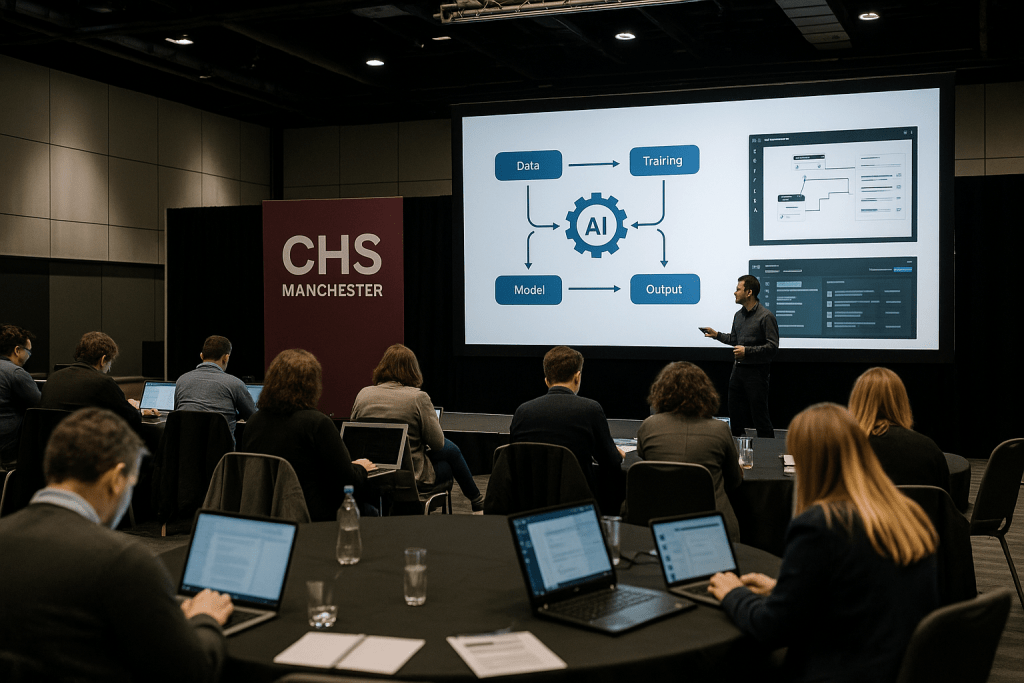
CHS Manchester is planning a live collaboration with delegates to help shape an industry-focused artificial intelligence tool, positioning the September event as an interactive testbed for practical AI in the meetings and events sector.
The initiative is being delivered in partnership with Zoby, a specialist agency that works with organisations looking to implement AI tools in a structured and responsible way. Rather than unveiling a finished product, the partners aim to involve event professionals directly in defining how the tool should work and which real-world challenges it should address.
Background and industry context
The meetings, incentives, conferences and exhibitions (MICE) sector is increasingly exploring AI to support tasks such as proposal writing, venue sourcing, content planning and delegate communication. While many planners are experimenting with general-purpose tools, there is growing demand for solutions trained around event-specific workflows and terminology.
At the same time, concerns persist around data security, bias, intellectual property and the risk of generic outputs that do not reflect the nuance of live events. This has led many organisations to seek guidance on how to adopt AI in a way that is both ethically grounded and operationally useful, rather than experimenting in isolation.
Against this backdrop, CHS Manchester’s decision to turn its show floor into a live development environment reflects a wider industry shift from theoretical discussions about AI to hands-on experimentation. Instead of simply presenting a keynote on the future of technology, the organisers intend to involve their audience in co-creating a tool that is directly informed by the realities of day-to-day event planning.
Key developments at CHS Manchester
The collaboration with Zoby will centre on the design and early-stage configuration of an AI tool tailored for event professionals. Delegates will be invited to contribute their perspectives during the show, providing input on use cases, pain points and workflows that could benefit from automation or AI-supported decision-making.
Ed Dench, founder of Zoby, is scheduled to present at the event, outlining the framework the agency uses to support AI adoption and explaining how structured, domain-specific tools can differ from mainstream consumer AI applications. His session is expected to set the context for the live build activity, giving participants a clearer understanding of what is technologically feasible and where human oversight remains critical.
Interactive elements are expected to include opportunities for attendees to feed in sample scenarios, task requirements and common bottlenecks. These contributions will help shape the logic and priorities of the evolving tool, with the intention that it reflects practical challenges such as responding to tight turnaround briefs, personalising attendee journeys at scale, or consolidating information from multiple suppliers.
While detailed technical specifications have not been disclosed, the partnership is being positioned as an attempt to move AI discussions beyond abstract predictions and into collaborative design. The live element is intended to make the process transparent, allowing event professionals to see how their input can influence the shape and direction of an emerging technology solution.
Potential industry impact
If successful, the initiative could provide a template for how conferences and trade shows can become environments for co-developing technology rather than merely showcasing it. By involving planners, venues and suppliers in the AI design process, CHS Manchester and Zoby aim to surface requirements that might be missed in a traditional product development cycle.
For technology providers, the experiment may highlight the value of integrating real-world operational feedback at an early stage, ensuring tools are capable of handling the complex, multi-stakeholder nature of events. For organisers, it suggests a model in which industry gatherings double as innovation labs, where new solutions can be stress-tested, challenged and refined in real time.
The focus on meaningful AI adoption could also help address scepticism among professionals who have yet to see tangible benefits from emerging technologies. By building a tool grounded in user-led scenarios, the partners hope to demonstrate how AI can support, rather than replace, the expertise of planners and event marketers.
Why this matters for event professionals and technology providers
For event planners, the live build offers an opportunity to influence how AI tools are structured around their day-to-day work, instead of simply adapting to pre-defined software. Attendees will be able to highlight the specific tasks they find most time-consuming or repetitive, from drafting event communications to managing supplier information, and see how these can be translated into AI-enabled workflows.
Participation may also give buyers greater confidence when assessing future AI offerings. By understanding how a tool is trained, what data it uses and how decisions are made, event professionals will be better equipped to evaluate vendors on issues such as data handling, transparency and integration with existing systems.
For technology companies targeting the events market, the initiative underscores the growing expectation that tools should be co-designed with practitioners. Providers that can demonstrate consultative development processes, robust governance and clear, measurable use cases are likely to find a more receptive audience among organisers, agencies and venues.
The collaboration further reflects how event technology is shifting from standalone systems to more connected, intelligent platforms. As AI is embedded into registration, marketing automation, content management and analytics, the need for tools that understand the specific language and logic of events will only increase.
Conclusion
By turning its September edition into a live workshop for building an event-specific AI tool, CHS Manchester is positioning itself at the intersection of industry gathering and technology development. The partnership with Zoby aims to ensure that any resulting solution is grounded in the lived experience of event professionals, rather than being engineered in isolation.
While the final form of the tool remains to be seen, the process itself may prove significant. Involving the sector directly in shaping AI capabilities could help accelerate adoption, build trust and ensure that new technologies address genuine operational challenges. For both event professionals and technology providers, the initiative offers a glimpse of how future conferences might evolve into active co-creation forums for the tools that will define the next phase of event delivery.