Kygo World Tour Adopts Sennheiser Spectera In-Ear Monitoring
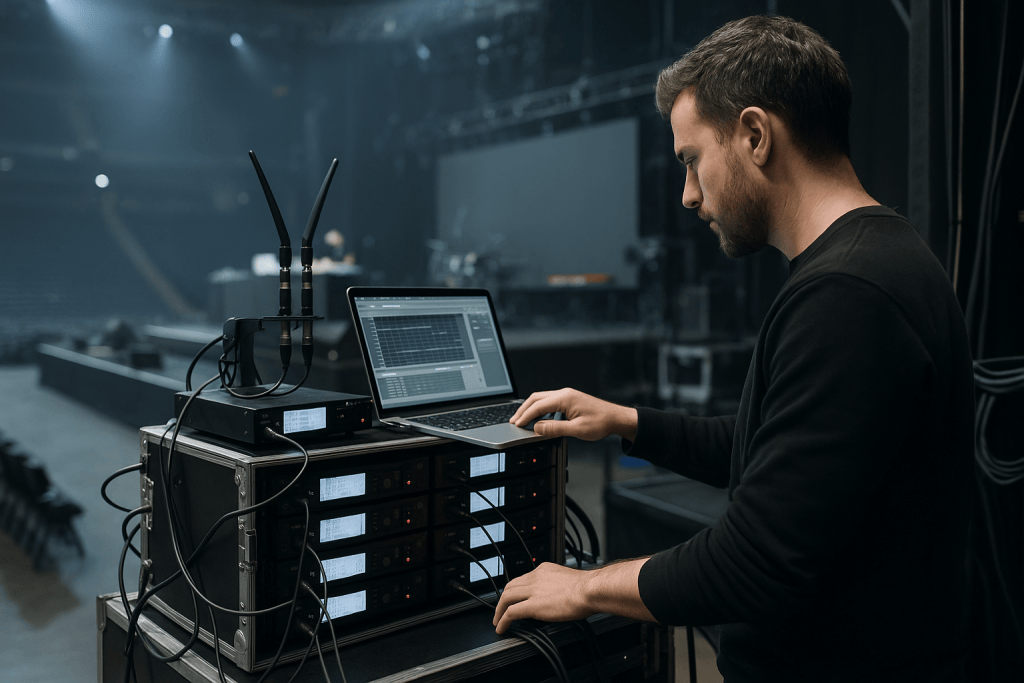
Sennheiser’s pro audio division has placed its new Spectera in-ear monitoring system at the center of Kygo’s current world tour, using the stadium and arena run as a large-scale testbed for the hybrid RF and software-controlled IEM platform.
The tour’s audio team has replaced its regular in-ear monitoring infrastructure with Spectera, integrating the system into a Sennheiser-based RF workflow that already includes digital wireless microphones and a digital RF matrix. The deployment gives one of electronic music’s highest-profile touring productions an early role in shaping the manufacturer’s next-generation monitoring toolset.
Tour Monitoring Built Around Spectera System
The Kygo production is using Spectera to handle all in-ear monitoring for the artist and band, as well as managing additional IFB-style feeds. Spectera is described as the first complete monitoring system from Sennheiser’s Pro Audio division, combining RF components, audio processing and centralized software control.
The system’s RF side employs 6000 Series transmitters and receivers, an antenna and a low power device. Those elements are linked to an entirely new monitoring control solution, the Spectera Control software, which serves as the operational interface for RF monitoring and audio workflow management.
On the tour, Spectera is operated as the core of a broader Sennheiser ecosystem. The show is already running EM 6000 digital receivers, SKM 6000 handheld transmitters with MD 9235 and MMK 965-1 microphone capsules, and SK 6000 bodypack transmitters. All of this is tied together via a Media Control Protocol-based Digital 6000 matrix, which unifies RF control, routing and supervision.
Centralized RF And Audio Control For Complex Show
The live production is built around a main stage and a B-stage, with multiple wireless mic and in-ear channels deployed across both performance areas. The RF and monitoring operation is managed from a dedicated radio room, with the local RF system on stage controlled and monitored remotely over a network.
Through Spectera Control and the D6000 matrix, the team can oversee spectrum use, device states and RF routing from a single interface. Transmitters, receivers, antenna distribution and the new in-ear hardware are supervised in one environment, designed to give engineers a consolidated view of all wireless and IEM activity across the show.
This integration extends to the tour’s monitoring console, a DiGiCo SD7, and stage racks. Spectera’s audio processing is inserted into the signal chain so that console outputs, RF hardware and monitoring control software are aligned in a single workflow. As a result, any adjustments made in Spectera Control are reflected across the spectrum and audio paths that feed the performers’ in-ears.
Hybrid Analog And Digital RF Approach
Spectera is described as a hybrid system because it combines classic analog FM in-ear monitoring with a digitally controlled RF backbone and audio processing. For touring productions and live events, this kind of architecture is directly relevant to how in-ear monitoring can be coordinated across crowded RF environments and evolving spectrum conditions.
In the Kygo deployment, the hybrid structure allows the show to maintain the familiar characteristics of analog IEM transmission while using digital tools for RF coordination, device management and audio workflow. Sennheiser positions Spectera as extending the functionality of the Digital 6000 platform rather than replacing it, by adding monitoring-specific features on top of the existing microphone and RF routing infrastructure.
The system is built to interface with third-party platforms, although the Kygo tour, as described, is running Spectera within a predominantly Sennheiser-based chain. That alignment is significant for production teams that are investing in a single-manufacturer ecosystem for RF microphones, monitoring and control.
In-Ear Monitoring For A High-Tempo Electronic Show
Kygo’s live format combines piano-based segments, full band performance and DJ-style sections, demanding monitoring that can accommodate rapid changes in arrangement and energy. Within that context, the Spectera deployment is handling multiple in-ear mixes, supporting both the artist’s performance and the band’s requirements on stage.
The monitoring setup also supports transitions between the main stage and the B-stage, where wireless mics and IEMs must remain fully coordinated while performers move through the venue. This is managed through the networked control architecture, allowing RF and audio routes to be adjusted without moving the monitoring control position itself.
From an event technology perspective, large-format electronic shows are particularly sensitive to RF stability and monitoring clarity, since the performance often relies heavily on click tracks, playback and synchronized visual systems. While the source material does not detail the show control architecture, the scale of the tour positions Spectera in an environment where monitoring reliability is central to both musical performance and overall production timing.
Software Control As A Core Monitoring Component
The Spectera Control software is at the core of how the system is operated on tour. It aggregates all connected RF and in-ear devices into a single user interface, displaying incoming spectrum information, device status and audio routing options.
For modern touring productions, this kind of software-centric approach is increasingly relevant, as it shifts monitoring from a set of standalone devices to a networked system. In Kygo’s case, Spectera Control communicates with the Digital 6000 receivers, the in-ear transmitters and the RF matrix, consolidating multiple tasks that would otherwise involve several separate tools or control surfaces.
The software is also intended to simplify show-to-show configuration work. While the specific workflow on the Kygo tour is not described in granular detail, centralized control is typically used to store, modify and recall setups for different venues, which is especially pertinent on a world tour where RF environments change from city to city and from country to country.
Relevance For Touring, Festivals And Large Venues
For audio teams in touring, festival and large-venue environments, the Kygo deployment highlights how Sennheiser is positioning Spectera as part of a full RF and monitoring ecosystem. Instead of treating in-ear systems as isolated from microphone and IFB infrastructure, the system merges them into a shared platform, both at the RF and control layers.
In practice, such an approach can be significant for productions running high channel counts, multiple stages or complex show structures where RF planning and monitoring have to be coordinated across many simultaneous demands. While the Kygo tour is a music-focused application, the same basic requirements apply in broadcast, multi-stage festivals, corporate shows with multiple breakout rooms and other large-scale event environments.
The Kygo tour’s use of Spectera therefore functions as a reference for how the system is being applied under real-world conditions where audio and RF teams have to manage both performance requirements and regulatory spectrum constraints across multiple territories.
Part Of Sennheiser’s Broader Pro Audio Portfolio
Sennheiser frames Spectera as a new layer within its established Digital 6000 and wireless portfolio, rather than a standalone product line. For operators already invested in 6000 Series receivers, transmitters and antenna systems, Spectera adds a monitoring-focused extension that can be controlled via the same underlying protocols.
The Kygo world tour implementation underscores this continuity, with the artist’s production using 6000 Series microphones, bodypacks and receivers as the RF foundation, and then adding Spectera as the monitoring system on top. The Digital 6000 matrix connects all of these elements via Media Control Protocol, providing a unified control network that Spectera Control can access.
Further information on Spectera and the wider RF ecosystem is available from Sennheiser’s professional audio channels and product communications, including its main website at sennheiser.com. For event technology professionals, the Kygo tour example provides an early view of how the new monitoring system is being integrated into a high-profile, large-scale touring production.