Projection Mapping in Events: Engineering Spatial Media Systems for Immersive Environments
Introduction: From Display Surfaces to Programmable Space
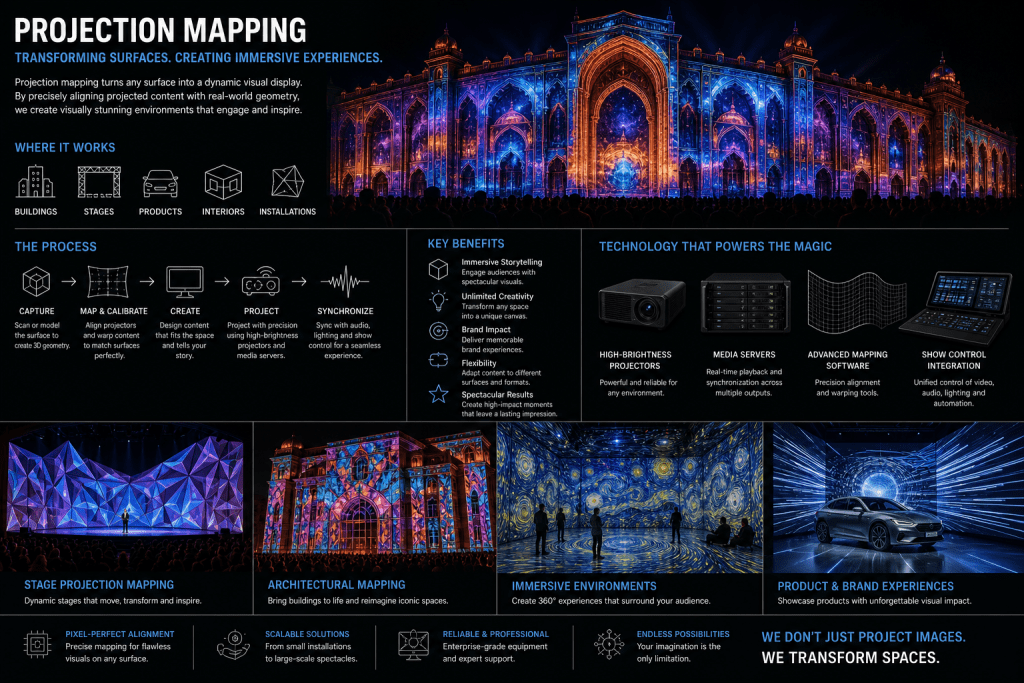
Event visuals have historically been constrained to screens—LED walls, projection screens, and digital signage. While these systems continue to evolve in resolution and brightness, they remain fundamentally planar. Projection mapping shifts this paradigm by transforming physical space into a programmable visual medium.
Rather than placing content onto screens, projection mapping aligns visuals with real-world geometry, allowing surfaces—architectural facades, stage elements, objects, and entire rooms—to function as dynamic display systems. This transition reframes video not as a layer applied to space, but as an intrinsic property of the environment itself.
For event technology, this introduces a new class of systems where spatial modeling, rendering, and synchronization converge to create immersive, site-specific experiences.
Technical Foundations: Geometry, Optics, and Synchronization
Projection mapping is built on the precise alignment of digital content with physical structures. This requires tight coordination across multiple technical domains.
Spatial Capture and Surface Modeling
The process begins with generating an accurate digital representation of the projection surface. This is typically achieved through:
- LiDAR scanning or structured-light scanning for complex geometries
- Photogrammetry for large-scale or architectural environments
- CAD models for pre-designed stage structures
The resulting model defines the coordinate system used for mapping and rendering.
Precision at this stage determines the success of the entire system. Even minor deviations can result in visible misalignment during playback.
Calibration and Warping
Once the geometry is defined, calibration aligns the projector output with the physical surface.
This involves:
- Keystone correction and perspective alignment
- Mesh warping to conform visuals to irregular shapes
- Edge blending for multi-projector setups
Calibration is both a technical and iterative process, often requiring on-site adjustments to account for environmental variables.
Rendering Pipeline
Projection mapping relies on real-time or pre-rendered visual content designed specifically for spatial alignment.
Rendering systems must account for:
- Surface topology and depth
- Lighting conditions and reflectivity
- Perspective from audience viewpoints
Content is typically created using 3D engines or specialized mapping software that integrates geometry directly into the design workflow.
Projection Hardware and Optics
Projector selection is critical and depends on:
- Brightness (measured in lumens) relative to ambient light
- Resolution and pixel density
- Lens configuration (throw ratio, shift capabilities)
For large-scale installations, multiple projectors are combined. Optical alignment and edge blending ensure seamless visual continuity across surfaces.
Media Servers and Real-Time Control
Media servers act as the execution layer, managing playback, synchronization, and system control.
They handle:
- Multi-output rendering across projectors
- Frame-accurate synchronization with audio and lighting
- Real-time adjustments during live operation
Integration with show control systems enables coordinated execution across all event technologies.
System Architecture: Distributed Visual Processing
Projection mapping systems typically follow a distributed architecture.
- Content creation systems generate spatially aligned visuals
- Media servers process and distribute content to outputs
- Projectors render visuals onto physical surfaces
- Control systems synchronize timing with audio, lighting, and stage automation
In advanced deployments, edge processing is used to reduce latency, particularly in interactive environments.
Integration with Event Technology Ecosystems
Projection mapping does not operate in isolation. It is tightly integrated with other event systems to create cohesive experiences.
Lighting Integration
Lighting must be carefully coordinated to avoid washing out projected visuals. In some cases, lighting is designed to complement projection, enhancing depth and contrast.
Audio Synchronization
Projection sequences are often synchronized with audio cues. This requires precise timing to maintain narrative coherence and impact.
Stage Automation and Kinetics
In dynamic stage environments, moving elements must remain aligned with projected content. This introduces additional complexity in tracking and synchronization.
Sensor and Interaction Systems
Interactive projection mapping integrates sensors such as:
- Motion tracking systems
- Depth cameras
- Touch or proximity sensors
These inputs allow visuals to respond in real time to audience or performer actions.
Experience Design: Spatial Narratives and Illusion Engineering
Projection mapping enables a form of storytelling that is inherently spatial.
Architectural Transformation
Buildings and structures can be visually reinterpreted, appearing to deform, collapse, or transform. This is achieved through precise alignment and perspective manipulation.
Dynamic Scenography
In stage environments, projection mapping can replace physical sets. Scenes can transition instantly, enabling rapid changes in narrative and atmosphere without physical reconfiguration.
Object-Level Mapping
Products or installations can be enhanced with projected visuals, revealing internal structures or simulated behaviors that would be impossible to display physically.
Immersive Environments
Full-room projection systems create environments where walls, floors, and ceilings are unified into a single visual space. This is particularly effective for experiential events and exhibitions.
Operational and Business Impact
Projection mapping introduces both creative and operational advantages.
From a production perspective, it reduces reliance on physical set construction, enabling more flexible and scalable designs. Changes can be implemented digitally rather than physically, reducing turnaround time.
For attendees, projection mapping delivers high-impact, immersive experiences that enhance engagement and memorability. The ability to transform familiar spaces into dynamic environments creates a strong emotional response.
For sponsors and stakeholders, it provides opportunities for integrated storytelling, where branding becomes part of the environment rather than an overlay.
Technical Challenges and Constraints
Despite its capabilities, projection mapping presents several challenges.
Environmental Dependency
Ambient light significantly affects visibility. Outdoor or brightly lit environments require high-lumen projectors and careful planning.
Calibration Complexity
Accurate alignment is critical. Changes in projector position, surface geometry, or environmental conditions can disrupt calibration.
Hardware and Cost Considerations
High-performance projectors, media servers, and control systems represent a significant investment, particularly for large-scale installations.
Content Production Complexity
Content must be designed specifically for each surface. This requires expertise in 3D modeling, animation, and spatial design, increasing production time and cost.
Future Trends: Toward Adaptive and Intelligent Projection Systems
Projection mapping is evolving alongside advancements in real-time rendering, AI, and spatial computing.
Real-Time and Generative Content
Modern rendering engines enable visuals to be generated dynamically, allowing content to adapt to live inputs such as audio, data streams, or user interaction.
AI-Driven Calibration
AI systems are being developed to automate calibration and alignment, reducing setup time and improving accuracy.
Integration with XR and Digital Twins
Projection mapping is increasingly integrated with digital twin systems, enabling precise alignment between physical and virtual environments.
Interactive and Responsive Environments
Future systems will be more responsive, using sensors and analytics to adapt visuals based on audience behavior and environmental conditions.
Conclusion: Programming Space as a Medium
Projection mapping represents a shift from screen-based visuals to spatial media systems. By aligning digital content with physical geometry, it transforms environments into programmable canvases.
This capability redefines how events are designed and experienced, enabling new forms of storytelling, interaction, and engagement.
For event technology leaders, projection mapping is not just a visual enhancement—it is a foundational technology for creating immersive, adaptive, and future-ready event environments where space itself becomes part of the content.