The Stage Bus expands sustainable mobile staging offer
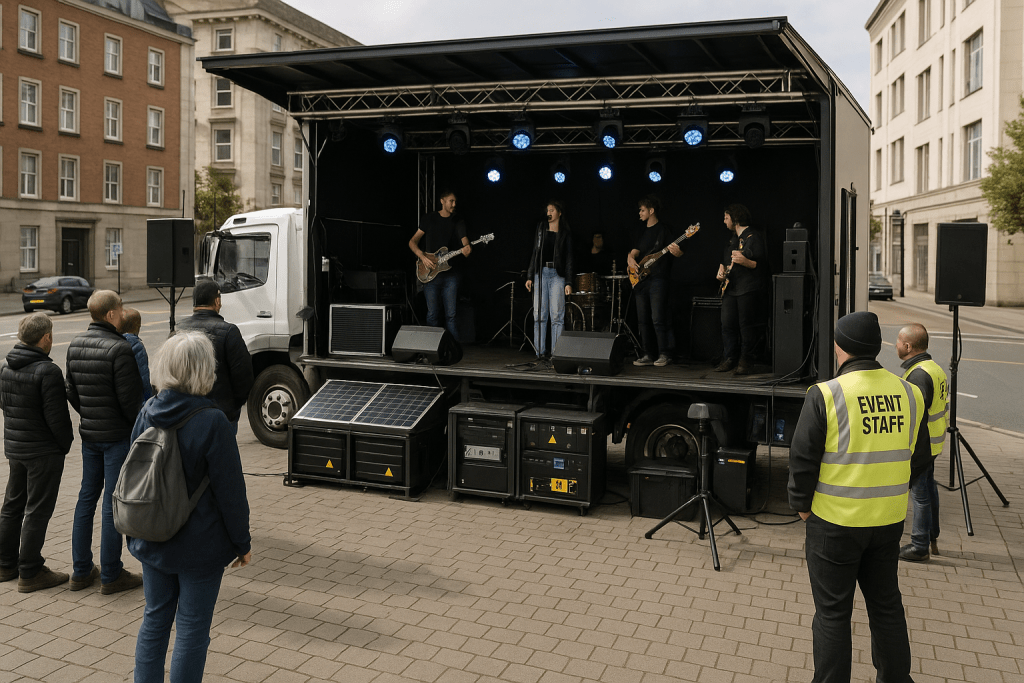
The push for lower-carbon, lower-impact outdoor events is accelerating, and mobile staging provider The Stage Bus has emerged as one of the suppliers attempting to redesign how temporary performance infrastructure is delivered. By shifting away from diesel-heavy set-ups and multi-vehicle site operations, the company is positioning its self-contained, quickly deployed stages as an alternative for organisers looking to reduce emissions without sacrificing production quality.
As event organisers reassess how they power festivals, city centre activations and touring roadshows, solutions that reduce on-site fuel use and shorten build times are increasingly under scrutiny. The Stage Bus has responded by developing a fleet of mobile stages with integrated power and production, designed to arrive, set up and break down with minimal additional infrastructure.
Background: pressure on temporary infrastructure
Outdoor events have traditionally relied on a combination of flatbed trucks, scaffold builds, separate PA systems and lighting rigs, all supported by diesel generators and multiple crew vehicles. While this model is well understood by production teams, it is resource-intensive and often at odds with the sustainability commitments many organisers now publish.
Local authorities, sponsors and attendees are also pushing for more visible efforts to curb noise, emissions and disruption during set-up and de-rig. In parallel, many events face compressed access windows and tighter budgets, making long build schedules and complex logistics harder to justify.
Against this backdrop, mobile staging based on vehicle-mounted structures with built-in production elements has gained traction. These units aim to reduce the volume of kit transported to site and streamline deployment, an approach The Stage Bus has focused on optimising around battery power and integrated systems.
Key developments: integrated, lower-impact stage units
The Stage Bus has developed a portfolio of mobile stages that combine structure, PA, lighting and power into a single unit. Each stage is built into a road-legal vehicle, arriving on site as a complete system rather than as separate components.
Core to the company’s approach is moving away from permanent reliance on diesel generators. The stages are based around battery systems that can be charged from mains power where available, with the option to supplement with generators when required. For many small to medium events, the battery capacity is intended to cover the entire programme, significantly cutting on-site fuel use.
The deployment process is designed to be handled by a small technical crew, typically involving stabilising the vehicle, unfolding the stage structure and activating onboard systems. This can reduce load-in and build time from several hours or more to a relatively short set-up window, depending on site conditions and event requirements.
The company’s range includes different stage sizes tailored for community events, brand activations and larger outdoor gatherings, all built on the same principle of integrated power and production. This model aims to simplify technical planning for organisers by making sound, basic lighting and the physical stage part of a single booking.
Industry impact: logistics, emissions and planning
The approach taken by The Stage Bus is part of a broader shift in event production, where compact, multi-function units are increasingly seen as a way to lower both carbon footprint and operational complexity. By reducing the number of trucks, generators and separate suppliers required, organisers can potentially cut transport-related emissions and limit traffic movements around sensitive sites.
For city authorities and local councils, the reduced footprint of mobile stages can help with licensing and public realm management. Fewer vehicle movements and shorter build times can mitigate disruption to residents and businesses, which is a recurring concern in densely populated areas.
In rural and greenfield locations, integrated mobile stages can ease infrastructure demands where power access is limited. By using battery systems and smaller back-up generators only when needed, events may be able to reduce fuel deliveries and noise pollution compared with traditional generator-led set-ups.
From a production standpoint, the model does have parameters: integrated systems are typically optimised for defined audience sizes and technical specifications. For large-scale touring productions or events requiring complex rigging and heavy flown hardware, conventional stages and separate technical suppliers may still be more appropriate. The impact of The Stage Bus and similar providers is therefore more pronounced in small to mid-scale outdoor events, civic programmes, and brand roadshows.
Why this matters for event professionals and technology providers
For organisers, sustainability targets are increasingly linked to commercial and reputational outcomes. Sponsors often ask for evidence of environmental planning, and audiences are more attuned to visible signs of lower-impact operations. Using mobile stages that demonstrate reduced generator use and quicker, cleaner builds can form part of a wider sustainability narrative backed by operational data.
Production managers and technical directors may also see benefits in risk management and resourcing. Integrated mobile stages streamline supplier coordination and can reduce the number of contractors on site. This may simplify health and safety oversight and provide more predictable set-up times, particularly useful for events with limited access windows or tight programming.
For technology providers and suppliers in the event sector, the model adopted by The Stage Bus highlights ongoing demand for systems that combine portability with efficiency. Battery technology, onboard control systems and modular AV set-ups are all areas where further innovation could support similar approaches across other infrastructure categories, including mobile control rooms, modular broadcast platforms and hybrid event pods.
As sustainability standards evolve, measurement will be another key factor. Solutions that can quantify fuel savings, reduced vehicle mileage and time-on-site will help organisers benchmark improvements year-on-year. Mobile stage providers that can supply this kind of data may find it easier to align with corporate ESG reporting frameworks and public sector procurement requirements.
Conclusion
The Stage Bus illustrates how mobile staging is adapting to a more sustainability-focused events landscape. By packaging structure, power and core production into a single, rapidly deployable vehicle, the company is offering organisers an alternative to diesel-led, multi-vehicle builds for a range of outdoor formats.
While not a universal replacement for all staging needs, particularly at the highest production tiers, integrated mobile stages are becoming a relevant tool in the planning toolkit for festivals, civic programmes and touring activations. As the events industry continues to balance environmental commitments with tight budgets and operational pressures, solutions that can cut fuel use, streamline logistics and shorten build times are likely to play a growing role in how live experiences are delivered.