Applying Deep Learning Architectures to Predict Event Attendee Behavior
Introduction
Event organizers have traditionally relied on historical attendance reports, registration statistics, post-event surveys, and basic business intelligence dashboards to understand attendee behavior. While these methods remain valuable, they primarily explain what happened after the event rather than predicting what attendees are likely to do during the event itself. As conferences, exhibitions, corporate meetings, and hybrid experiences generate increasingly diverse digital footprints, event technology platforms now have access to behavioral data at a scale that makes predictive analytics both feasible and commercially valuable.

Every attendee interaction—registration timing, session bookmarking, mobile app usage, badge scans, booth visits, networking requests, polling responses, content downloads, and post-event engagement—creates signals that reveal preferences and behavioral patterns. Deep learning architectures provide the computational capability to identify complex relationships within these multidimensional datasets, enabling organizers to anticipate attendee actions rather than merely observe them.
For event technology providers, predictive modeling is becoming a strategic capability rather than an experimental feature. Deep learning can improve session planning, personalize attendee experiences, optimize exhibitor engagement, reduce operational bottlenecks, and increase measurable event ROI. However, realizing these benefits requires more than selecting a neural network model. It depends on robust data architecture, thoughtful feature engineering, responsible AI governance, and seamless integration with the broader event technology ecosystem.
Why Traditional Event Analytics Have Reached Their Limits
Conventional event analytics generally focus on descriptive metrics such as attendance, check-in rates, session popularity, mobile application downloads, sponsor impressions, and survey responses. Although these indicators provide useful operational insights, they offer limited predictive capability.
Rule-based segmentation also struggles with increasingly dynamic attendee journeys. Two attendees may register for identical sessions but behave very differently once the event begins. One may actively network, visit multiple exhibitors, participate in polls, and download resources, while another may attend only keynote sessions before leaving early. Static segmentation methods rarely capture these evolving behavioral patterns.
Deep learning excels in environments where numerous variables interact simultaneously over time. Rather than relying on predefined rules, models learn behavioral relationships directly from historical event data, enabling more accurate predictions across diverse attendee populations.
Event Data Suitable for Deep Learning
Predictive performance depends largely on data quality rather than model complexity. Modern event platforms generate both structured and unstructured information that can support behavioral prediction.
Structured datasets include:
- Registration history
- Ticket categories
- Session attendance
- Badge scans
- Booth visits
- Mobile app interactions
- Networking requests
- Poll participation
- Purchase history
- Event schedules
Unstructured datasets include:
- Survey comments
- Session feedback
- Live chat messages
- Q&A transcripts
- Social media interactions
- Support conversations
- Speaker evaluations
Combining these data sources enables models to understand not only what attendees did but also why they behaved that way.
Choosing the Right Deep Learning Architecture
Different prediction tasks require different neural network architectures. Selecting the appropriate model depends on the structure of the available event data and the desired business outcome.
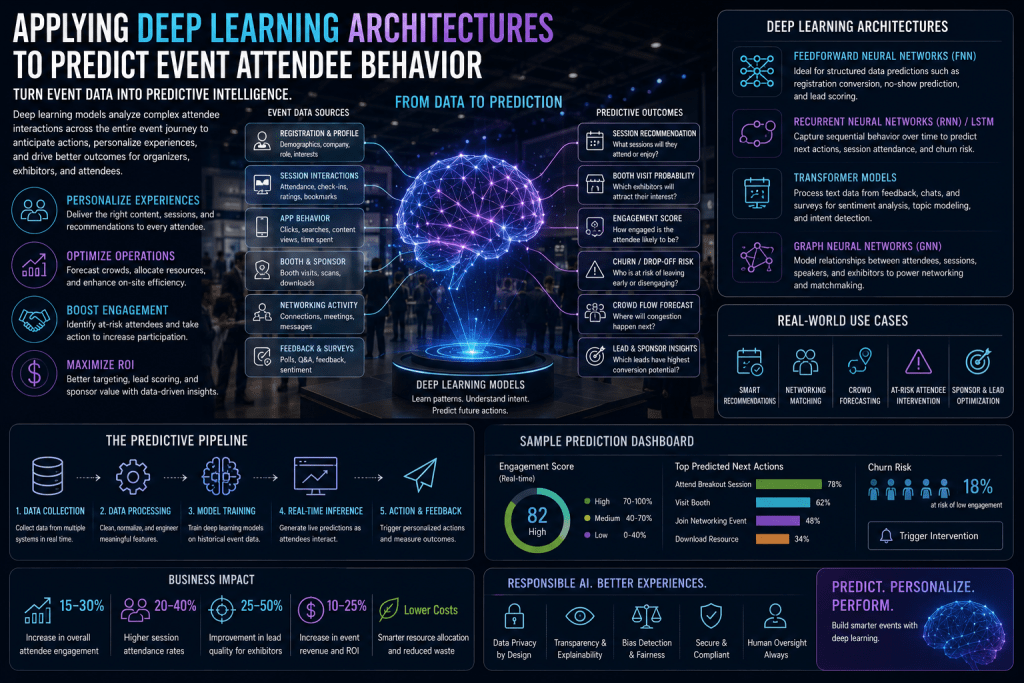
Feedforward Neural Networks
Feedforward neural networks perform well when predicting outcomes from structured numerical and categorical features.
Typical use cases include:
- Registration conversion
- VIP qualification
- Lead scoring
- No-show prediction
- Sponsorship engagement probability
These models are relatively straightforward to implement and often provide strong baseline performance.
Recurrent Neural Networks and LSTMs
Attendee behavior unfolds as a sequence rather than isolated events. Long Short-Term Memory (LSTM) networks and other recurrent architectures are particularly useful because they model temporal dependencies across interactions.
Examples include predicting:
- Next session attendance
- Likelihood of exhibition visits
- Networking participation
- Early event departure
- Repeat attendee probability
Sequence-aware models capture behavioral progression more effectively than traditional classification techniques.
Transformer Architectures
Transformer-based models have become increasingly valuable for processing event-related text.
Applications include:
- Sentiment analysis
- Session feedback summarization
- Topic extraction
- Recommendation systems
- Intent classification
- Conversational analytics
Their ability to process long textual contexts makes them particularly useful for hybrid events generating substantial chat and discussion content.
Graph Neural Networks
Events naturally create relationship networks between attendees, exhibitors, speakers, sessions, and organizations.
Graph Neural Networks (GNNs) model these interconnected relationships, making them highly effective for:
- Networking recommendations
- Community detection
- Interest clustering
- Exhibitor matching
- Collaboration prediction
Rather than evaluating attendees individually, graph models analyze how participants influence one another within the event ecosystem.
Practical Prediction Applications
Deep learning becomes valuable when predictions translate into operational improvements.
Personalized Session Recommendations
Recommendation models analyze historical behavior alongside real-time interactions to suggest relevant sessions, workshops, or networking opportunities.
Unlike simple collaborative filtering, deep learning considers multiple behavioral signals simultaneously, producing recommendations that evolve throughout the event.
Booth Visit Prediction
Exhibitors benefit when organizers identify attendees most likely to engage with specific product categories.
Prediction models combine:
- Professional role
- Registration objectives
- Session attendance
- Industry sector
- Previous booth activity
- Digital interactions
This enables targeted invitations and personalized exhibitor recommendations that improve lead quality.
Crowd Flow Forecasting
Large conferences often experience congestion around keynote entrances, registration counters, food service areas, and popular exhibitors.
Sequence models trained on historical movement patterns can forecast crowd density, allowing organizers to:
- Adjust staffing
- Open additional entrances
- Redirect traffic
- Modify digital signage
- Optimize security deployment
Operational forecasting improves both attendee experience and venue safety.
Churn and Drop-Off Prediction
Some attendees disengage before the event concludes.
Behavioral models can identify participants showing declining interaction patterns and trigger interventions such as:
- Personalized notifications
- Session recommendations
- Networking suggestions
- Exclusive content offers
- Sponsor incentives
Timely intervention helps maximize event participation.
Building the Machine Learning Pipeline
Deploying predictive models requires an end-to-end architecture rather than isolated experiments.
Data Collection
Information should be gathered consistently from:
- Registration systems
- Mobile applications
- Badge scanners
- CRM platforms
- Marketing automation
- Event websites
- Session management tools
Standardized identifiers enable accurate attendee profiles across systems.
Feature Engineering
Raw event data must be transformed into meaningful predictive features.
Examples include:
- Average session duration
- Time between booth visits
- Mobile engagement frequency
- Networking intensity
- Registration timing
- Historical attendance consistency
Well-designed features often improve prediction accuracy more than increasingly complex neural networks.
Model Training
Historical event datasets provide labeled examples for supervised learning.
Training should account for:
- Class imbalance
- Missing data
- Seasonal variation
- Event-specific characteristics
- Geographic differences
Cross-validation ensures models generalize beyond individual conferences.
Real-Time Inference
The greatest value comes from live prediction.
As attendees interact with the event, models continuously update behavioral probabilities, enabling immediate recommendations and operational decisions.
Integration with Event Technology Platforms
Predictive models become operationally useful only when connected to existing event systems.
Recommendations should appear inside mobile applications.
Booth predictions should integrate with exhibitor dashboards.
Crowd forecasts should feed venue management systems.
Lead scores should synchronize with CRM platforms.
Marketing automation platforms can use behavioral predictions to trigger personalized communications before, during, and after the event.
Without these integrations, predictive insights remain disconnected from operational decision-making.
Ethical and Privacy Considerations
Predicting attendee behavior introduces important governance responsibilities.
Organizers should clearly communicate what behavioral information is collected and how it is used.
Models should avoid making sensitive inferences unrelated to event operations or attendee experience.
Bias testing is essential because historical attendance patterns may unintentionally disadvantage certain attendee groups, industries, or geographic regions.
Data minimization principles should guide feature selection, ensuring predictions rely only on information genuinely necessary for improving event experiences.
Human oversight remains important for high-impact decisions such as VIP prioritization or sponsor lead qualification.
Future Developments
Deep learning for event analytics is moving toward multimodal intelligence.
Future systems will simultaneously analyze:
- Video streams
- Audio interactions
- Mobile behavior
- Spatial movement
- Text conversations
- Sensor data
Foundation models specialized for event operations may generate real-time operational recommendations rather than isolated predictions.
Federated learning approaches could also allow organizers to improve predictive models across multiple events without sharing sensitive attendee data directly, strengthening privacy while improving accuracy.
Conclusion
Deep learning architectures are transforming event analytics from retrospective reporting into predictive operational intelligence. By learning complex behavioral patterns across registration systems, mobile applications, exhibitor interactions, session attendance, and attendee communications, these models enable organizers to anticipate participant needs before problems emerge. Whether recommending relevant sessions, forecasting crowd movement, improving sponsor engagement, or identifying attendees at risk of disengagement, predictive deep learning supports more personalized and efficient event experiences. Success, however, depends on high-quality data, robust integration, responsible AI governance, and continuous model refinement. As event ecosystems continue to generate richer behavioral data, predictive deep learning will become an increasingly essential capability for technology-driven event management.