Moving canal performance in Beijing adopts discreet L-Acoustics audio system
Background and context
Beijing’s Tongzhou district, historically the northern terminus of China’s Grand Canal, is now the site of a new large-scale cultural attraction that places unusual demands on sound design. The Grand Canal, a UNESCO World Heritage Site dating back to 486 BC, historically linked the country’s southern grain-producing regions to northern capitals.
The new production, Yun Shang Xing Grand Canal Waterscape Poetry and Music Experience, tells the story of the canal across centuries through live performance, music and projected imagery. The project is overseen by cultural tourism organisation Tongzhou on the Canal, with artist Han Meilin acting as general advisor and cross-disciplinary artist Liu Zhouming serving as chief director and screenwriter.
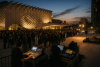
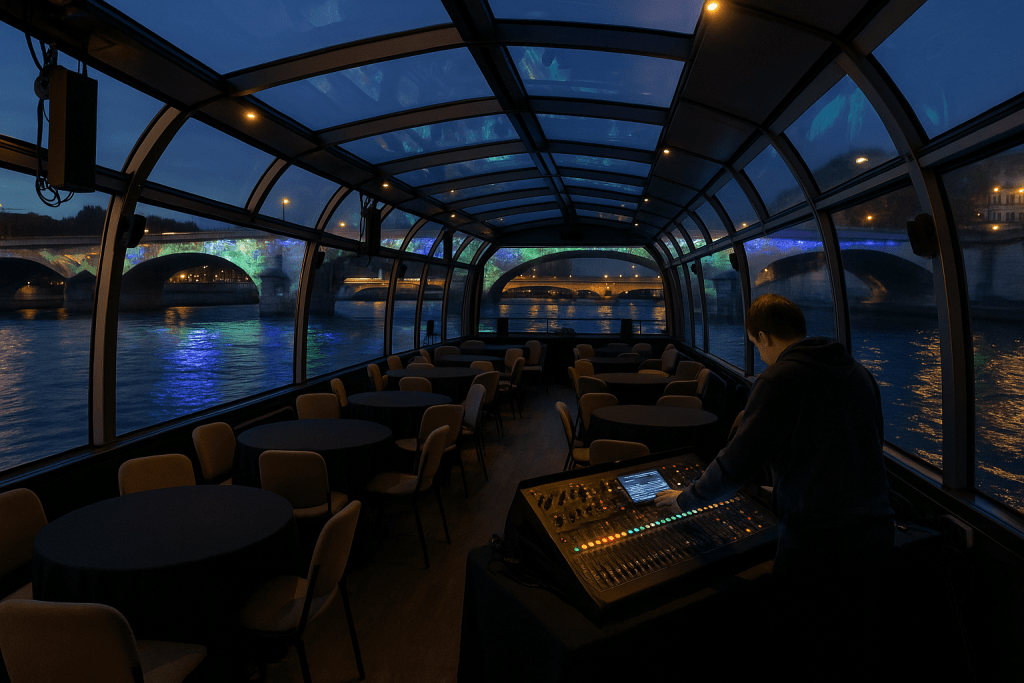
Unlike a conventional theatre show, the audience occupies a purpose-built panoramic cruise boat that travels around 3.5 kilometres along the canal over approximately 50 minutes. The performance unfolds simultaneously on the water, on smaller boats, on bridges and along both banks, in six narrative sections referred to as the “Six Canals”.
Key announcement
To support this 360-degree moving experience, L-Acoustics certified distributor Racpro has installed a compact sound system based on the manufacturer’s Soka colinear loudspeakers inside the glass-walled vessel. The brief required consistent, immersive coverage for a moving audience while preserving a minimalist interior design and wide sightlines toward the surrounding scenery.
The main reinforcement inside the cabin is handled by Soka units positioned at the front and rear. Their slim format allows the loudspeakers to sit close to the window frames without obstructing views, while their directivity is used to steer sound towards the seating area and away from the extensive glass surfaces that make the space highly reflective.
Low-frequency coverage comes from SB10i subwoofers, whose placement was determined using L-Acoustics’ Soundvision modelling software. Instead of the typical corner placement often used in compact rooms, Racpro simulated multiple configurations and then validated them on site with measurement equipment.
This process led to two SB10i cabinets being located nearer the centre of the cabin. According to the project team, this configuration avoided hull resonance that would have occurred with corner mounting and produced more even bass coverage across all seats. The full system consists of four Soka loudspeakers, two SB10i subwoofers and two LA2Xi amplified controllers driving the installation. Technical details of the Soka product line are available on the L-Acoustics website at l-acoustics.com.
Industry impact
Yun Shang Xing functions as both a cultural narrative and a technical case study in delivering immersive audio for mobile, glass-heavy environments. The installation highlights several themes that are increasingly relevant for integrators and production companies working in themed entertainment and waterfront developments:
- Maintaining coherent imaging and coverage for an audience that is in motion rather than fixed in a venue.
- Designing around highly reflective architecture, in this case a cabin with glass walls and roof.
- Balancing aesthetic requirements from architects and experience designers with the practical needs of loudspeaker placement and cabling.
- Using predictive modelling tools not only for large venues but also for compact, non-standard spaces.
The project also demonstrates a trend towards leaner loudspeaker counts, with a relatively small number of enclosures used to cover an entire passenger cabin while aiming to remain visually unobtrusive.
Why this matters
For event technology professionals, the Beijing canal project underscores how audio design is adapting to new types of location-based experiences that fall outside traditional theatre or arena formats. As cities invest in cultural corridors and mixed-use waterfront districts, shows are increasingly embedded in infrastructure such as boats, promenades and public parks.
In such environments, the ability to deliver controlled, high-intelligibility sound without dominating the visual design can be a deciding factor in equipment selection. The Yun Shang Xing installation provides an example of how manufacturers’ smaller-format systems and design software are being applied in these emerging spaces.
With Yun Shang Xing planned as a long-term element of the Grand Canal Cultural Belt and directly connected to a 1.3-kilometre waterfront commercial area, the project signals ongoing demand for integrated AV solutions in destination-based attractions, particularly in China’s rapidly developing cultural tourism sector.