How AI and automation are reshaping event experiences
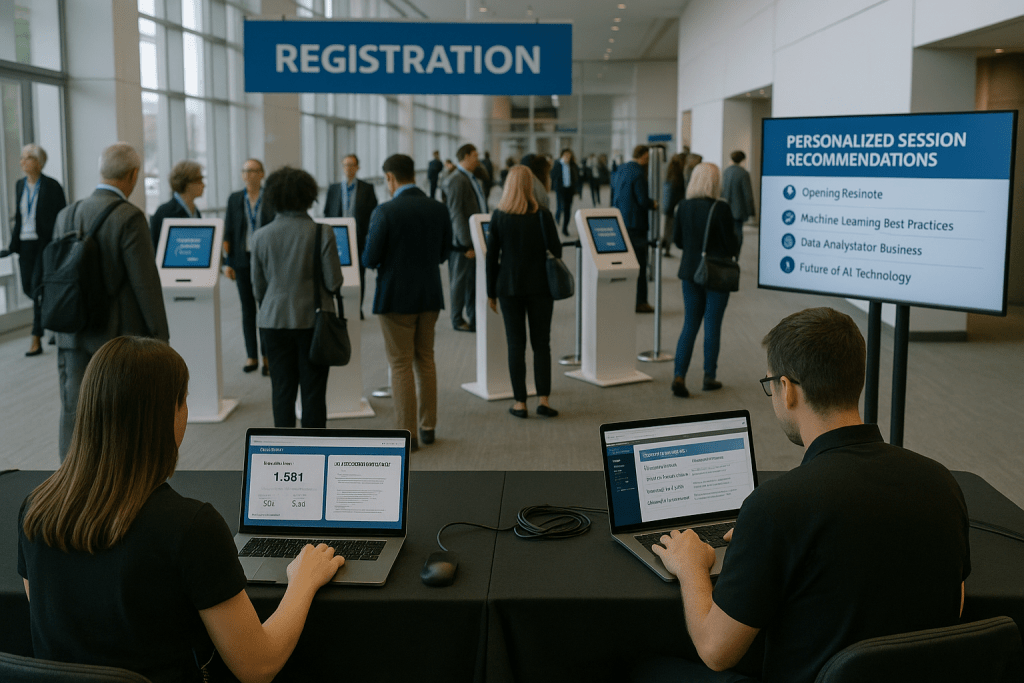
Artificial intelligence (AI) and automation are moving rapidly from theoretical talking points to operational reality in the events sector. Across conferences, exhibitions and hybrid formats, event teams are adopting data-driven tools to improve planning efficiency, personalise attendee journeys and prove return on investment more clearly.
While many organisations are still at an early stage of implementation, AI is increasingly embedded in core event workflows – from marketing and registration through to onsite service and post-event analytics. The shift is gradual rather than disruptive, but it is beginning to redefine how experiences are designed, delivered and measured.
Background and industry context
Event organisers face a complex environment: rising audience expectations, pressure to justify budgets, and the need to balance in-person and digital participation. At the same time, teams are often lean, with limited capacity to manage high volumes of data or manually personalise experiences at scale.
AI and automation are emerging as tools to bridge that gap. In consumer sectors, recommendation engines, predictive analytics and conversational interfaces have already reset expectations around relevance and responsiveness. Event audiences now bring those expectations with them, whether they are attending a trade show, corporate conference or association congress.
Initially, AI made its way into events through point solutions such as chatbots on event websites or recommendation widgets in event apps. More recently, these capabilities have started to integrate with registration platforms, CRM systems and marketing tools, enabling more joined-up use of data across the event lifecycle.
Key developments in AI-driven event workflows
Several areas of the event cycle are seeing notable adoption of AI and automation technologies:
- Planning and forecasting: Predictive models are being applied to historical registration, attendance and engagement data to inform venue selection, room layouts, session scheduling and staffing levels. By anticipating likely attendance patterns, organisers can reduce waste and better allocate resources.
- Marketing and audience acquisition: Automated campaign tools are using AI to segment audiences, test messaging and adjust channels in real time based on response rates. This supports more targeted outreach and can help control acquisition costs while improving conversion from invitation to registration and attendance.
- Registration and ticketing: Intelligent forms and workflows can adapt questions based on previous responses, reducing friction for registrants. Some platforms use AI to flag incomplete or duplicate records and to predict no-show risk, giving organisers the option to adjust capacity or send tailored reminders.
- Content discovery and matchmaking: Recommendation engines within event apps or platforms analyse attendee profiles, behaviour and stated interests to suggest sessions, exhibitors, products and networking opportunities. This is particularly relevant in large exhibitions and multi-track conferences, where choice can be overwhelming.
- Onsite service and support: Chatbots and virtual assistants, accessible via mobile apps or messaging platforms, provide instant answers to routine questions about schedules, wayfinding, access rules and amenities. This can reduce strain on helpdesks and improve response times for attendees.
- Post-event analytics and reporting: Automated dashboards are consolidating data from registration systems, app usage, badge scans, surveys and digital engagement. AI is being used to detect patterns, attribute value to specific sessions or interactions, and generate insights that can be communicated to sponsors, exhibitors and internal stakeholders.
As these tools mature, vendors are focusing on tighter integration, aiming to reduce data silos and provide a more complete picture of how attendees interact with events before, during and after they take place.
Impact on event business models and operations
The wider use of AI and automation is beginning to influence both the economics and operational models of events.
On the cost side, automation can reduce manual workload around tasks such as lead capture processing, badge printing, basic customer support and survey analysis. For some organisers, this enables smaller teams to manage larger or more frequent events without proportionally increasing headcount.
On the revenue side, more granular understanding of attendee behaviour can support refined sponsorship and exhibitor propositions. For example, data on which segments engaged with particular content, products or demos can help demonstrate value to partners and inform more targeted packages. Recommendation engines and personalised agendas can also increase dwell time with exhibitors and content, potentially improving lead quality.
However, the adoption of AI is not uniform. Larger organisers and corporate event teams with access to wider data sets and technology budgets are often moving faster than smaller organisers. There is also variation by region and sector in terms of investment appetite, regulatory considerations and audience readiness for automated interactions.
Questions around data privacy, consent and algorithmic transparency are central to implementation decisions. Organisers are having to ensure that any AI deployment complies with applicable data protection laws and that attendees understand how their data is used to power personalisation or analytics.
Why this matters for event professionals and technology providers
For event professionals, AI and automation are no longer optional experiments but tools that are likely to become embedded in standard operating procedures. Practical implications include:
- Skill sets: Teams may need to develop capabilities in data literacy, workflow design and vendor evaluation, in addition to traditional event management skills. Understanding how to interpret analytics and act on insights will be increasingly important.
- Process design: Automation works best when processes are clearly defined. Organisers may need to map attendee journeys and internal workflows more rigorously in order to decide where AI can add value and where human interaction remains critical.
- Attendee experience design: Personalisation powered by AI must be balanced with simplicity and control. Attendees should be able to override recommendations, manage their own preferences and opt out of certain data uses if they wish.
- Vendor relationships: Technology providers are differentiating on the depth of their AI features, integration capabilities and approach to data governance. Event teams will need to assess how new tools fit with existing platforms and long-term digital strategies.
For technology vendors, the shift creates both opportunity and responsibility. There is growing demand for solutions that are easy to implement, explainable to non-technical users and aligned with regulatory requirements. Providers that can demonstrate clear outcomes – such as higher attendance, improved lead quality or more efficient operations – are likely to gain traction.
Conclusion
AI and automation are steadily changing how events are conceived and executed, moving from isolated pilots to integrated components of the event technology stack. The changes are shaping operational decisions, commercial models and audience expectations across physical, digital and hybrid formats.
While the technology will continue to evolve, the immediate task for organisers and suppliers is practical: identify high-impact use cases, ensure responsible data practices, and build the skills needed to interpret and act on insights. Those that approach AI implementation with clear objectives and realistic expectations are likely to find it becomes a core enabler of more targeted, efficient and measurable event experiences.