How AI Is Quietly Reshaping the End-to-End Event Journey
Artificial intelligence has quickly become one of the most talked-about themes in event technology, but much of the discussion still centres on eye-catching features rather than real-world outcomes. For organisers trying to understand what actually changes when AI is applied to the event journey, the more relevant question is simpler: at each stage of an attendee’s experience, what is genuinely improved by AI, and what remains mostly buzz?
From initial discovery to post-event follow-up, AI and automation tools are now embedded across the event lifecycle. Yet their impact is uneven. Some touchpoints are already being materially reshaped by data-driven systems, while others see experimental use cases that have yet to prove lasting value.
Industry context: AI moves from experiment to infrastructure
For more than a decade, digital platforms have been streamlining registration, session management and lead capture. The current wave of AI innovation builds on that foundation, adding layers of automation and prediction rather than replacing core systems outright. Machine learning models, recommendation engines and generative tools are being incorporated into existing registration, marketing and engagement platforms rather than deployed as standalone solutions.
This shift matters because it changes how AI is evaluated. Instead of being judged as a separate product category, AI is now assessed on whether it improves conversion rates, reduces manual workload or increases attendee satisfaction within familiar workflows. Vendors are moving away from abstract AI branding and towards specific use cases: smarter targeting, personalised schedules, faster content production and more efficient post-event analysis.
Key developments across the event journey
Discovery and marketing
AI is most visible at the top of the funnel, where it is used to optimise advertising, email campaigns and content. Predictive models draw on past attendee behaviour, website analytics and campaign performance data to refine audience targeting and adjust spending in real time. This can mean automatically shifting budget towards channels and audiences more likely to convert, or adapting creative and messaging for particular segments.
Automation has also entered content production. Generative tools assist marketing teams with drafting copy variations for ads, email subject lines and landing pages, which can then be A/B tested at scale. While human oversight remains essential for tone and accuracy, this approach shortens production cycles and enables faster experimentation.
Registration and onboarding
Once potential attendees arrive on an event website, AI can influence how registration flows are presented. Recommendation systems may suggest ticket types or add-ons based on browsing behaviour, job role or organisation size, aiming to match users with relevant packages without overcomplicating the process.
Chatbots and virtual assistants now handle a growing share of basic queries about pricing, dates, venue information and access options. When well trained on event-specific FAQs, these tools can reduce pressure on support teams and offer 24/7 responses. However, they are most effective when clearly scoped; complex queries and exception handling still require human intervention and well-signposted escalation paths.
Personalisation and agenda building
As soon as registration data is captured, AI starts to shape the attendee’s prospective experience. Many event platforms now use profile details and stated interests to suggest sessions, exhibitors and networking opportunities. These recommendation engines draw on tags, historical engagement data and similarity models to propose personalised agendas.
In practice, this can streamline the task of sorting through large programmes, especially for multi-track conferences and exhibitions. However, organisers need to balance automation with transparency: attendees are more likely to trust recommendations when it is clear why a particular session or meeting has been suggested and when options remain easy to explore and adjust manually.
Onsite experience and engagement
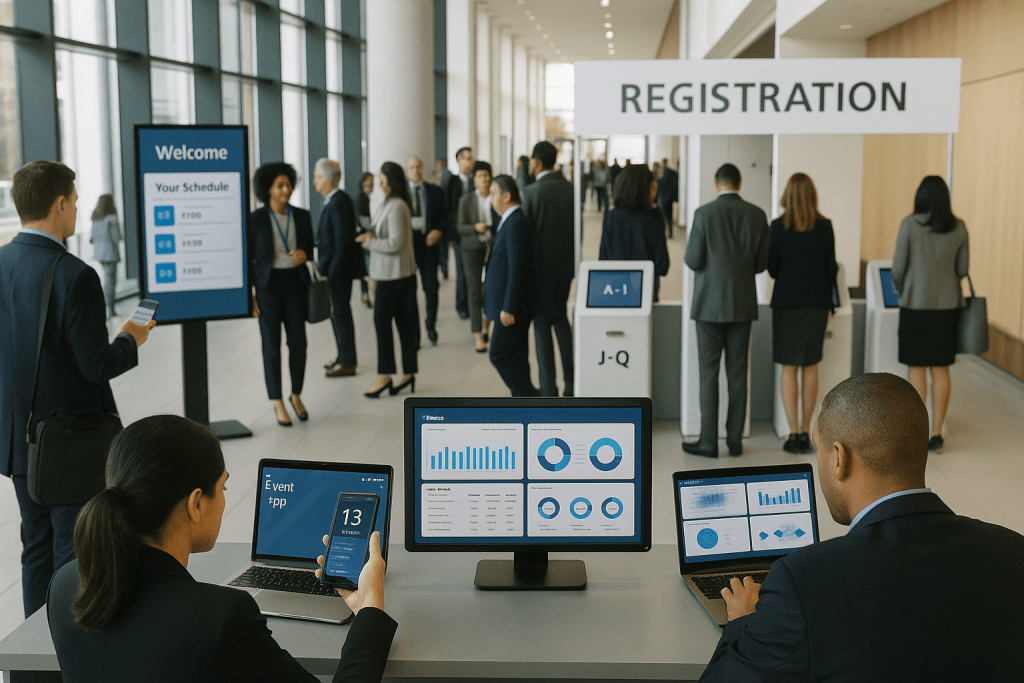
At the live event, AI’s role is more operational than visible in many cases. Automated badge printing, facial recognition for check-in (where permitted and appropriate) and dynamic staffing alerts rely on algorithms to forecast demand and manage throughput. These tools help reduce queues and smooth entry, particularly at large-scale events.
Inside the venue or online platform, AI can support matchmaking between attendees and exhibitors by ranking potential connections based on shared interests or goals. While matchmaking algorithms are not new, their sophistication has increased as more data points are integrated, from interaction history to content engagement. Event apps may surface recommended people to meet, products to explore or live sessions to join, updating those suggestions as behaviour changes during the event.
Live content is also being influenced. Automated transcription and translation services are becoming standard for keynotes and breakouts, supporting accessibility and widening reach. Generative models can assist in producing near real-time summaries of sessions, although human review remains important to maintain context and nuance.
Post-event follow-up and analysis
After an event concludes, AI and automation are increasingly central to follow-up workflows. Lead scoring models assess attendee and visitor interactions—such as session attendance, booth visits and content consumption—to prioritise outreach for sales and marketing teams. Rather than treating all leads equally, these models attempt to highlight those most likely to progress in a sales cycle or return to future events.
On the content side, platforms can automatically generate highlight reels, written recaps and personalised follow-up emails summarising the sessions an attendee joined or bookmarked. For organisers, AI-driven analytics tools consolidate feedback surveys, engagement metrics and revenue data into dashboards that identify trends and gaps. This can inform programming, pricing and marketing decisions for subsequent editions.
Industry impact: from manual workflows to continuous optimisation
The broadest impact of AI across the event journey is a shift from static planning to continuous optimisation. Data once reviewed only after an event is now analysed in near real time, enabling organisers to adjust room allocations, push notifications, staffing and content promotion during the show itself.
However, this evolution is not purely technical. Teams must adapt processes to make use of constant feedback, and they need clear governance around data usage, privacy and consent. As AI touches more attendee interactions—from email content to networking suggestions—questions about transparency and control become more pressing. Industry bodies and technology providers are gradually developing guidelines, but practical implementation remains uneven.
Why this matters for event professionals and technology providers
For organisers, the practical value of AI lies less in individual features and more in how well tools integrate into existing operations. Systems that automate repetitive tasks, surface clear recommendations and reduce friction for attendees are seeing the strongest adoption. The emphasis is shifting towards measurable outcomes: higher registration conversion, better-qualified leads, improved satisfaction scores and more efficient use of staff time.
Technology providers, meanwhile, face growing pressure to move beyond generic AI labels and demonstrate specific, verifiable benefits. Event planners are becoming more cautious about experimental add-ons that add complexity without clear return. Vendors that can connect AI capabilities directly to business metrics—while offering appropriate controls for data, branding and compliance—are better positioned as AI moves from experiment to standard expectation.
Both sides also need to consider skills. Effective use of AI in events requires staff who can interpret analytics, configure automation rules and supervise generative outputs. Training and change management are now part of AI adoption strategies, not optional extras.
Conclusion
AI is no longer an isolated trend in event technology; it is becoming part of the underlying infrastructure that shapes every stage of the event journey. Its influence is strongest where it quietly optimises decisions and reduces manual effort, from targeting and registration to matchmaking and follow-up. Highly visible, experimental features may attract attention, but the lasting transformation is emerging in the operational layers that attendees rarely see.
For event professionals, the priority is to distinguish between hype and practical value: focusing on use cases that genuinely enhance the attendee journey and support commercial objectives, while maintaining clear guardrails around data and automation. As platforms continue to embed AI deeper into their architectures, the competitive advantage will lie not in having AI as such, but in using it judiciously and transparently across the lifecycle of each event.