AI Meeting Matchmaking Seeks to Solve Event Networking Overload
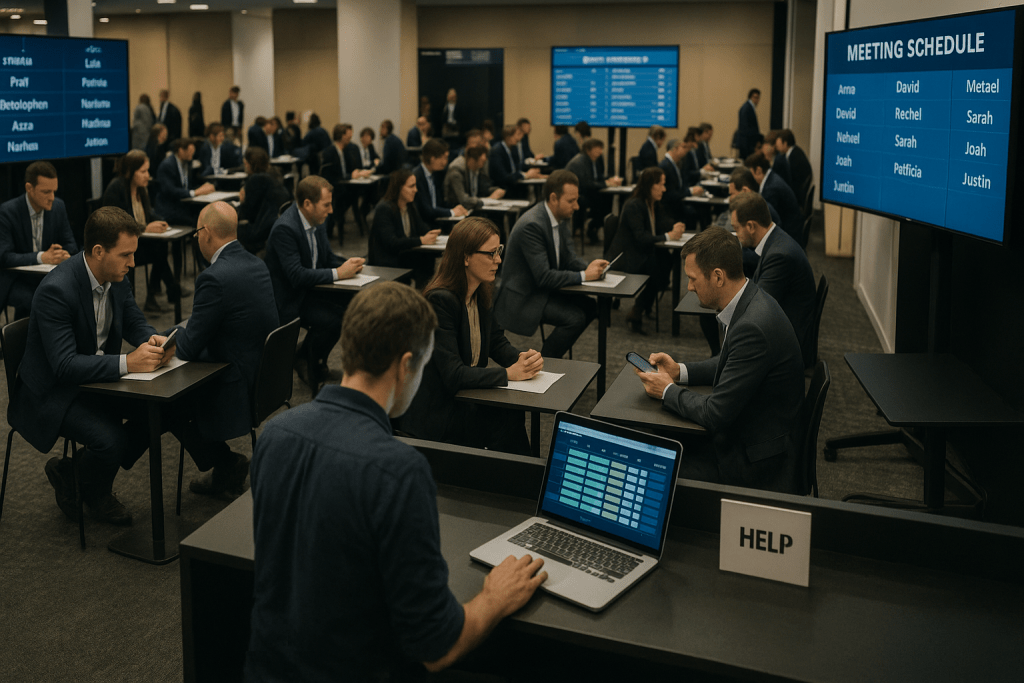
Business events have long promised high-value connections, yet many attendees still leave conferences and exhibitions feeling they missed out on the “right” meetings. As in-person and hybrid formats return at scale, the volume of potential contacts at a typical event is outpacing what most participants can realistically manage on their own.
Event technology providers are increasingly turning to artificial intelligence to narrow this gap, using data-led matchmaking tools to help attendees identify and schedule the most relevant 1:1 interactions from thousands of possible combinations.
Background: a maths problem at the heart of networking
For many delegates, networking remains the primary motivation for attending trade shows, congresses and corporate events. Content is a close second, but the promise of meeting new prospects, partners or peers is still a major driver of registration. The challenge arises once attendees actually arrive onsite or log in to a platform.
Even at modest scale, the networking equation quickly becomes unmanageable. A 500-person event can, in theory, generate 124,750 possible one-to-one pairings. For organisers that encourage pre-scheduled meetings or hosted-buyer style appointments, the complexity of aligning interests, availability, and meeting spaces grows dramatically with every additional participant.
Without support, most attendees fall back on chance encounters, ad hoc introductions, or manual searches through attendee lists and event apps. While serendipity still plays an important role, it is a risky foundation for those who are under pressure to justify time and budget spent on travel.
Key developments in AI-driven matchmaking
To address this, a new generation of matchmaking and meeting management tools is being embedded into event platforms, mobile apps and hosted-buyer programmes. These solutions typically combine data captured at registration with behavioural signals and profile information to predict which meetings are likely to be most valuable.
Core capabilities often include:
- Profile-based recommendations: Matching attendees by sector, role, interests, purchasing intent or other declared preferences, rather than simple category filters.
- Ranking and prioritisation: Using algorithms to sort potential matches into high, medium or low relevance, helping users focus on the most promising contacts first.
- Automated scheduling: Coordinating mutually available time slots, room allocations and virtual meeting links in the background, reducing manual back-and-forth.
- Dynamic updates: Adjusting suggestions as new participants register, sessions are added or schedules change, reflecting the fluid nature of live events.
The aim is not to replace human decision-making, but to streamline the initial discovery phase. Attendees remain in control of accepting or rejecting meeting suggestions, while AI handles the underlying calculations involved in sifting through large datasets.
Industry impact: from random encounters to structured outcomes
For organisers, the ability to facilitate targeted meetings is becoming a key differentiator in a competitive events calendar. Exhibitors and sponsors, in particular, are seeking more measurable outcomes from their investment than stand traffic alone. Pre-qualified meetings with buying influence or defined project needs can substantially increase perceived return on participation.
In hosted-buyer formats, where organisers commit to guaranteeing a set number of appointments, automation can help reduce the operational load traditionally carried by coordination teams. Instead of manually aligning diaries, staff can focus on refining match criteria, monitoring engagement, and supporting high-priority accounts.
For delegates, curated meeting recommendations can reduce the cognitive load of navigating dense attendee lists. Rather than scanning hundreds of profiles, they can start from a shortlist generated by the platform and refine from there. This can be particularly valuable in time-constrained programmes, where coffee breaks and short networking windows need to be used efficiently.
Nevertheless, adoption is not solely a technology question. Successful matchmaking relies on the quality and completeness of attendee data. If participants under-report their interests, fail to update their availability or opt out of sharing information, the effectiveness of AI-driven matching is limited. Organisers must therefore balance privacy considerations with clear communication about why detailed profiles improve the experience.
Why this matters for event professionals and technology providers
As budgets face continued scrutiny, the pressure on organisers to prove the business value of events is intensifying. Meeting output is one of the most tangible metrics available: how many qualified conversations took place, how many follow-ups were scheduled, and what pipeline or partnerships were created as a result.
AI matchmaking tools can support this shift from attendance-based metrics to outcome-based reporting by generating data on:
- The volume of suggested and accepted meetings.
- Engagement with recommended contacts versus manual searches.
- Participation across buyer, exhibitor and sponsor segments.
- Post-event feedback on meeting relevance and quality.
For technology providers, networking and matchmaking features are moving from optional add-ons to core components of event platforms, especially in sectors where deal-making and procurement are central. Integrations with CRM and marketing automation systems are also becoming more important, allowing meeting outcomes to flow directly into sales processes.
At the same time, vendors must manage expectations. AI can significantly narrow the field of options, but it cannot guarantee commercial outcomes or chemistry between individuals. There is a risk that over-automating the process could reduce opportunities for unplanned, serendipitous encounters that often define the most memorable event experiences.
Designing programmes that blend structured, data-driven meetings with informal networking formats remains a strategic task for organisers. The most effective use of AI appears to be in handling the scale and complexity of the network, while leaving room for human judgment and spontaneous interaction.
Conclusion
The core challenge of event networking is no longer simply bringing people into the same space, physical or virtual. It is making sure that the most relevant connections actually happen within limited timeframes and increasingly data-driven environments.
By taking on the heavy lifting of calculations and scheduling, AI matchmaking tools aim to give attendees a clearer path to the people who matter most to their objectives. For event professionals and technology suppliers, the opportunity lies in using these capabilities to enhance, rather than replace, the human elements that make meetings productive and relationships enduring.