AR Indoor Wayfinding: Eliminating Navigation Friction in Massive Convention Centers
Introduction
Modern convention centers have evolved into highly sophisticated event ecosystems that host international conferences, trade exhibitions, corporate summits, healthcare congresses, technology expos, and government forums. Many of these venues span hundreds of thousands of square meters, featuring multiple exhibition halls, meeting rooms, keynote theaters, networking lounges, food courts, registration zones, and temporary structures. While their scale enables organizers to accommodate thousands of attendees and exhibitors, it also introduces one of the most persistent operational challenges in event management: indoor navigation.
Unlike outdoor environments where satellite-based Global Positioning System (GPS) navigation is highly effective, indoor spaces present unique obstacles. Thick concrete structures, multiple floors, temporary booth layouts, and complex corridors reduce the reliability of traditional location services. As a result, attendees frequently spend valuable time searching for meeting rooms, exhibitor booths, or networking areas instead of participating in event activities.
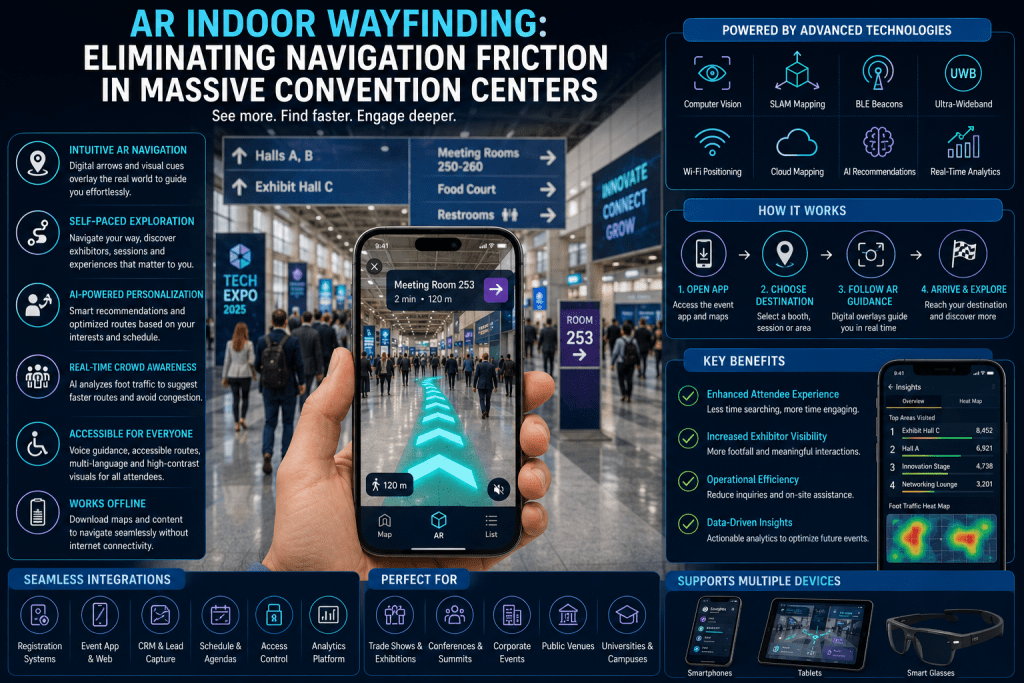
Augmented Reality (AR) indoor wayfinding addresses this challenge by overlaying digital navigation cues directly onto a user’s smartphone or wearable display. By combining computer vision, simultaneous localization and mapping (SLAM), Bluetooth Low Energy (BLE), Ultra-Wideband (UWB), Wi-Fi positioning, and artificial intelligence (AI), AR wayfinding systems provide intuitive, context-aware navigation that significantly reduces confusion while improving attendee engagement.
For event technology professionals, AR indoor navigation represents a major advancement in creating frictionless, personalized, and data-driven event experiences.
Why Indoor Navigation Remains Difficult
Large convention venues continuously change.
Temporary exhibition booths, sponsor activations, partition walls, catering areas, and networking spaces are frequently reconfigured between events or even during multi-day conferences.
Common attendee challenges include:
- Difficulty locating exhibitors
- Missing scheduled sessions
- Long travel times between halls
- Congestion around popular attractions
- Confusing floor layouts
- Multiple vertical levels
- Limited static signage
Traditional printed maps and directional signs provide only static guidance, requiring attendees to interpret complex layouts manually.
AR navigation transforms this experience by guiding users visually through the venue in real time.
Understanding AR Indoor Wayfinding
AR indoor navigation combines physical environments with digital guidance displayed through smartphones, tablets, or smart glasses.
Instead of viewing a separate floor map, attendees see navigation instructions overlaid directly onto the real-world environment.
Typical visual elements include:
- Directional arrows
- Path indicators
- Distance markers
- Floor transition guidance
- Destination highlights
- Booth identification
- Session notifications
- Contextual information panels
This approach reduces cognitive effort because users follow intuitive visual directions rather than constantly interpreting static maps.
Core Technology Architecture
Successful AR navigation systems depend on several integrated technologies.
Computer Vision and SLAM
Simultaneous Localization and Mapping (SLAM) enables devices to understand their position within indoor environments by analyzing visual features.
Computer vision continuously identifies:
- Architectural landmarks
- Corridor geometry
- Structural features
- Signage
- Fixed reference points
This allows highly accurate positioning even where GPS signals are unavailable.
Indoor Positioning Systems
AR platforms often combine multiple positioning technologies.
Common options include:
- Bluetooth Low Energy (BLE) beacons
- Ultra-Wideband (UWB)
- Wi-Fi fingerprinting
- QR code checkpoints
- NFC markers
- Visual positioning systems
Hybrid positioning improves accuracy while maintaining reliable navigation throughout complex venues.
Cloud Mapping Services
Venue maps, exhibitor layouts, schedules, and navigation data are managed through cloud-based platforms.
Real-time synchronization allows organizers to publish updates immediately if room assignments, booth locations, or walking routes change during the event.
Artificial Intelligence and Personalized Navigation
AI significantly enhances navigation beyond simple route calculation.
Recommendation engines analyze:
- Registration profiles
- Meeting schedules
- Session interests
- Previous booth visits
- Walking patterns
- Crowd conditions
- Accessibility requirements
The system dynamically recommends optimized routes while minimizing unnecessary travel throughout the venue.
Generative AI can also answer natural-language navigation requests such as:
- “Take me to the nearest networking lounge.”
- “Show booths related to artificial intelligence.”
- “Find the fastest route to Hall C.”
This conversational interaction simplifies navigation even further.
Real-Time Crowd Optimization
Large exhibitions frequently experience congestion near keynote entrances, popular exhibitors, or food service areas.
AI-powered analytics continuously monitor:
- Foot traffic
- Queue lengths
- Occupancy levels
- Walking speeds
- Route utilization
Navigation algorithms automatically recommend alternative paths that reduce travel time while improving attendee flow.
This benefits both participants and venue operations by distributing pedestrian traffic more evenly.
Integration with Event Technology Platforms
AR navigation becomes substantially more valuable when integrated across the event ecosystem.
Registration Systems
Personalized itineraries automatically generate navigation routes based on each attendee’s registered sessions, appointments, and access permissions.
Mobile Event Applications
Navigation integrates directly within existing event applications rather than requiring separate software installations.
Participants can transition seamlessly between schedules, networking, exhibitor information, and indoor guidance.
CRM Platforms
With attendee consent, navigation data supports richer engagement analytics by identifying booth visits, meeting attendance, and interaction patterns.
Analytics Dashboards
Organizers gain operational insights including:
- Heat maps
- Traffic flow
- Popular destinations
- Average travel times
- Queue formation
- Navigation success rates
- Session arrival patterns
These metrics inform future venue layouts and operational planning.
Accessibility Advantages
AR navigation significantly improves accessibility for diverse attendee groups.
Important capabilities include:
- Voice-guided navigation
- High-contrast visual overlays
- Wheelchair-accessible routing
- Elevator prioritization
- Multilingual interfaces
- Haptic guidance
- Screen reader compatibility
Participants with visual, hearing, or mobility impairments benefit from navigation experiences tailored to their specific accessibility needs.
Personalized routing improves independence while reducing reliance on onsite assistance.
Operational Benefits
AR wayfinding delivers measurable value across multiple stakeholder groups.
Improved Attendee Experience
Participants spend less time searching for destinations and more time engaging with event content.
Greater Exhibitor Visibility
Accurate navigation increases booth discovery while improving visitor distribution throughout exhibition halls.
Reduced Staffing Requirements
Digital navigation decreases demand for information desks and manual directional assistance.
Better Venue Analytics
Movement data provides evidence-based insights for optimizing floor plans, signage placement, and event logistics.
Implementation Challenges
Despite its advantages, AR indoor navigation requires careful deployment.
Venue mapping must remain accurate despite temporary structures and changing exhibition layouts.
Battery consumption should be minimized because continuous camera use and positioning services increase power usage.
Lighting conditions may also affect computer vision performance in certain environments.
Reliable wireless infrastructure remains essential for delivering cloud-based updates, although offline map caching can reduce dependence on constant connectivity.
Privacy considerations deserve equal attention. Organizers should communicate transparently how movement data is collected, processed, retained, and protected while allowing attendees to control participation through clear consent mechanisms.
Future Trends
AR navigation is rapidly evolving alongside spatial computing and artificial intelligence.
Emerging innovations include:
- Smart glasses navigation
- Digital twins of convention centers
- AI-powered conversational assistants
- Context-aware recommendations
- Indoor drone mapping
- Personalized accessibility routing
- Predictive congestion management
- Wearable device integration
As spatial computing platforms mature, attendees may eventually experience persistent digital navigation overlays that remain anchored naturally within physical environments without requiring smartphones.
These advances will create increasingly intuitive event journeys while supporting richer personalization and operational intelligence.
Conclusion
AR indoor wayfinding is transforming navigation within large convention centers by combining augmented reality, computer vision, AI, indoor positioning technologies, and cloud-based event management into a unified attendee experience. Rather than relying on static maps and conventional signage, participants receive intuitive, context-aware guidance that reduces navigation friction while improving engagement, accessibility, and operational efficiency. When integrated with registration systems, mobile event applications, analytics platforms, and CRM solutions, AR navigation becomes a powerful component of intelligent event ecosystems. As spatial computing technologies continue advancing, augmented reality wayfinding will play an increasingly important role in delivering seamless, personalized, and data-driven experiences for conferences, exhibitions, and large-scale corporate events.