Frictionless Check-In: Combining Biometrics with Pre-Printed Smart Badges
The first few minutes of an event often shape an attendee’s entire perception of the experience. Long registration queues, manual identity verification, misplaced tickets, and badge printing delays can quickly diminish excitement before the event has even begun. For organizers, check-in bottlenecks not only create operational challenges but also affect session attendance, exhibitor engagement, and overall attendee satisfaction.
As events continue growing in size and complexity, organizers are increasingly looking beyond traditional registration methods. In 2026, frictionless check-in has become a strategic priority, driven by the convergence of biometric authentication, RFID and NFC-enabled smart badges, artificial intelligence, and cloud-based event management platforms.
Instead of waiting in line to collect credentials, attendees arrive with pre-printed smart badges already linked to their registration profiles. Facial recognition, fingerprint verification, or digital identity confirmation authenticates each participant within seconds, allowing them to enter the venue almost instantly. The result is a faster, more secure, and highly personalized arrival experience that benefits attendees, organizers, sponsors, and venue operators alike.
Why Traditional Event Check-In Falls Short
Despite advances in event technology, many registration processes still involve manual steps.
Common challenges include:
- Long registration queues
- Manual identity verification
- Badge printing delays
- Human data entry errors
- Lost or forgotten tickets
- Staffing shortages
Large conferences often process thousands of attendees within a short arrival window, making these issues particularly noticeable.
Even with self-service kiosks, printing badges onsite consumes valuable time and resources.
What Is Frictionless Check-In?
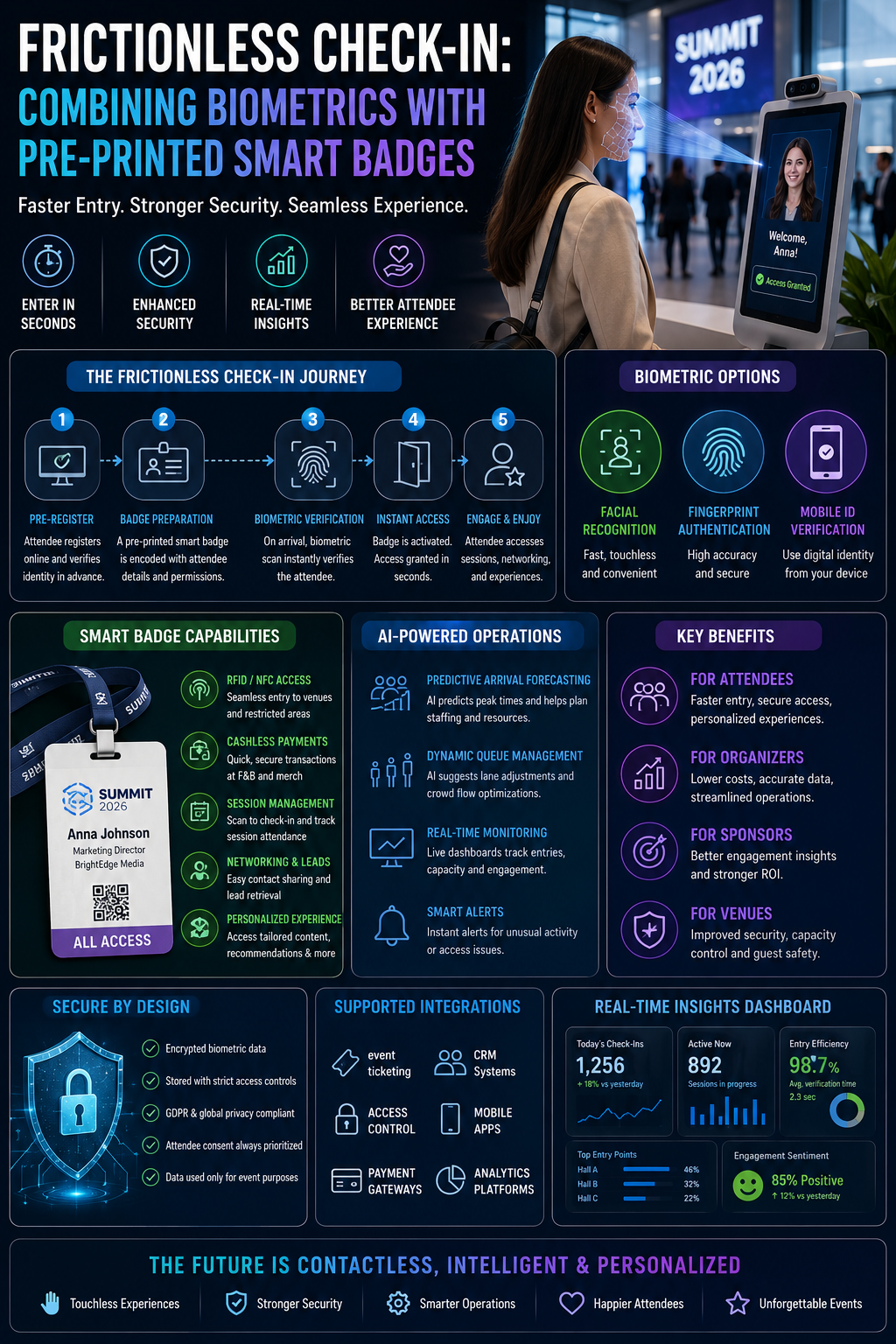
Frictionless check-in combines biometric identity verification with pre-configured smart badges that are prepared before attendees arrive.
Each badge contains embedded technologies such as:
- RFID chips
- NFC chips
- QR codes
- Secure digital identifiers
Before the event, attendees securely verify their identities through the registration platform.
Upon arrival, biometric authentication confirms their identity and immediately activates their smart badge.
The entire process typically takes only a few seconds.
The Role of Biometrics
Biometric technologies provide a highly reliable method of confirming attendee identity.
Facial Recognition
Facial recognition is becoming the preferred option for premium events.
As attendees approach the entrance, cameras compare facial features with encrypted registration records.
Successful matches automatically authorize entry.
Fingerprint Authentication
Some corporate and government events continue using fingerprint verification where higher levels of identity assurance are required.
Mobile Digital Identity
Increasingly, event platforms also support mobile identity credentials that complement biometric verification, providing additional flexibility.
Why Pre-Printed Smart Badges Matter
Biometrics verify identity, but smart badges enable everything that follows.
Once activated, badges become digital credentials supporting:
- Venue access
- Session admission
- Cashless payments
- Networking
- Lead retrieval
- Loyalty programs
- VIP permissions
- Attendance tracking
Because badges are printed before the event, organizers eliminate onsite printing delays while maintaining a professional attendee experience.
AI-Powered Registration Management
Artificial intelligence plays an increasingly important role in optimizing check-in operations.
Predictive Arrival Forecasting
Machine learning analyzes historical registration data to predict peak arrival periods.
Organizers can adjust staffing and entrance configurations before congestion develops.
Dynamic Queue Management
If crowd density increases unexpectedly, AI can recommend:
- Opening additional entrances
- Redirecting attendees
- Reallocating staff
- Adjusting access lanes
This improves overall flow.
Identity Verification Support
AI assists biometric systems by improving image quality, reducing false matches, and detecting unusual authentication attempts.
Enhancing Security Without Increasing Delays
Security remains one of the strongest advantages of biometric check-in.
Eliminating Credential Sharing
Traditional printed tickets can be transferred between individuals.
Biometric verification ensures that badges are activated only for their registered owners.
Preventing Counterfeit Badges
RFID and NFC credentials contain encrypted digital identities that are significantly more difficult to duplicate than conventional printed badges.
Multi-Level Access Control
Smart badges can automatically grant different permissions based on attendee profiles.
Examples include:
- General admission
- VIP access
- Speaker areas
- Media zones
- Backstage operations
- Executive lounges
Access permissions can also be updated remotely throughout the event.
Improving the Attendee Experience
Frictionless check-in enhances much more than registration speed.
Reduced Waiting Times
Attendees spend less time in queues and more time networking, visiting exhibitors, or attending sessions.
Personalized Welcome Experiences
Once authenticated, event applications can automatically display:
- Personalized schedules
- Meeting reminders
- Venue maps
- Session recommendations
creating a more engaging arrival experience.
Accessibility Improvements
Attendees with mobility challenges benefit from touch-free identity verification and simplified entry procedures.
Benefits for Organizers
Frictionless registration creates measurable operational advantages.
Lower Staffing Requirements
Automated identity verification reduces reliance on large registration teams.
Staff can instead focus on attendee assistance and hospitality.
Accurate Attendance Data
Every successful authentication generates precise attendance records.
These insights support:
- Capacity planning
- Session analytics
- Sponsor reporting
- Emergency management
Stronger Sponsor ROI
Verified attendance data provides sponsors with more accurate engagement metrics for sessions, exhibitions, and networking events.
Privacy and Ethical Considerations
Biometric technologies require responsible implementation.
Explicit Consent
Attendees should always choose whether to participate in biometric verification.
Alternative authentication methods should remain available where appropriate.
Secure Data Protection
Biometric information should be protected using:
- Encryption
- Secure cloud storage
- Role-based access controls
- Data minimization
Sensitive information should never be stored unnecessarily.
Regulatory Compliance
Organizers must comply with applicable privacy regulations governing biometric information and digital identity management.
Transparent policies strengthen attendee trust.
Challenges of Implementation
Despite its advantages, frictionless check-in requires thoughtful planning.
Infrastructure Investment
Successful deployments require:
- Biometric cameras
- RFID readers
- Secure networking
- Registration platforms
- Identity management systems
These investments should align with event size and security requirements.
System Integration
Registration, CRM, access control, payment systems, and mobile applications must exchange information seamlessly.
Poor integration reduces efficiency.
Attendee Communication
Participants should receive clear instructions before arriving.
Explaining registration procedures in advance reduces confusion and accelerates adoption.
The Future of Intelligent Event Check-In
Several innovations are expected to further simplify attendee arrivals.
Emerging developments include:
- AI-powered digital identity verification
- Wallet-based event credentials
- Wearable biometric authentication
- Voice recognition check-in
- Blockchain-secured digital identities
- Digital twin crowd management
- Autonomous registration kiosks
These technologies will continue reducing friction while strengthening both convenience and security.
Conclusion
Frictionless check-in is redefining the arrival experience by combining biometric identity verification with pre-printed smart badges that extend far beyond simple access credentials. Together, these technologies accelerate registration, strengthen security, reduce operational costs, and create a seamless foundation for the entire event journey.
For attendees, the benefits include shorter queues, personalized experiences, and effortless venue access. Organizers gain stronger attendance analytics, improved operational efficiency, and enhanced security, while sponsors benefit from more accurate engagement data and higher-quality visitor interactions.
As digital identity technologies continue evolving, the future of event registration will become increasingly invisible. Rather than standing in line to prove who they are, attendees will simply arrive, be securely recognized, and immediately begin enjoying the event. Frictionless check-in is not merely making registration faster—it is transforming the first impression into one that is efficient, secure, and memorable.