Hikarie Hall standardises on L-Acoustics platform for flexible two-hall audio
Background and context
Hikarie Hall, located on the ninth floor of the Shibuya Hikarie complex in central Tokyo, has completed a major upgrade of its sound systems across its two main spaces, Hall A and Hall B.
The venue, directly connected to Shibuya Station, hosts a broad mix of events, including corporate conferences, receptions and fashion shows. It is a regular site for Rakuten Fashion Week Tokyo, where it reportedly stages around half of the week’s runway shows.
As event formats have become more demanding, the hall’s previous loudspeaker system had reached its limits in terms of output and flexibility, especially during noisier receptions and high-SPL productions. Venue operator Pacific Art Center turned to systems integrator Bestec Audio, an L-Acoustics Certified Partner, to design and deliver a replacement.
Key announcement
The new installation is built around a standardised L-Acoustics platform, combining fixed systems in both halls with a mobile rig that can be shared when additional coverage or low-frequency reinforcement is required.
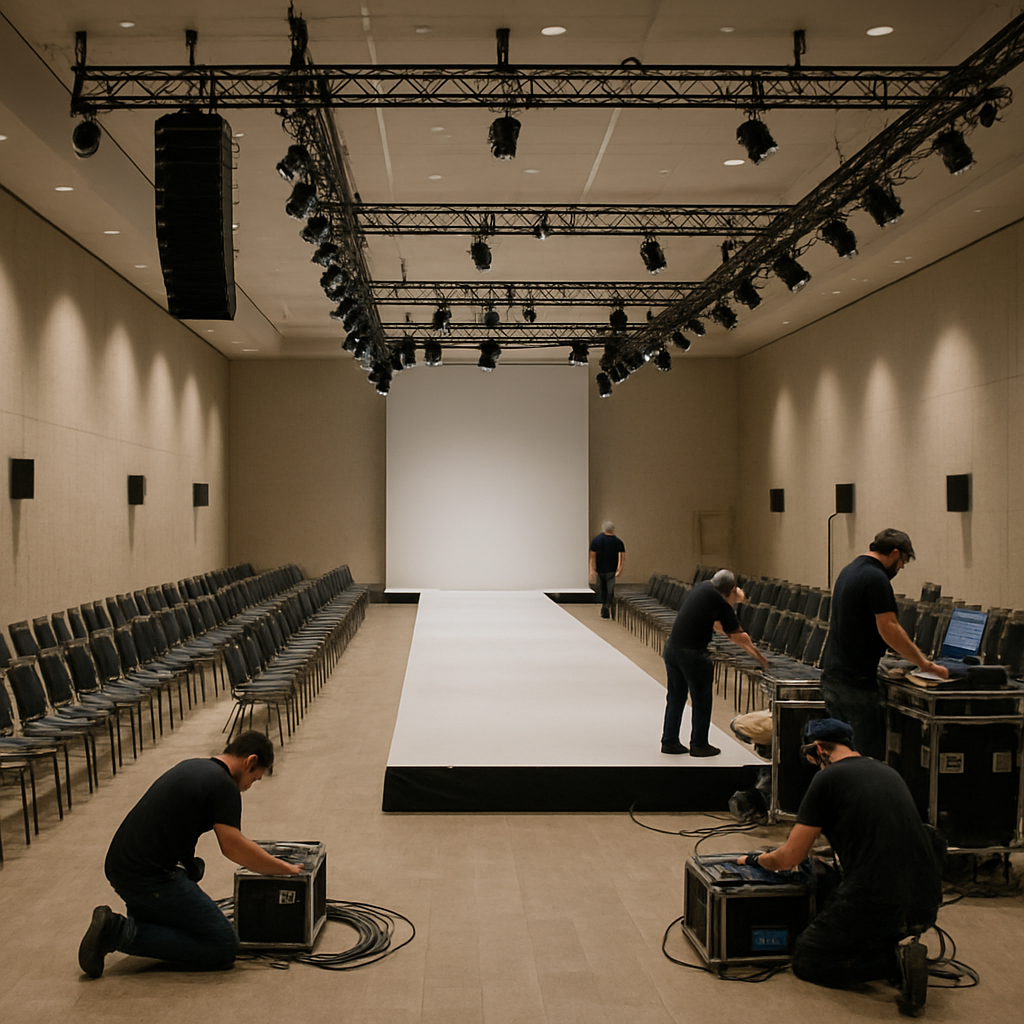
In Hall A, the main system is based on Kiva II line source enclosures, with two cabinets in the centre and four per side, left and right. Twenty X8i coaxial loudspeakers are flush-mounted around the room to provide consistent coverage without visually dominating the space.
Hall B uses a smaller but similar approach, with two A10i Wide loudspeakers as the main system, chosen for their wide horizontal dispersion to suit the room dimensions. Two X8 units provide side-fill, and 15 more X8i loudspeakers are built into the room for even tonal coverage.
Both halls can draw on a shared mobile inventory consisting of eight A10 Focus and four A10 Wide enclosures, plus eight KS21 subwoofers for additional low end. Amplification is handled by seven LA12X and five LA4X amplified controllers, managed via LA Network Manager control software.
Bestec Audio designed the system using L-Acoustics’ Soundvision acoustic simulation software and trained Pacific Art Center’s in-house team to carry out system configuration themselves. Further details on the product lines involved are available via the manufacturer’s website at l-acoustics.com.
Industry impact
The project illustrates how medium-sized urban venues are increasingly looking for scalable, software-driven audio infrastructures that can adapt quickly to changing room layouts and event types.
Using Soundvision, staff can preconfigure system designs and store presets that are later recalled through LA Network Manager. According to the technical team, this allows them to adjust quickly when clients request non-standard room orientations, such as using the hall widthways instead of lengthways.
The mobile A Series and KS21 package provides additional capacity for the most demanding events while retaining a familiar control workflow. Angle-adjustable enclosures and pre-defined presets are intended to reduce setup times during tight turnarounds and make it easier for external engineers to work with the in-house system.
The upgrade has also had operational implications. With the increased headroom and sub-bass capability, the hall’s team reports being able to accommodate higher level events they previously declined, broadening the type of productions that can be hosted in the city-centre venue.
Why this matters
For event technology professionals, Hikarie Hall’s move highlights several ongoing trends in installed sound for multi-purpose venues:
- A shift toward a single, unified loudspeaker platform across multiple rooms, simplifying operation and inventory sharing.
- Greater reliance on predictive design tools such as Soundvision to manage complex coverage needs and frequent room reconfigurations.
- A focus on aesthetics and compact, flush-mounted loudspeakers in venues where the visual environment is as critical as the audio, such as fashion shows and corporate brand events.
- The use of transportable subwoofers and additional tops to scale systems up or down, rather than permanently overspecifying each room.
As venues in dense urban markets compete for a wider variety of events, investments like Hikarie Hall’s suggest that flexible, reconfigurable audio infrastructures are becoming a key part of how operators respond to client expectations around sound quality and production value.