Sennheiser Spectra wireless systems support large-scale brass music festival deployment
Background and context
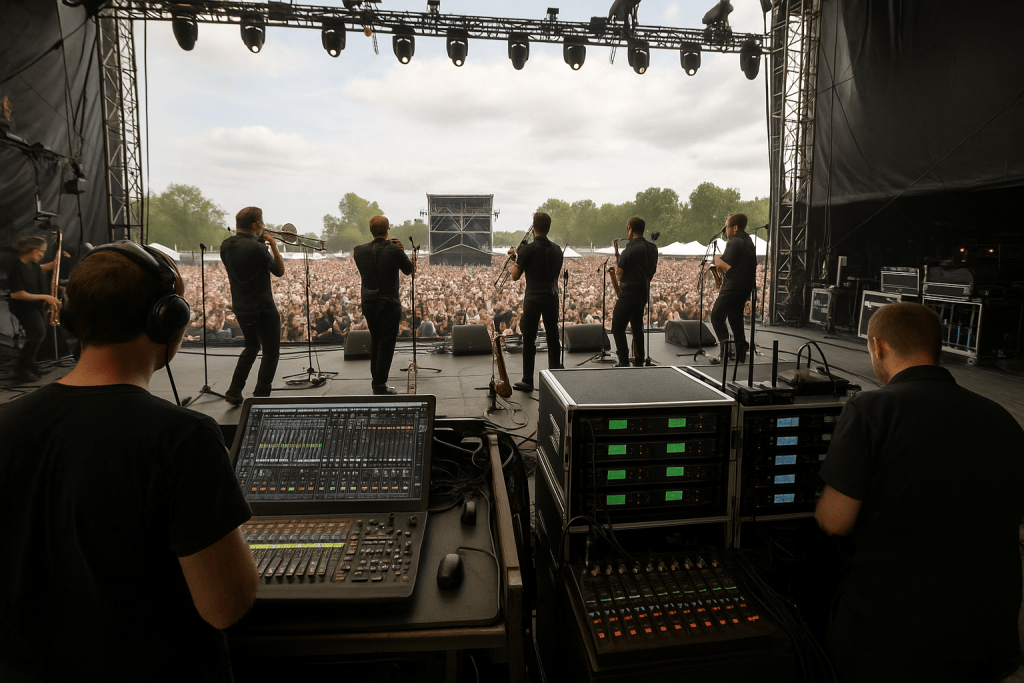
One of Europe’s largest brass music festivals has recently served as a practical testbed for broadband wireless microphone technology, with Sennheiser’s Spectra systems deployed across multiple stages and performance areas.
The event brought together numerous ensembles, soloists, and presenters, creating a dense RF environment with a high concentration of wireless channels operating in parallel. For the technical teams involved, the core challenge was to provide reliable audio transmission while managing limited spectrum and navigating complex local regulations.
Festivals of this scale increasingly rely on wireless solutions not only for performers, but also for stage management and broadcast-related tasks. This raises the bar for spectrum efficiency, coordination workflows, and system robustness in ever more crowded RF conditions.
Key announcement
Sennheiser reports that its Spectra broadband wireless systems were used as the main RF backbone for the festival, covering both stage and backstage requirements. The setup included a mix of handheld and bodypack transmitters, in-ear monitoring paths, and coordinated receiver racks distributed across various performance locations.
According to the manufacturer, the Spectra platform was chosen because of its wide tuning range, allowing engineers to place a large number of channels within a limited spectrum window. Frequency planning and coordination were handled centrally, with remote monitoring tools to track RF performance and interference.
The deployment also aimed to demonstrate how broadband-capable wireless systems can help production teams adapt quickly when frequencies need to be changed on short notice—an increasingly common requirement as spectrum allocations shift and local conditions vary.
Technical staff reported that the system supported multi-day operation with frequent changeovers between acts and configurations, underlining the role of software-based coordination in keeping the RF landscape stable throughout the event.
Industry impact
For the wider event technology sector, the festival illustrates how broadband wireless platforms are being used in real-world, high-density scenarios. As spectrum available for wireless microphones and in-ear systems continues to shrink in many regions, large festivals face growing pressure to do more with less.
Systems like Sennheiser’s Spectra are designed to handle a greater number of channels within a given frequency range, potentially reducing the need for multiple hardware platforms and easing coordination between different production teams and external broadcasters.
- Higher channel counts in limited spectrum
- Centralized RF coordination across multiple stages
- Flexibility to react to local interference or regulatory constraints
This type of deployment also highlights the importance of collaboration between manufacturers, system integrators, and event organizers, especially when integrating wireless audio into broader production and broadcast workflows.
Why this matters
For production managers and audio engineers working on festivals, tours, and corporate events, the use of broadband wireless systems at a large brass music festival offers a case study in managing RF complexity at scale.
As spectrum policies evolve and different wireless users compete for bandwidth, being able to deploy adaptable, broadband-capable systems becomes a strategic requirement rather than a technical luxury. The reported stability of the Spectra system in this environment suggests that wider tuning ranges, sophisticated coordination tools, and centralized monitoring are becoming standard expectations for high-profile events.
More information about the Spectra platform and its technical specifications is available via Sennheiser’s official website at sennheiser.com.
For the live events community, this deployment underlines a broader shift: wireless audio systems are now judged not only on sound quality, but also on how effectively they help productions navigate increasingly contested RF landscapes.