Wave Church adopts L-Acoustics L2D system for immersive sound in challenging sanctuary
Background and context
Wave Church in Virginia Beach, Virginia, has upgraded the sound system in its main 2,500-seat worship auditorium, aiming to resolve long-standing coverage and imaging issues in a challenging room layout.
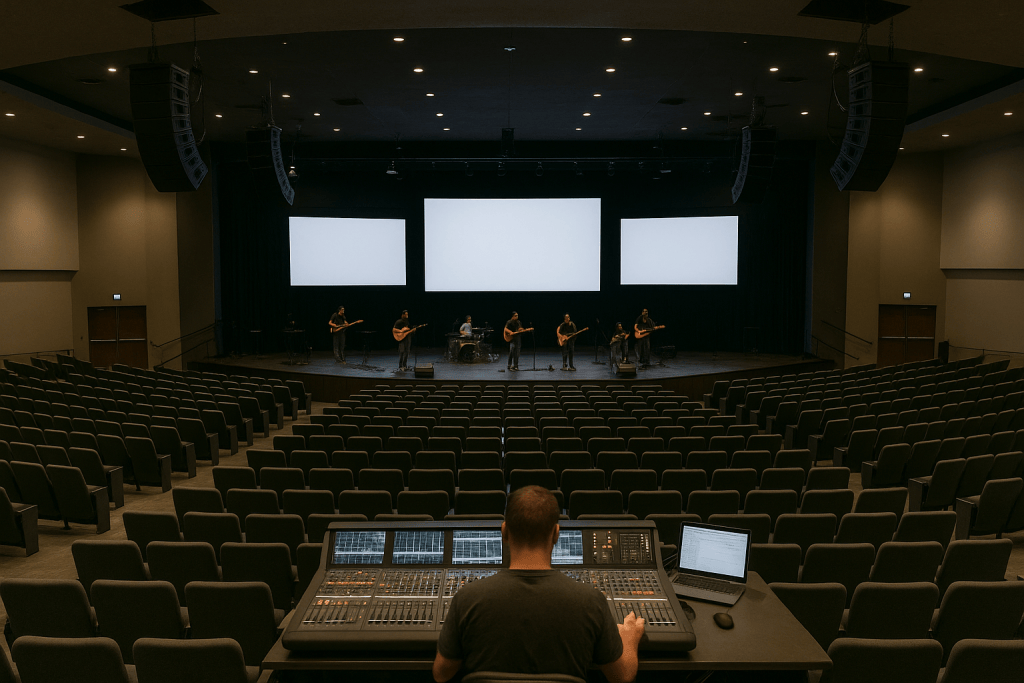
The church’s headquarters facility spans 80,000 square feet and supports weekend services, conferences, and concerts. Its main sanctuary is notably wide, with a 180-degree seating arc and a relatively low trim height. The previous mono PA struggled to provide consistent level and clarity to all seats, leaving areas of the room with compromised sound.
According to Wave Church Production Director Steve “Tig” Tignor, the team had explored multiple system options over the years but found that conventional arrays typically required more boxes, introduced sightline conflicts with the architecture, and did not easily accommodate immersive audio.
Key announcement
To address these challenges, Wave Church commissioned house-of-worship AVL specialist HouseRight to design and integrate a new system based on L-Acoustics’ L Series and L-ISA immersive platform.
At the heart of the installation is a Scene system comprising five L-Acoustics L2D arrays. These compact line source elements were selected to deliver the required output and clarity within the sanctuary’s limited trim height, while minimizing visual impact on stage and screens.
Supporting systems include:
- An Extension system of four arrays, each with three A10i Focus over one A10 Wide, deployed in pairs to the left and right of the Scene hangs.
- Out-fills made up of four A15i Focus over one A15i Wide, positioned behind the far left and right Scene arrays to reach the outer seating areas.
- Low-frequency coverage from nine KS28 subwoofers flown centrally in three cardioid-configured hangs behind the middle Scene array.
- Twelve X12 loudspeakers used as delays for upper stadium seating, and eight additional X12 placed along the stage lip as spatialized front fills.
The system is powered by L-Acoustics LA7.16i amplified controllers for the Scene and Extension arrays, out-fills, and delays, with LA12X units driving the subs and front fills. An L-ISA Processor II manages object-based mixing for the room. More information on L-ISA technology is available on the L-Acoustics website at http://www.l-acoustics.com/products/l-isa-hyperreal.
Industry impact
The Wave Church project illustrates how immersive audio systems are being adapted for non-traditional and architecturally constrained venues, particularly within the house-of-worship sector.
HouseRight’s configuration was shaped by the need to keep as many seats as possible within the effective L-ISA coverage area, often referred to as the L-ISA zone. The wide seating arc and a ring of seats around the rear of the room required a combination of spatial imaging and delay strategies.
Instead of simply increasing level in the back rows, HouseRight used X12 loudspeakers in an arc as imaging delays, time-aligned and spatially matched to the front fills. This approach extends the sense of localization and spatial placement from the front of the room through to the rear seating, aiming to maintain a coherent immersive experience.
The new system also tackles a front-of-house design issue common in retrofitted spaces: a slightly off-center mix position. With object-based mixing in L-ISA, engineers can place audio elements according to their positions on stage, and the system renders those objects consistently across the audience area, reducing the disadvantages of a non-central FOH location.
Why this matters
For AV professionals, the Wave Church installation highlights several trends in large-room sound design:
- Immersive and object-based systems are increasingly being deployed not only in purpose-built performance venues but also in multi-use worship spaces.
- Compact, high-output arrays like L2D can help reconcile acoustic goals with architectural and sightline constraints, especially in wide, low-trim rooms.
- Delay and fill loudspeakers are playing a more active role in preserving spatial imaging, not just in maintaining level, particularly in 180-degree seating configurations.
From an operational perspective, Wave Church reports that the move from a mono PA with dead spots to a predominantly spatialized system has changed both coverage and workflow. The majority of the room now receives a spatial image, while remaining seats experience an improved mono mix relative to conventional stereo or mono designs.
As immersive audio continues to move into the mainstream of live production, projects such as this suggest that object-based approaches are becoming a practical option for churches and other venues seeking to modernize sound systems without major structural changes.