Real-Time Feedback: Benefits of Audience Response Systems

An Audience Response System (ARS) is a technology-based tool used to engage participants, collect feedback, and enhance interactivity in various events, including conferences, training sessions, and educational seminars. The system integrates hardware devices like keypads or mobile devices and specialized software to collect and process participant responses instantly. The growing demand for immediate, actionable feedback in live events highlights the importance of ARS, offering several benefits, including improved engagement, data-driven decision-making, and enhanced learning outcomes. This article delves into the technical benefits of real-time feedback using ARS and examines how this technology optimizes various event types.
The Core Components of an Audience Response System
An ARS typically consists of the following key components:
- Hardware Devices: These include keypads, mobile phones, tablets, or computers used by the audience to provide their input. Modern systems often leverage smartphones or other personal devices, reducing the need for additional hardware.
- Software Platform: The core engine that captures, processes, and analyzes audience responses. The software often integrates with other presentation tools like PowerPoint, allowing seamless incorporation of audience interaction in real time.
- Receiver/Server: A central unit that collects data from individual devices. This could be a local server in a conference room or a cloud-based solution for remote events.
- Data Analytics Tools: These tools are used to interpret collected data, provide real-time results, and generate reports.
Technical Benefits of Real-Time Feedback with Audience Response Systems
1. Enhanced Audience Engagement
An Audience Response System fosters a high level of engagement by allowing real-time interactions. The following technical aspects contribute to increased engagement:
- Immediate Response Collection: ARS allows instant collection of responses from all participants, reducing the time lag between question delivery and feedback reception. This immediate collection boosts participant motivation to engage and respond.
- Dynamic Content Adjustment: Real-time feedback enables presenters to adapt their content dynamically based on audience reactions. For instance, if a significant portion of the audience struggles with a particular topic, the speaker can revisit the concept, ensuring clarity and comprehension.
- Interactive Question Formats: Modern ARS platforms support multiple question formats, such as multiple choice, open-ended questions, or rating scales. These diverse formats cater to different learning styles, keeping the audience interested and engaged.
2. Data-Driven Decision Making
The real-time data provided by an ARS enhances decision-making processes in various events and sessions:
- Instant Data Aggregation and Visualization: The system instantly aggregates data from all responses and presents it in graphical formats like bar charts, pie charts, or heat maps. This visualization aids in quickly understanding audience sentiment or knowledge levels.
- Informed Adjustments: Event organizers and presenters can make informed decisions on the fly. For instance, during a product launch, if the majority of the audience expresses confusion or concern over a feature, organizers can address these issues immediately.
- Post-Event Analytics: The data captured during the event can be analyzed later to understand trends, audience preferences, and areas needing improvement. This data is valuable for designing future events that are more aligned with audience expectations.
3. Improved Learning Outcomes
Real-time feedback significantly enhances learning outcomes, especially in educational settings:
- Adaptive Learning Techniques: An ARS allows for adaptive learning, where content is tailored in real-time based on student performance and feedback. This ensures that learners receive targeted instruction that meets their individual needs.
- Immediate Clarification of Misconceptions: Teachers or trainers can instantly identify common misconceptions or areas where the audience lacks understanding. They can address these gaps promptly, ensuring that learners do not leave with incorrect knowledge.
- Active Participation Encouragement: The anonymity of responses in an ARS encourages participation from all audience members, including those who may be reluctant to speak up in public settings. This broad participation enhances the overall learning environment by incorporating diverse viewpoints and questions.
4. Efficient Time Management
Real-time feedback through ARS helps optimize the use of time during events:
- Focused Discussions: ARS can guide discussions toward areas of interest or concern based on audience input, reducing time spent on irrelevant or already understood topics.
- Quick Polling and Surveys: The ability to conduct quick polls and surveys without needing to distribute paper or conduct lengthy discussions saves valuable time during meetings and presentations.

Key Features of an Audience Response System
- Real-Time Feedback: Immediate collection and processing of responses.
- Data Analytics and Reporting: In-built tools for data analysis, visualization, and report generation.
- Cross-Platform Compatibility: Works on multiple devices, such as smartphones, tablets, and computers.
- Customizable Interaction Formats: Supports various question types like multiple-choice, true/false, short answer, and ranking.
- Integration with Other Software: Seamless integration with presentation and learning management systems (LMS).
- Secure and Anonymous Feedback: Ensures participant data privacy and encourages honest feedback.
Real-World Applications of Audience Response Systems
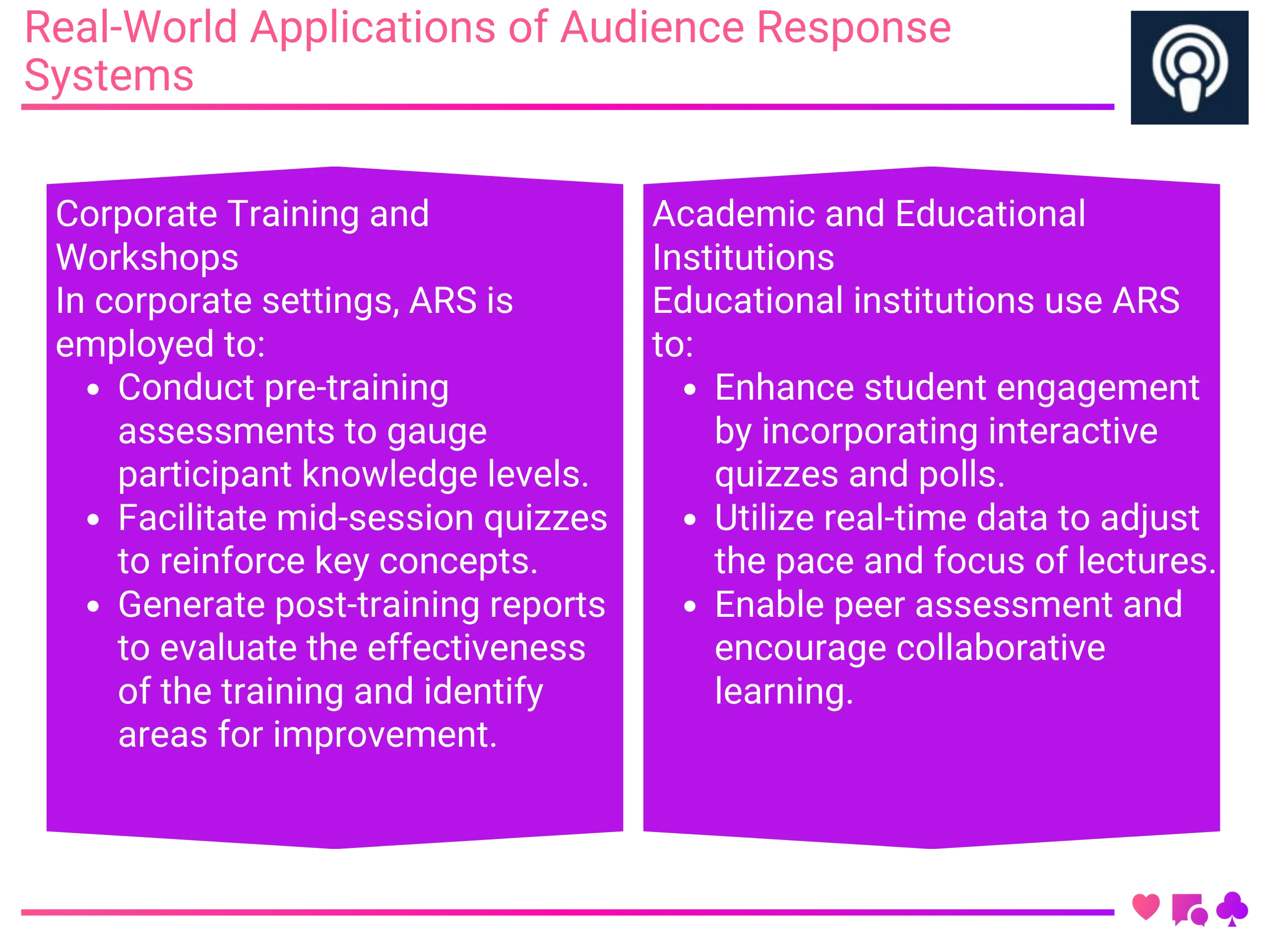
1. Corporate Training and Workshops
In corporate settings, ARS is employed to:
- Conduct pre-training assessments to gauge participant knowledge levels.
- Facilitate mid-session quizzes to reinforce key concepts.
- Generate post-training reports to evaluate the effectiveness of the training and identify areas for improvement.
2. Academic and Educational Institutions
Educational institutions use ARS to:
- Enhance student engagement by incorporating interactive quizzes and polls.
- Utilize real-time data to adjust the pace and focus of lectures.
- Enable peer assessment and encourage collaborative learning.
3. Conferences and Public Events
At conferences and large public events, ARS helps:
- Gather instant feedback on speakers and topics.
- Conduct live polls to gauge public opinion on critical issues.
- Enhance networking opportunities by facilitating discussions based on shared interests.
Technical Requirements for Implementing an Audience Response System
- Reliable Network Infrastructure: A robust network to ensure uninterrupted data transmission between devices and servers.
- Scalable Software Platform: The software should handle a large number of simultaneous users without performance degradation.
- Device Compatibility: Compatibility with various operating systems and devices, including iOS, Android, Windows, and MacOS.
- Data Security Protocols: Secure encryption protocols for data transmission and storage to protect user privacy.
- User-Friendly Interface: An intuitive interface for both participants and administrators to manage and engage seamlessly.
- Customizable Feedback Formats: Options for different feedback types and question formats to suit various event needs.

Benefits of Real-Time Feedback for Various Stakeholders
1. Benefits for Event Organizers
- Enhanced Audience Satisfaction: By adapting content in response to real-time feedback, organizers can ensure the audience finds the event valuable and engaging.
- Better Planning for Future Events: The data collected can highlight areas for improvement, helping organizers plan more successful events in the future.
2. Benefits for Presenters and Trainers
- Improved Content Delivery: Real-time feedback allows presenters to modify their content dynamically to suit audience needs.
- Higher Retention Rates: Engaging with the audience through ARS keeps their attention, improving content retention and comprehension.
3. Benefits for Participants
- Increased Participation: ARS allows even the shyest participants to contribute, leading to a more inclusive discussion environment.
- Immediate Knowledge Assessment: Participants can immediately assess their understanding of the material through quizzes and polls.
Comparative Analysis of Audience Response Systems
| Feature | Traditional Methods | Audience Response Systems |
| Feedback Speed | Delayed | Immediate |
| Data Collection | Manual | Automated |
| Engagement Level | Moderate | High |
| Anonymity of Responses | Limited | Complete |
| Flexibility in Question Types | Limited | Multiple Formats Supported |
| Data Analysis | Manual | Automated with Real-Time Visualization |
| Customization Options | Minimal | Extensive |
Real-Time Feedback: Benefits of Audience Response Systems
Real-time feedback through an Audience Response System offers a multitude of technical benefits that enhance the overall experience for organizers, presenters, and participants. From fostering higher engagement levels to providing data-driven insights and improving learning outcomes, ARS technology plays a critical role in the success of modern events. As technology continues to evolve, the importance of utilizing ARS for capturing real-time feedback will only grow, making it an indispensable tool for any event that prioritizes interaction, learning, and audience satisfaction.
By understanding the components, benefits, and real-world applications of ARS, stakeholders can make informed decisions about integrating this technology into their events, ultimately leading to more impactful and engaging experiences.
Academic Reference on Real-Time Feedback: Benefits of Audience Response Systems
- Examining the benefits and challenges of using audience response systems: A review of the literature
- [PDF] Observations on benefits/limitations of an audience response system
- [PDF] A systematic review of audience response systems for teaching and learning in higher education: The student experience
- Audience response systems: technology to engage learners
- [HTML] The benefits of a real–time web-based response system for enhancing engaged learning in classrooms and public science events
- [HTML] Smartphones as audience response systems for lectures and seminars
- Audience response systems in medical student education benefit learners and presenters
- Sensing a live audience
- Use of audience response systems for summative assessment in large classes
- Exploring the use of audience response systems in secondary school science classrooms