L-Acoustics DJ Spatial Sound Transforms Nameless Festival 2026
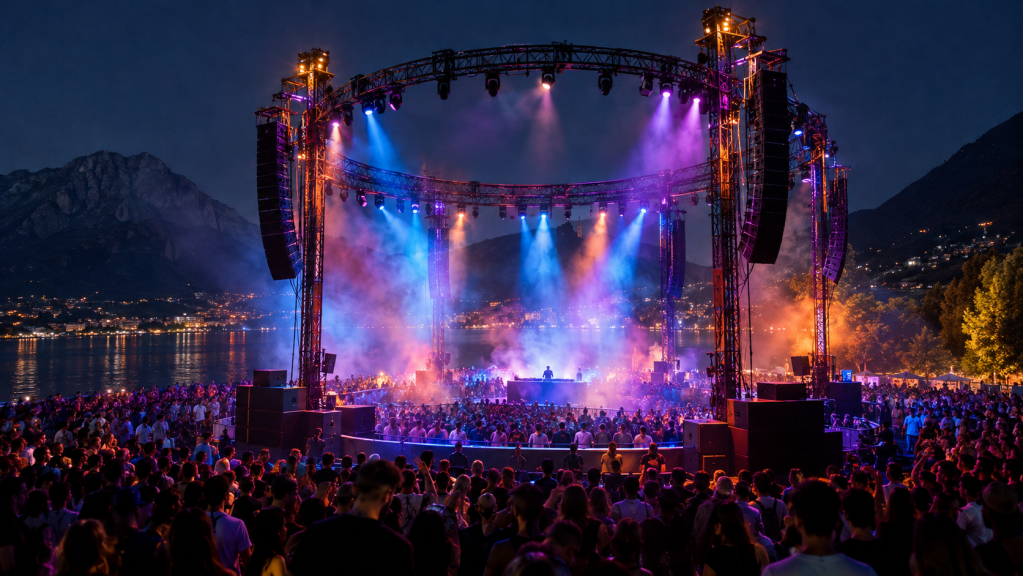
Nameless Festival 2026 in Lecco, Italy, has become the first European festival to showcase the L-Acoustics DJ spatial sound system on a festival stage, while standardizing every performance area on L-Acoustics loudspeaker and amplification technology. Across three days from 30 May to 1 June 2026, more than 90,000 fans experienced four stages and over 100 artists, including headliners Calvin Harris, John Summit and FISHER, on a unified L-Acoustics infrastructure.
Festival Return To Original Ground With Unified Brand Strategy
Nameless Festival began in 2013 as a single-stage party created by friends at the Bione sports centre in Lecco. Thirteen years and three venue changes later, the 2026 edition returned to this original field as one of Italy’s leading electronic music festivals, but with a far more ambitious technical footprint.
Production director Angelo Loizzi set a clear brief for the audio delivery: L-Acoustics systems on every stage, from the main arena to the smallest platform. Because Nameless supplies its own front of house and system engineers, the specification was driven by operational teams and artist requirements rather than purely commercial considerations.
Loizzi notes that L-Acoustics consistently appears as the preferred option on artist riders and is particularly valued for its low-frequency performance in electronic music. The unified approach meant visiting touring engineers encountered the same ecosystem across the site, streamlining changeovers and ensuring sonic consistency for audiences moving between stages.
Production Partnership Between Milano Show Rent And Black Box
L-Acoustics Certified Provider Milano Show Rent took responsibility for supplying, deploying and crewing the systems on all five stages. Technical and lighting designer Nico Berna of Black Box, also an L-Acoustics partner, collaborated with Nameless production representative Jacopo Naso on stage layouts and coverage design.
The companies had already collaborated with the Nameless team on smaller festivals earlier in the year, allowing the relationship and workflows to scale for this larger project. For Nameless 2026, Milano Show Rent handled the entire five-stage audio, video and lighting production in-house, under the direction of project manager and owner Amaury Froiio.
European First For L-Acoustics DJ Spatial Sound System
The Red Bull Energy Zone provided the platform for a European first: the debut of L-Acoustics DJ on a festival stage. Programmed with brands including Defected, Glitterbox and CRUNCH, this area was conceived as an in-the-round dance floor instead of a conventional end-on stage, opening the door to a fully spatialised audio experience.
Loizzi and the production team viewed the circular geometry as incompatible with a traditional stereo configuration. Instead, they opted to wrap the dance floor in sound, aligning the system design with audience expectations for immersive club and house music experiences.
Working from Berna’s scenic concept, Milano Show Rent and L-Acoustics sound engineer Rafael Pereira developed a system around a 16 meter diameter circular truss. Six towers carried both audio and lighting, creating a 360-degree spatial listening field instead of a single frontal source.
L-Acoustics DJ System And Workflow Detail
L-Acoustics DJ combines loudspeakers, amplification and software from the L-Acoustics ecosystem with an interface designed specifically for DJs, accessible via iPad or the L-Acoustics DJ Controller. At its core is a low-latency, machine-learning-powered engine that separates a stereo feed into discrete stems in real time, such as beats, basslines, melodies and vocals.
These stems are routed into a spatial mix engine, allowing elements to be positioned and moved dynamically throughout the audience area. The solution supports both digital and analogue DJ setups without requiring changes to existing equipment or performance techniques. Artists can control the spatial mix themselves or collaborate with a dedicated spatial audio engineer.
According to Froiio, L-Acoustics DJ was designed with a low barrier to entry. Visiting DJs unfamiliar with spatial workflows could be trained quickly on site, and around 80% of performers on the Red Bull Energy Zone chose to adopt the system during the festival. Naso reports that both artists and attendees commented on the distinctiveness of the experience on the in-the-round dance floor.
Site Challenge And System Design On Familiar Ground
Although the Bione field was a historic location for Nameless, the 2026 build far exceeded anything attempted there previously, requiring a full resurvey of the site. A row of buildings directly behind the main stage demanded strict control of noise spill. To address this, the main hangs combined K1 and K1-SB in extended arrays, with KS28 subwoofers configured in cardioid mode to focus energy onto the audience and reduce rearward propagation.
With no suitable positions for delay towers in the main field, the system had to cover the entire audience area from the stage structure itself. At the same time, the Nameless Tent faced the main stage across the site, introducing another set of spill control challenges, while the tent’s load limits restricted the weight of any flown systems.
The audio crew shared a 10-day build schedule with structure contractor Stageco, installing all systems over two days and striking them in a single night. L-Acoustics Soundvision design software was central to this efficiency. Berna’s team prepared vector drawings and SketchUp models, which system engineer Luigi Vargiolo translated into Soundvision projects for three of the stages. These files then became the common reference for the entire audio crew and for visiting engineers.
With eight audio crew members all proficient in Soundvision, preproduction allowed for coordinated planning. Shared files and brief meetings before load-in helped accelerate deployment, while on-site adjustments for wind and weather were guided by the same simulation data.
Main Stage And Support Stage System Configuration
Each stage at Nameless was engineered according to its footprint, load capacity and program content:
-
Main Ploom Stage — Hosting Calvin Harris, John Summit and FISHER, the main stage deployed twelve K1 with two K2 as downfills per side, flown beneath six K1-SB that extended the line for improved low-frequency control. Across the stage front, 48 KS28 subwoofers in cardioid configuration delivered substantial low-end impact.
-
Live Stage — This stage used hangs of four K1-SB with twelve K2 per side, supported by 16 groundstacked KS28 subwoofers.
-
Garnier Fructis Arena — Dedicated to rap, urban and pop programming, this arena featured ten K2 per side and 16 cardioid-configured, groundstacked KS28 subwoofers.
-
Red Bull Energy Zone — The spatial stage ran Kara II and A15 across seven arrays on the 16 meter circular truss, with eight KS28 handling low frequencies for the in-the-round dance floor.
-
Heineken Stage — An open platform where members of the public could book performance slots used a scaled-down Kara II and A15 configuration.
Monitoring across all stages relied on Kara II and SB18, while LA12X amplified controllers powered the entire site. In total, more than 80 K2 and over 100 KS28 were deployed, alongside 24 K1 cabinets, creating a coherent sonic signature for audiences navigating the festival.
Consistent Audience Experience And Differentiated Stage Offering
For the Nameless team, standardizing on L-Acoustics produced a consistent sound profile across stages for the first time in the festival’s history. At the same time, the Red Bull Energy Zone’s spatial design and L-Acoustics DJ implementation delivered a differentiating feature no other Italian festival currently offers.
With artists and technical crews able to rely on a familiar ecosystem and audiences exposed to both conventional line array deployments and next-generation spatial dancefloor experiences, Loizzi describes Nameless 2026 as one of the festival’s most successful editions to date, both artistically and technically.