L-Acoustics System Powers Freedom 250 Spectacle At Washington Monument
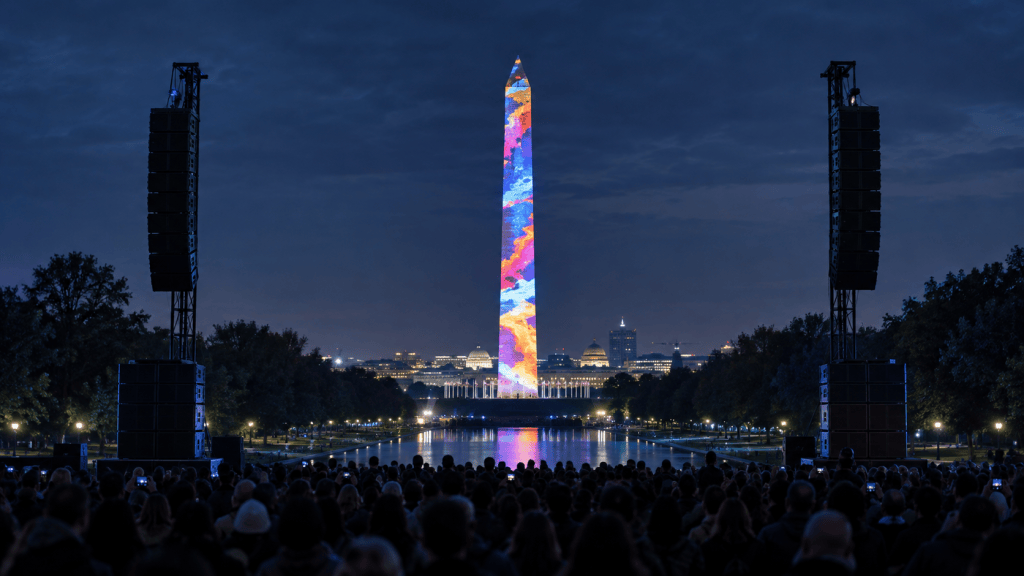
Freedom 250, the official launch of the United States’ semiquincentennial celebrations, turned the Washington Monument into a towering projection canvas supported by a large-scale, adaptive sound system from L-Acoustics. Event technology provider LMG delivered both the projection mapping and a multi-directional L-Acoustics K and L Series system to carry a cinematic score and spoken narrative across the National Mall for thousands of spectators.
Projection Showcase Turns Landmark into Storytelling Canvas
Staged in Washington, D.C. around the July 4 holiday and officially dated in late June 2026, the Freedom 250 experience illuminated the 555-foot Washington Monument with a six-night projection show. Designed by artist and videographer Kyle Barrett, the content traced key episodes in the American story, from wooden ships crossing the Atlantic and covered wagons moving west to the rise of skyscrapers and the Apollo moon landing.
The Washington Monument, long used as a backdrop for Independence Day fireworks, became the focal point for a tightly synchronized audio-visual narrative. LMG, which had already supported a Washington Monument illumination earlier in the year, was tasked with again supplying projection and sound—this time for the country’s official 250th anniversary kickoff.
For the projection element, LMG deployed Barco projectors driven by a Ross Vertex media server ecosystem, repeating a configuration that had proven successful during New Year’s Eve celebrations. For Freedom 250, producers wanted to elevate the audio experience to match the expanded creative ambition of the show, turning to L-Acoustics as the primary loudspeaker platform.
Soundvision Guides System Design For Complex Mall Layout
According to LMG Audio Systems Director Robby Schlegel, the event on June 24 combined playback for the projection show with live music and a rally. That mix of content, combined with the scale of the National Mall, led LMG to specify L-Acoustics K Series as the main system, with L Series loudspeakers used as delay and fill arrays.
The audio system was initially designed in L-Acoustics Soundvision software around an oval-shaped, 600-by-400-foot perimeter surrounding the monument. Crowd management plans called for spectators to remain outside this oval to preserve clear sightlines for the projection mapping, so the Soundvision model targeted coverage beyond that inner zone, aligned with projector positions and viewing areas.
Schlegel notes that LMG placed large shipping containers around the oval to house the projection equipment, with plans for the audience to stand behind those structures. Using Soundvision, the team modeled coverage from multiple tower positions around the Mall to create a coherent, immersive sound field that would track the narrative content and musical score across a wide listening area.
Last-Minute Crowd Shift Forces Rapid System Reorientation
On site, the event’s success with attendees created an unexpected challenge. Far more visitors than anticipated moved into the central oval close to the monument, forcing the production team to rethink coverage just as the show was about to begin.
Schlegel explains that the initial configuration focused sound outward, away from the monument, in line with the original crowd plan. As the oval filled up, the team was asked to prioritize coverage inside that area instead. In response, LMG technicians reoriented key arrays by 180 degrees, with north and south towers turned inward toward the Washington Monument, while larger west-side towers were adjusted to continue covering the wider Mall.
Because the system had been modeled in Soundvision, engineers could quickly validate the impact of these changes and ensure that the reconfigured coverage remained consistent. The rapid pivot preserved clarity and impact for both the close-in audience experiencing the towering projections at short range and the broader crowd spread along the National Mall.
Mall East System Configuration Delivers High-Output Coverage
The final Mall East system used L-Acoustics K and L Series components in a high-output, multi-array design. The main arrays comprised eight K1 over six K2 loudspeakers per side, supported by six KS28 subwoofers beneath each main hang, arranged in two stacks of three. These arrays fired away from the monument and flanked the Washington Monument Lodge, supplying long-throw coverage down the Mall.
Mall East out-fills were handled by arrays of three L2 per side, with low-frequency support again provided by six KS28 subwoofers, configured in two stacks of three per side. This combination extended horizontal coverage and helped maintain tonal consistency as the program material moved across different parts of the audience area.
Mall North And South Fills Balance Monument-Centric Experience
To balance the experience for spectators gathered around the monument itself, LMG deployed identical systems on the Mall North and Mall South positions. Each location used arrays of three L2 per side, with eight K1-SB subwoofers per main array, configured in two stacks of four.
In this layout, the Mall North and South arrays fired inward toward the center, drawing focus toward the Washington Monument and synchronizing sound with the projection content on the obelisk. The K1-SB subwoofers were conversely oriented to fire away from the monument, helping manage low-frequency build-up near the structure while still providing full-range impact for the audience.
Amplified Controller Network And Processing Backbone
Power and processing for the system relied entirely on L-Acoustics amplification and control hardware. All K Series elements, including K1, K2, and K1-SB, were driven by LA12X amplified controllers, while LA7.16 units powered the L2 components serving as delays and fills around the Mall.
Signal management centered on a pair of P1 processors, providing system processing, monitoring, and alignment. An LC16D network audio converter allowed LMG to route feeds directly from the live concert front-of-house area to speaker arrays on the Mall West side, integrating the rally and musical performances into the wider Freedom 250 sound design.
The entire networked audio infrastructure ran over a redundant Milan-AVB architecture. Despite the long fiber runs required to connect distributed tower positions across the National Mall, the network operated seamlessly throughout the event, according to Schlegel.
Adaptive System Underscores Role Of Predictive Software
Reflecting on the project, Schlegel highlights the value of Soundvision in enabling fast, data-driven decisions as audience patterns changed. With the initial design already modeled in detail, the team could recalculate coverage scenarios quickly and confidently when arrays had to be rotated and priorities shifted closer to the monument.
LMG reports that client feedback on the Freedom 250 launch was overwhelmingly positive, citing both the impact of the projection mapping and the clarity and reach of the sound system. For the company, the project marked one of its most innovative integrations of large-format projection with a flexible, networked audio design, with L-Acoustics loudspeakers and software at the core of the execution.