Sponsor Activations in WebAR: Maximizing Impressions Without App Downloads
Introduction
Sponsorship remains one of the primary revenue drivers for conferences, trade shows, festivals, sporting events, and hybrid experiences. As attendee expectations shift toward personalized and interactive engagement, sponsors increasingly seek activations that move beyond static banners, printed collateral, and conventional exhibition booths. They want measurable digital interactions, immersive brand experiences, and actionable engagement data without introducing friction into the attendee journey.
Historically, augmented reality (AR) campaigns at events required attendees to install dedicated mobile applications. Although native apps provide powerful capabilities, download requirements often create a significant barrier to participation. Limited device storage, privacy concerns, poor connectivity, and the reluctance to install applications for short-term events frequently reduce activation rates and sponsor return on investment.
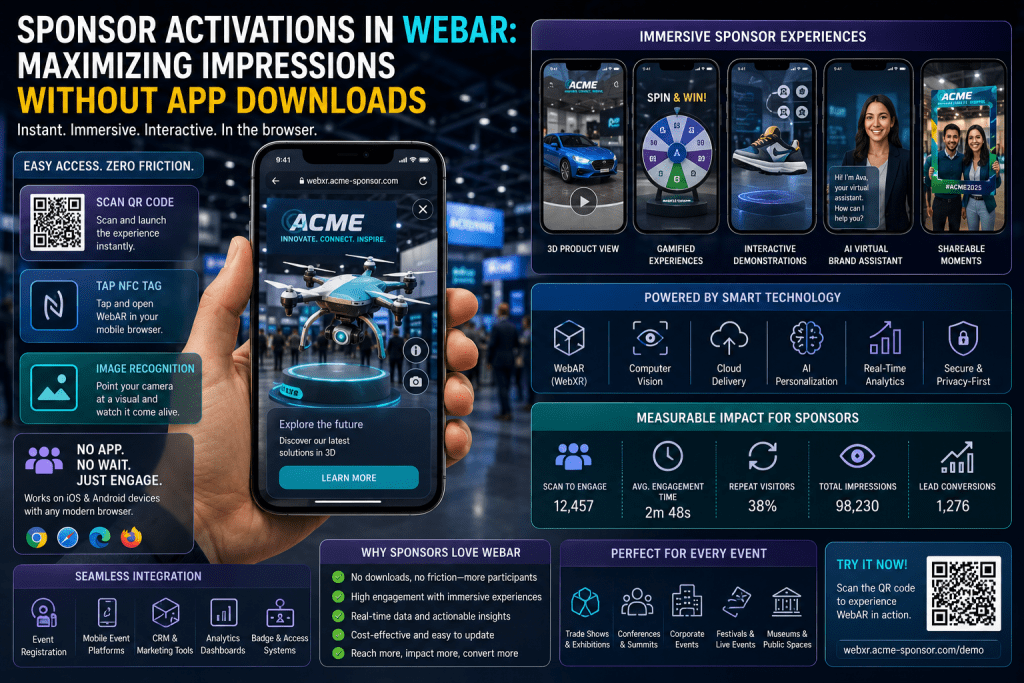
Web-based Augmented Reality (WebAR) eliminates this obstacle by enabling immersive experiences directly within a mobile browser. Using technologies such as WebXR, WebGL, WebAssembly, JavaScript frameworks, computer vision, cloud content delivery, and artificial intelligence (AI), attendees can access AR experiences by scanning a QR code, tapping an NFC tag, or opening a simple web link—without downloading software.
For event technology professionals, WebAR has become an effective platform for creating scalable sponsor activations that combine accessibility, analytics, personalization, and measurable business outcomes while significantly reducing participation friction.
Why Traditional Sponsor Activations Have Limitations
Conventional sponsor engagement often depends on physical interactions that are difficult to measure comprehensively.
Common activation formats include:
- Exhibition booths
- Product displays
- Printed brochures
- Promotional giveaways
- Photo walls
- Interactive kiosks
- Demonstration stages
While these approaches remain valuable, they frequently provide limited visibility into attendee engagement beyond basic lead collection.
Native mobile applications improve measurement capabilities but introduce adoption challenges.
Every additional installation step reduces participation, particularly among casual attendees.
WebAR removes these barriers by delivering immersive content instantly through standard mobile browsers.
Understanding WebAR Architecture
WebAR combines browser-based technologies with cloud infrastructure to deliver interactive augmented reality experiences.
A typical architecture includes:
- Mobile web browsers
- WebXR or AR frameworks
- Cloud content management
- Computer vision engines
- Image or object recognition
- Content delivery networks (CDNs)
- Analytics platforms
- Sponsor management systems
Because the experience runs directly within the browser, deployment becomes significantly faster while supporting a broader range of devices.
Triggering WebAR Experiences
Multiple technologies initiate browser-based activations.
QR Codes
Attendees scan strategically placed QR codes located on sponsor booths, digital signage, badges, packaging, or presentation screens.
The browser launches directly into the AR experience without requiring application installation.
Near Field Communication (NFC)
NFC tags embedded in promotional materials or product displays allow participants to launch experiences simply by tapping their smartphones.
This creates faster interactions while reducing visual clutter associated with printed QR codes.
Image Recognition
Computer vision detects predefined visual markers such as logos, posters, products, or printed graphics.
The browser overlays three-dimensional digital content directly onto the recognized object.
Artificial Intelligence and Personalization
AI significantly expands the capabilities of sponsor activations.
Recommendation engines analyze:
- Registration profiles
- Event interests
- Session attendance
- Previous booth visits
- Interaction history
- Geographic location
- Device capabilities
Based on these signals, WebAR experiences adapt dynamically by presenting personalized product demonstrations, promotional offers, or educational content.
Generative AI can also create conversational virtual brand ambassadors capable of answering attendee questions directly within the browser.
Interactive Sponsor Experiences
WebAR supports a wide range of activation formats.
Examples include:
- Interactive product visualization
- Virtual equipment demonstrations
- Gamified brand experiences
- 3D product exploration
- Digital scavenger hunts
- Virtual prize collection
- Interactive storytelling
- Photo experiences with branded AR elements
These experiences encourage longer engagement compared with passive promotional displays while generating measurable interaction data.
Integration with Event Technology Platforms
WebAR delivers maximum value when integrated into the broader event ecosystem.
Registration Platforms
Attendee profiles personalize activation content while respecting consent preferences and access permissions.
Customer Relationship Management Systems
With participant approval, interactions synchronize automatically with CRM platforms.
Sponsors gain insights into:
- Product interest
- Engagement duration
- Content viewed
- Interaction frequency
- Follow-up requests
- Lead quality
Event Mobile Platforms
Although WebAR eliminates mandatory application downloads, optional integration with existing event platforms enables unified attendee experiences across scheduling, networking, and sponsor engagement.
Analytics Dashboards
Organizers and sponsors can monitor:
- QR scans
- Session duration
- Completion rates
- Repeat visits
- Device compatibility
- Geographic engagement
- Conversion performance
These analytics support evidence-based optimization throughout multi-day events.
Performance and Scalability
Cloud-native architecture allows WebAR experiences to scale rapidly.
Content Delivery Networks distribute three-dimensional assets, videos, and interactive content across geographically distributed servers.
Performance optimization techniques include:
- Asset compression
- Progressive loading
- Adaptive rendering
- Browser caching
- Device capability detection
- Edge computing
These strategies reduce loading times while maintaining responsive interactions across diverse smartphone models.
Accessibility Considerations
Inclusive design remains essential for sponsor activations.
Important accessibility features include:
- Alternative text content
- Voice narration
- Captioned multimedia
- High-contrast interfaces
- Simplified interactions
- Keyboard compatibility where applicable
- Screen reader support for surrounding web content
Providing non-AR alternatives ensures meaningful participation for attendees whose devices lack augmented reality capabilities.
Operational Benefits
WebAR delivers measurable advantages for organizers and sponsors alike.
Lower Participation Friction
Attendees access experiences instantly without installing applications.
Greater Audience Reach
Browser compatibility significantly expands the number of supported devices.
Rich Engagement Analytics
Every interaction generates actionable behavioral insights unavailable through traditional sponsorship methods.
Faster Campaign Deployment
Cloud-based content management enables rapid updates throughout the event without requiring software distribution.
Implementation Challenges
Successful WebAR deployment requires thoughtful planning.
Lighting conditions, camera quality, and network performance influence computer vision accuracy.
Three-dimensional assets should be optimized carefully to balance visual quality against loading speed.
Browser compatibility testing across Android and iOS devices remains essential before large-scale deployment.
Privacy is another important consideration. Organizations should explain clearly how camera access, interaction analytics, and optional location information are collected and processed while allowing users to control permissions transparently.
Finally, sponsor experiences should remain purposeful. Excessively complex AR interactions may reduce completion rates rather than increasing engagement.
Future Trends
WebAR continues evolving alongside advances in artificial intelligence and spatial computing.
Emerging innovations include:
- AI-generated AR experiences
- Markerless object recognition
- Shared collaborative AR
- Real-time personalization
- Spatial commerce
- Voice-controlled AR interfaces
- Digital twins of exhibition spaces
- Wearable browser-based AR
As browser standards mature, WebAR experiences will become increasingly immersive while maintaining the accessibility advantages that distinguish them from native applications.
These developments position WebAR as one of the most scalable technologies for sponsor engagement in modern event environments.
Conclusion
WebAR is transforming sponsor activations by delivering immersive, browser-based augmented reality experiences without requiring attendees to install dedicated mobile applications. Through the integration of computer vision, AI-driven personalization, cloud content delivery, QR codes, NFC technologies, analytics platforms, and event management systems, WebAR reduces participation barriers while creating highly measurable and engaging brand interactions. Although careful attention to performance, accessibility, privacy, and content optimization remains essential, browser-based AR offers sponsors a scalable and cost-effective approach to maximizing visibility and attendee engagement. As event technology continues embracing frictionless digital experiences, WebAR will play an increasingly important role in redefining how sponsors connect with audiences across conferences, exhibitions, and hybrid events.