Canadian festivals adopt new event tech approaches across music, street performance, and cultural programming
Background and context
Canadian festivals are entering a new phase of production, with organizers placing greater emphasis on stage design, sound quality, and audience engagement tools. A range of summer events, including the Edmonton Folk Music Festival, Ottawa International Buskerfest, and Light Up Chinatown, are illustrating how different formats are adapting technology to suit their artistic and community goals.
From outdoor music stages to street performance zones and cultural districts, producers are rethinking how audio, lighting, and digital infrastructure can support both creative flexibility and reliable operations in unpredictable conditions. These events provide useful case studies for planners and AV teams working in variable climates and high-traffic urban settings.
Key announcement
Recent editions of the Edmonton Folk Music Festival in Alberta, the Ottawa International Buskerfest in Ontario, and Light Up Chinatown in British Columbia have each highlighted incremental shifts in how festival organizers are deploying event technology.
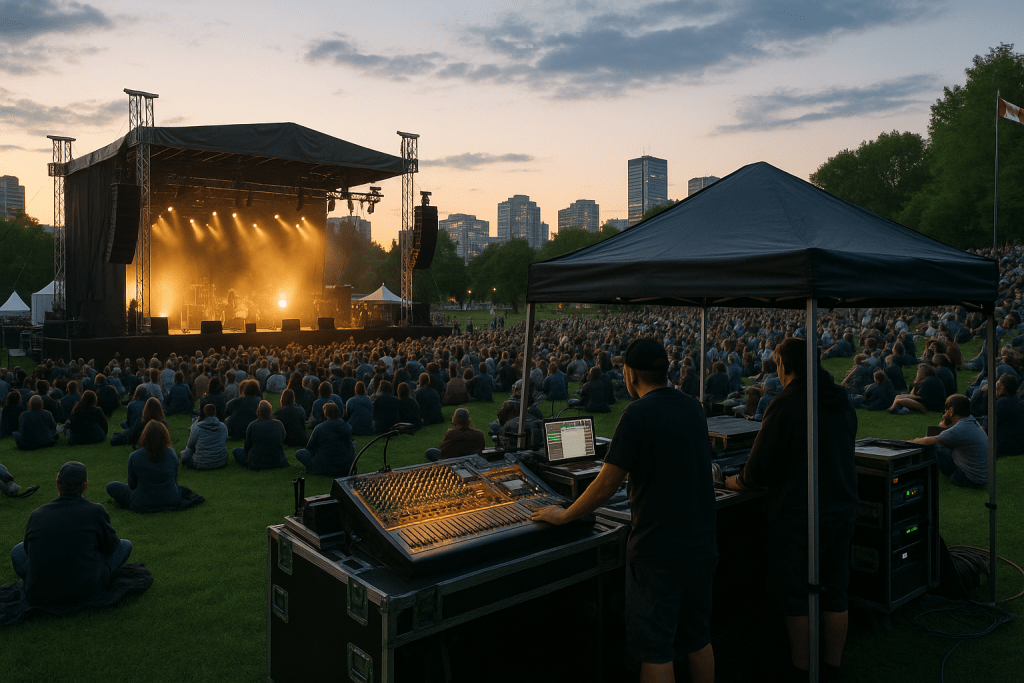
At the Edmonton Folk Music Festival, multi-stage outdoor setups continue to drive demand for scalable audio systems, weather-ready lighting rigs, and streamlined changeovers between acts. Festival crews are relying on networked consoles and distributed PA configurations to maintain consistent coverage across sloped terrain, audience hillsides, and side stages.
Ottawa International Buskerfest, held in a downtown streetscape, faces a different set of production challenges. Here, compact PA systems, portable power solutions, and flexible lighting play a central role. Programmers must balance crowd flow, noise spill between acts, and the visibility needs of performers working in daylight and evening conditions.
In Vancouver’s Light Up Chinatown, organizers are layering cultural programming with architectural lighting, projection elements, and curated soundscapes. The event has become a testing ground for integrating decorative and functional lighting, as well as for managing audio playback and live performance within dense urban blocks.
Across these festivals, production teams are also experimenting with back-of-house improvements: streamlined crew communication, power distribution planning, and load-in/load-out timelines that need to work around city regulations and neighborhood residents. More information about these events and their technical partners can typically be found via their official event sites, such as the Edmonton Folk Music Festival homepage.
Industry impact
For the wider Canadian event technology sector, these festivals serve as real-world laboratories for outdoor and street-based production. Audio-visual suppliers, staging companies, and rental houses are being asked to provide equipment that is not only robust and weather-resistant, but also adaptable to different performance formats.
Music-focused events like the Edmonton Folk Music Festival emphasize full-band reinforcement, monitor mixes, and audience coverage. By contrast, busker and street festivals prioritize portability, speed of setup, and the ability to accommodate wide variations in performance style, from acoustic acts to high-energy circus shows.
Cultural events such as Light Up Chinatown reinforce the importance of lighting as both an experiential and practical tool. Programmable fixtures, projection mapping, and ambient audio can transform existing streetscapes while remaining sensitive to residents, traffic, and local business operations.
Why this matters
For event professionals, these developments underscore the need for adaptable production strategies that can scale from large-ticketed festivals to open, street-level experiences. As Canadian cities host more hybrid cultural and entertainment programs, the pressure grows on AV teams to deliver reliable results within tight physical and regulatory constraints.
Vendors and planners watching these festivals can draw lessons in several areas:
- Designing audio and lighting systems for uneven, outdoor terrain and changing weather.
- Managing crowd circulation and sound spill in urban street environments.
- Integrating decorative lighting and projection into heritage or high-density neighborhoods.
- Coordinating power, cabling, and communication infrastructure around public rights of way.
As audiences return to large-scale gatherings and cities invest in cultural programming, the technical expectations around sound, visibility, and overall production quality continue to rise. The Edmonton Folk Music Festival, Ottawa International Buskerfest, and Light Up Chinatown offer a snapshot of how Canadian organizers are meeting those expectations while experimenting with new tools and approaches.