Future Of Live Event Technology Becomes More Experiential
Future Of Live Event Experience And Attendee Expectation
Live event organizers are rapidly reshaping experiences as attendee expectations shift toward deeper engagement, personalization, and immersive storytelling. The future of live events is defined less by traditional programs and more by continuous experiences that blend physical and digital touchpoints before, during, and after the event.
Across conferences, trade shows, brand activations, and festivals, audiences now expect to participate rather than only observe. This is pushing organizers, agencies, and venues to rethink formats, space design, and technology stacks so that every element supports interaction, discovery, and meaningful connection.
Role Of Event Technology In Experiential Design
Technology has moved from a supporting role into the core of experiential event strategy. Registration, check-in, content delivery, and measurement are increasingly integrated into a single journey that feels intuitive for attendees and data rich for organizers.
Wearables, mobile apps, and sensor-based solutions help map traffic flows, dwell time, and engagement hotspots. This data feeds back into live operations, enabling agile decisions on everything from crowd management to content scheduling, and informs long-term planning for future editions.
Type Of Immersive Tool And Interactive Format
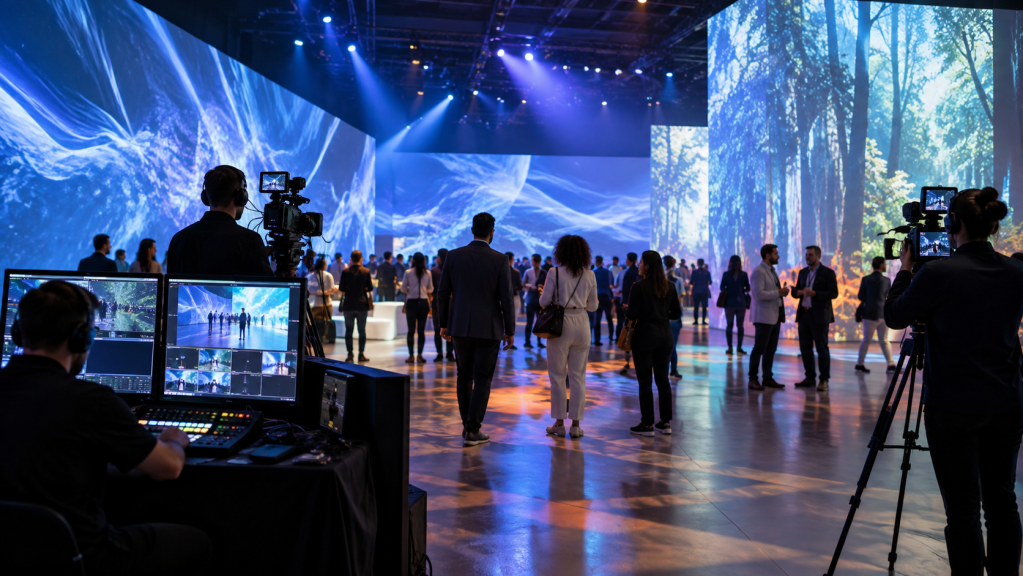
Immersive tools are reshaping how attendees consume and contribute to content. Organizers are experimenting with extended reality environments, interactive installations, and multisensory spaces to create standout moments that deepen memory and emotional impact.
- Projection mapping and dynamic lighting turn ordinary rooms into narrative environments that evolve during the event.
- Interactive touchpoints such as motion tracking, gesture control, and responsive surfaces invite attendees to co-create visual or audio content.
- Audio innovation, including spatial audio zones and silent systems, enables differentiated experiences within the same physical footprint.
These formats encourage exploration and self-directed journeys rather than fixed, one-directional programming, giving each participant a unique path through the event.
Hybrid Format And Persistent Digital Layer
The hybrid format has matured from an emergency response into a deliberate design choice. Many events now consider a digital layer as an always-on extension of the physical experience, supporting remote participation and enhancing on-site interaction.
Live-streamed sessions, companion apps, and on-demand archives allow attendees to move between plenary content, small-group engagement, and self-paced viewing. Networking platforms, matchmaking tools, and chat functions help bridge the gap between on-site and online participants, creating broader communities that outlast the event dates.
Impact On Venue Technology And Spatial Design
As experiences become more experiential, venues are investing in infrastructure that can support complex productions and flexible room configurations. Reliable, high-capacity connectivity is now a baseline requirement, with Wi-Fi and network resilience directly affecting attendee satisfaction and sponsor performance.
Spaces are being designed or retrofitted to enable rapid reconfiguration between plenary, breakout, and experiential zones. Power distribution, rigging capacity, and audiovisual integration are planned with interactive installations, broadcast-quality streaming, and immersive environments in mind.
Integration Of Audiovisual System And Content Workflow
Audiovisual systems are increasingly integrated into unified control and content workflows. Organizers seek setups that support high production values on site while also feeding clean signals to remote audiences and recording workflows.
Flexible stage design, modular LED surfaces, and adaptive lighting rigs allow content teams to reframe spaces quickly for different formats, from keynotes to collaborative workshops. Audio systems are optimized not only for in-room clarity but also for capture and distribution across multiple channels.
Data, Measurement, And Return Of Experience
As budgets face scrutiny, measurement frameworks are expanding beyond attendance numbers to capture the quality of engagement. Organizers are using technology to understand how attendees move, what they interact with, and which sessions or activations sustain attention.
Analytics from access control, app usage, audience response tools, and interactive installations provide a multi-layered picture of behavior. This data helps quantify return on experience for brands, exhibitors, and sponsors, and informs better alignment between program design and business objectives.
Attendee Journey Mapping And Personalization
Mapping the attendee journey across multiple touchpoints is becoming a central planning discipline. From invitation and registration to on-site navigation and post-event follow-up, each step is treated as an opportunity to add relevance and reduce friction.
Personalization strategies use declared preferences and behavioral signals to recommend sessions, highlight relevant exhibitors, and prompt connections. In turn, attendees experience events that feel tailored to their roles, interests, and time constraints, rather than generic one-size-fits-all schedules.
Collaboration Between Stakeholder And Skill Set Evolution
The shift toward more engaging, experiential events is changing how organizers collaborate with agencies, production partners, and venues. Successful projects require close alignment between creative vision, technical feasibility, and operational realities.
Teams are expanding to include specialists in experience design, live broadcast, data analytics, and digital product management alongside traditional roles in production, logistics, and sponsorship. This multidisciplinary approach helps ensure that technology choices support clear outcomes, rather than becoming isolated add-ons.
Future Direction For Live Event Innovation
Looking ahead, innovation in live events will continue to focus on making experiences more participatory, measurable, and inclusive. Organizers are exploring ways to reduce barriers to access, accommodate different learning and engagement styles, and support sustainable operations.
Experimentation with new formats is likely to continue, with smaller, highly curated gatherings, large-scale flagship experiences, and year-round digital communities all playing distinct roles. Underpinning these developments is a shared priority: to design events where people feel actively involved, emotionally connected, and motivated to return.