NFC-Enabled Smart Badges: Streamlining Lead Retrieval and Cashless Payments
Introduction
Event badges have evolved far beyond simple identification cards. Once used primarily to display attendee names and access levels, badges have become intelligent digital interfaces connecting participants with exhibitors, sponsors, venues, and event management platforms. As conferences, exhibitions, trade fairs, and corporate summits continue to embrace digital transformation, Near Field Communication (NFC)-enabled smart badges are emerging as one of the most impactful technologies for simplifying attendee interactions while generating valuable operational data.
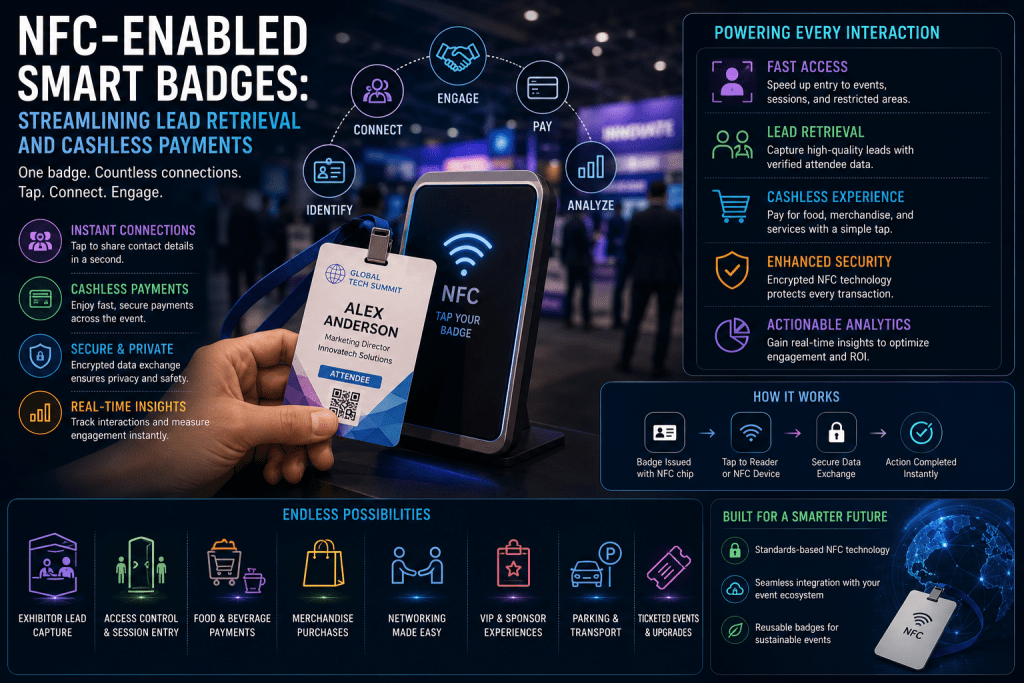
Unlike conventional paper or QR-code badges, NFC smart badges contain embedded wireless chips capable of exchanging encrypted information with compatible readers over short distances. A simple tap enables rapid identity verification, exhibitor lead capture, access control, networking, session tracking, and increasingly, cashless payments throughout the venue.
For event organizers, the technology reduces operational friction while improving analytics and attendee convenience. Exhibitors gain faster, more accurate lead retrieval, while attendees benefit from shorter queues and seamless transactions. However, realizing these advantages requires thoughtful system integration, robust security controls, and careful attention to privacy and payment regulations.
Why Traditional Event Badges Are Reaching Their Limits
Most events still rely on printed badges paired with barcode or QR code scanning. While these approaches are inexpensive and widely supported, they require participants to orient badges correctly, pause for scanning, or manually present credentials.
Lead retrieval often introduces additional inefficiencies. Exhibitors typically scan badges before manually entering notes or qualifying prospects in separate applications, creating fragmented workflows and inconsistent data quality.
Cashless purchases present another challenge. Attendees frequently switch between event badges, mobile wallets, payment cards, and identification documents during food purchases, merchandise sales, or premium session upgrades.
As attendee expectations increasingly mirror frictionless retail and transportation experiences, organizers are seeking technologies capable of reducing these repeated interactions to simple tap-based transactions.
Understanding NFC Technology
Near Field Communication is a short-range wireless communication standard operating at 13.56 MHz, typically within a range of approximately four centimeters. NFC devices exchange encrypted information almost instantly when brought into close proximity.
An event smart badge typically contains:
- An embedded NFC chip
- A unique digital identifier
- Encrypted memory
- Security keys
- Optional access credentials
Unlike RFID systems designed for longer-range identification, NFC requires intentional proximity, reducing accidental reads while giving attendees greater control over interactions.
Modern badges often combine NFC with printed QR codes, Bluetooth Low Energy (BLE), or RFID technologies, allowing organizers to support multiple operational workflows using a single credential.
Lead Retrieval Without Friction
One of the most valuable applications of NFC badges is exhibitor lead capture.
Traditional lead collection often depends on business cards, handwritten notes, or mobile badge scanning applications that introduce delays during conversations.
With NFC-enabled badges, exhibitors simply tap an attendee’s badge against a reader or compatible mobile device.
The interaction can automatically retrieve:
- Name
- Organization
- Professional title
- Contact information
- Registration category
- Industry sector
- Consent preferences
Additional lead qualification workflows can immediately prompt exhibitors to record:
- Product interests
- Purchase timeline
- Budget estimates
- Follow-up priority
- Meeting outcomes
Because attendee information transfers electronically, transcription errors and duplicate records are significantly reduced.
Cashless Payments Across the Venue
Cashless event ecosystems continue expanding as venues seek faster transactions and simplified financial operations.
NFC smart badges enable attendees to purchase:
- Food and beverages
- Merchandise
- Workshop upgrades
- Premium networking events
- Parking
- Locker rentals
- Sponsored experiences
Depending on event design, payments may link to:
- Credit cards
- Mobile wallets
- Prepaid balances
- Corporate expense accounts
- Sponsor credits
- Complimentary allowances
Transactions typically complete within seconds, reducing queue lengths while increasing concession throughput during peak periods.
For organizers, centralized payment systems simplify reconciliation, inventory tracking, and financial reporting.
Technical Architecture
Deploying NFC smart badges requires coordinated integration across multiple event systems.
Badge Management Platform
The badge platform manages credential issuance, attendee identity, permissions, and lifecycle management.
Capabilities typically include:
- Badge activation
- Credential updates
- Lost badge replacement
- Access permissions
- Security monitoring
- Usage history
Cloud-based management enables rapid updates without physically replacing badges.
NFC Readers
Readers may be installed at:
- Registration desks
- Session entrances
- Exhibition booths
- Food vendors
- Access gates
- Hospitality lounges
- Payment terminals
Modern readers often support multiple communication standards, allowing future expansion without replacing hardware.
Event Management Integration
NFC systems should synchronize with:
- Registration platforms
- Customer relationship management systems
- Marketing automation
- Payment gateways
- Session management
- Mobile event applications
- Analytics platforms
Integrated architecture ensures attendee interactions update operational systems in real time.
Operational Benefits
NFC-enabled badges improve several aspects of event operations.
Faster Check-In
Although facial recognition and mobile credentials continue evolving, NFC badges remain one of the fastest methods for high-volume attendee verification at entrances and session rooms.
Improved Lead Quality
Electronic transfer of verified registration data reduces manual entry errors while enabling richer lead qualification workflows.
Better Attendee Analytics
Every authorized badge interaction generates operational intelligence.
Organizers can analyze:
- Session attendance
- Booth visitation
- Networking participation
- Purchase behavior
- Venue traffic
- Dwell time
- Sponsor engagement
These insights support post-event reporting and future event planning.
Simplified Access Control
Permission updates can occur dynamically throughout the event.
VIP upgrades, workshop purchases, speaker access, or staff authorizations become effective immediately without reissuing credentials.
Security and Privacy Considerations
Because NFC badges may contain identity information and payment capabilities, security must remain a design priority.
Encryption
Sensitive badge information should never be stored in plain text.
Modern implementations use encrypted identifiers and tokenized payment credentials rather than exposing personal information directly on the badge.
Authentication
Mutual authentication between badge and reader reduces cloning risks and unauthorized access.
Role-based permissions ensure exhibitors access only information attendees have explicitly agreed to share.
Payment Security
When supporting financial transactions, payment systems should follow established industry security standards.
Tokenization ensures payment credentials are replaced with temporary identifiers, reducing exposure if badge information is intercepted.
Privacy Controls
Attendees should understand:
- What information is shared
- Which exhibitors receive contact details
- How payment information is protected
- How interaction history is retained
- Available consent options
Transparent communication strengthens trust while supporting regulatory compliance.
Challenges and Deployment Considerations
Despite their advantages, NFC deployments require careful operational planning.
Badge distribution and activation workflows must remain efficient to avoid replacing one bottleneck with another.
Lost or damaged badges require rapid replacement procedures that preserve payment balances and access permissions without introducing security vulnerabilities.
Battery-free passive NFC badges offer simplicity and low cost but rely on compatible reader infrastructure throughout the venue.
Organizations must also evaluate interoperability across multiple technology vendors to ensure registration, payments, analytics, and CRM platforms exchange information consistently.
Finally, contingency planning remains essential. Offline operation, network redundancy, and manual fallback procedures should be available to maintain continuity during connectivity disruptions.
Future Trends
NFC badges are increasingly becoming multifunction digital identity devices rather than simple access credentials.
Future implementations are expected to integrate with:
- Digital identity wallets
- Decentralized identity (DID) frameworks
- Mobile credentials
- AI-powered networking recommendations
- Indoor positioning systems
- Real-time personalization engines
Artificial intelligence may also analyze badge interactions during the event to recommend exhibitors, networking opportunities, educational sessions, or dining options tailored to each attendee’s evolving interests.
As open standards mature, NFC badges are likely to become interoperable across recurring conferences, venues, and professional communities, reducing repetitive registration while improving attendee convenience.
Conclusion
NFC-enabled smart badges have transformed from basic identification tools into intelligent digital credentials supporting registration, lead retrieval, cashless payments, access control, networking, and operational analytics. By enabling secure tap-based interactions throughout the venue, they reduce friction for attendees while providing organizers and exhibitors with richer behavioral insights and more efficient workflows. Their greatest value emerges when integrated into broader event technology ecosystems that connect registration platforms, CRM systems, payment gateways, analytics engines, and mobile applications. As organizations continue prioritizing seamless attendee experiences and data-driven event management, NFC smart badges will remain a foundational technology for creating connected, efficient, and increasingly personalized events.