Conference Microphones: Precision Audio Capture for High-Stakes Event Environments

Introduction: Audio as the Backbone of Event Communication
In event environments, audio is not just a support function—it is the primary channel through which content is delivered, interpreted, and experienced. While visual systems capture attention, it is audio clarity that determines comprehension, engagement, and accessibility.
Conference microphones sit at the origin of this audio chain. Their performance directly impacts every downstream system—public address, live streaming, interpretation, recording, and analytics. As events evolve into hybrid, multilingual, and distributed ecosystems, microphone systems must meet higher standards of precision, adaptability, and integration.
Role of Conference Microphones in Event Systems
Conference microphones are engineered for structured communication environments where multiple participants interact within controlled acoustic conditions. Unlike general-purpose microphones, they are optimized for:
- Multi-speaker coordination
- Controlled pickup patterns to reduce noise
- Integration with conferencing and interpretation systems
- Scalability across sessions and venues
They function as input nodes in a broader audio infrastructure.
Microphone Categories and Deployment Strategies
Gooseneck and Podium Microphones
Widely used in conferences and formal settings, these microphones provide directional pickup for individual speakers.
Their design ensures:
- Focused audio capture
- Minimal background interference
- Stable positioning for consistent output
They are ideal for keynote sessions and formal presentations.
Lavalier and Handheld Wireless Microphones
Wireless systems enable mobility and flexibility.
- Lavalier microphones support hands-free presentation
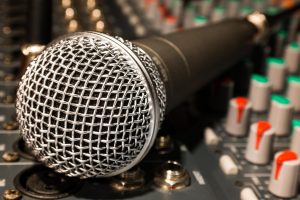
- Handheld microphones are suited for audience interaction and Q&A
These systems require spectrum management to avoid interference, especially in large events.
Boundary and Tabletop Microphones
Boundary microphones capture sound across a surface area, making them suitable for panel discussions and meetings.
Integrated tabletop units may include:
- Microphone elements
- Speaker outputs
- Control interfaces (e.g., mute, voting)
They are commonly used in governance and structured discussions.
Ceiling Arrays and Beamforming Systems
Advanced deployments use ceiling-mounted microphone arrays with beamforming technology.
These systems:
- Dynamically focus on active speakers
- Track movement within a room
- Reduce the need for individual microphones
They are particularly effective in hybrid collaboration environments.
System Architecture: Audio Signal Flow
Conference microphones operate within a multi-stage audio processing pipeline.
Capture and Preprocessing
Microphones convert acoustic signals into electrical signals. Preprocessing includes:
- Gain staging for consistent levels
- Noise suppression to remove ambient sounds
- Echo cancellation for hybrid setups
This stage ensures signal clarity before processing.
Digital Signal Processing (DSP)
DSP systems refine and manage audio inputs.
Core functions include:
- Automatic mixing of multiple microphones
- Equalization for tonal balance
- Feedback suppression
DSP enables stable performance in complex environments.
Routing and Distribution
Processed audio is routed to multiple outputs:
- PA systems for in-room amplification
- Streaming platforms for remote audiences
- Interpretation systems for multilingual delivery
- Recording systems for archival and analytics
This requires synchronized and latency-controlled distribution.
Monitoring and Control
Operators monitor audio quality in real time using:
- Audio meters and diagnostics
- Headphone monitoring
- Automated alert systems
Continuous monitoring ensures consistency and rapid issue resolution.
Integration with Event Technology Ecosystems
Conference microphones are tightly integrated with broader event systems.
In hybrid events, audio feeds must synchronize with video streams. In multilingual environments, audio is routed into interpretation pipelines.
Integration with event data platforms enables:
- Speech-to-text transcription
- Real-time captioning
- Content indexing and searchability
Microphones also contribute to analytics, such as speaker engagement and participation patterns.
Operational and Experience Impact
The quality of microphone systems directly influences event outcomes.
For attendees, clear audio ensures understanding and sustained engagement. For virtual participants, it is often the primary connection to the event.
For speakers, reliable audio systems enable confidence and fluid delivery. For organizers, they ensure consistency across sessions and formats.
From a business perspective, audio quality is closely tied to perceived professionalism and event success.
Technical Challenges
Conference microphone systems must operate within complex acoustic environments.
Challenges include:
- Room acoustics affecting clarity and feedback
- Wireless spectrum congestion in large events
- Latency in hybrid and interpreted setups
- Scalability across multiple rooms and sessions
Addressing these requires careful design, calibration, and management.
Future Outlook: Intelligent and Adaptive Audio Systems
The evolution of conference microphones is moving toward intelligent systems.
AI-driven processing will enhance:
- Speaker identification and tracking
- Automatic mixing and noise suppression
- Context-aware audio optimization
Beamforming and spatial audio technologies will further improve clarity and immersion.
Integration with analytics and AI systems will transform audio from a transmission medium into a source of actionable insights.
Conclusion: Engineering Clarity at the Source
Conference microphones are the starting point of the event communication pipeline. Their performance determines the effectiveness of every downstream system.
In modern event ecosystems, they must deliver more than sound—they must integrate seamlessly, adapt dynamically, and support diverse use cases.
For event technology leaders, investing in advanced microphone systems is essential to ensuring clear, reliable, and scalable communication across increasingly complex event environments.