AI-Powered Noise Suppression Microphones for Flawless Hybrid Panel Discussions
Introduction
Hybrid panel discussions have become a defining feature of modern conferences, corporate events, academic symposiums, and government forums. By connecting in-person speakers with remote participants and global audiences, these sessions expand accessibility while enabling organizations to engage experts regardless of their location. However, hybrid formats also introduce complex audio challenges that can undermine the attendee experience. Background conversations, HVAC systems, keyboard typing, audience noise, microphone handling, venue reverberation, and inconsistent speaker positioning often reduce speech clarity, particularly for remote attendees who depend entirely on audio quality.
Unlike video imperfections, poor audio has an immediate impact on comprehension and engagement. Listeners are more likely to become fatigued, miss critical information, or disengage entirely when speech competes with environmental noise. Traditional microphones equipped with basic noise filters provide limited improvement in dynamic event environments where acoustic conditions change continuously.
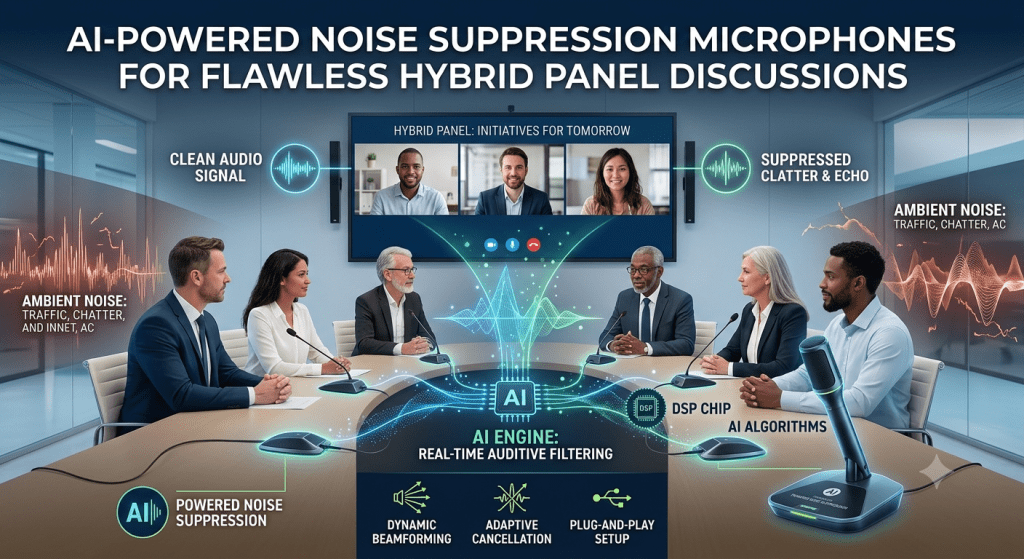
AI-powered noise suppression microphones address these challenges by combining advanced microphone hardware with machine learning, digital signal processing (DSP), and real-time acoustic analysis. Rather than simply filtering sound, these intelligent systems distinguish human speech from unwanted noise, adapt automatically to changing environments, and deliver clearer audio for both in-person and virtual audiences.
For event technology professionals, AI-enhanced microphones have become a key component of reliable hybrid event infrastructure, improving communication quality while reducing the operational burden on audio engineers.
Why Hybrid Panel Discussions Present Unique Audio Challenges
Unlike keynote presentations involving a single speaker, hybrid panels include multiple participants with varying speaking styles, microphone positions, and acoustic conditions.
Common sources of interference include:
- Audience conversations
- Air conditioning systems
- Projectors and cooling fans
- Laptop keyboards
- Paper handling
- Microphone movement
- Room reverberation
- Cross-talk between panelists
Remote speakers may also join from home offices, airports, hotel rooms, or coworking spaces where environmental noise is unpredictable.
Maintaining consistent speech quality across these diverse conditions requires far more than conventional audio processing.
How AI-Powered Noise Suppression Works
Modern AI microphones use neural networks trained on extensive datasets containing human speech alongside thousands of environmental noise profiles.
Instead of reducing all background sound equally, AI algorithms classify incoming audio into categories such as:
- Human speech
- Mechanical noise
- Crowd activity
- Wind
- Keyboard typing
- Vehicle traffic
- HVAC systems
- Electrical interference
The system preserves speech frequencies while suppressing competing sounds in real time, often within just a few milliseconds.
This selective approach maintains natural vocal characteristics without producing the artificial artifacts associated with aggressive traditional noise filters.
Core Technology Architecture
Successful AI-powered microphone systems combine several complementary technologies.
Multi-Microphone Arrays
Many professional conference microphones incorporate multiple microphone elements.
Beamforming techniques compare signals from each element to determine the speaker’s direction while reducing sounds arriving from other angles.
Advantages include:
- Improved voice isolation
- Reduced room reflections
- Better audience rejection
- Consistent speech pickup
- Greater microphone flexibility
Beamforming becomes particularly valuable when panelists move naturally while speaking.
Digital Signal Processing
DSP provides the foundation for real-time audio enhancement.
Typical processing includes:
- Noise suppression
- Echo cancellation
- Automatic gain control
- Equalization
- Feedback prevention
- Dynamic compression
- Frequency optimization
These adjustments occur continuously without requiring manual intervention from sound engineers.
Machine Learning Models
AI extends traditional DSP through adaptive decision-making.
Machine learning models continuously evaluate:
- Background noise levels
- Speaker activity
- Voice characteristics
- Acoustic reflections
- Microphone handling noise
- Environmental changes
Rather than applying fixed settings, the system modifies suppression parameters dynamically throughout the event.
Intelligent Voice Detection
Voice Activity Detection (VAD) has become significantly more accurate through AI.
Instead of relying solely on volume thresholds, intelligent systems recognize linguistic and acoustic patterns associated with human speech.
Benefits include:
- Faster microphone activation
- Reduced clipping
- Lower false triggers
- Improved speech continuity
- More natural transitions between speakers
This is particularly valuable during lively panel discussions where interruptions and overlapping dialogue frequently occur.
Enhancing Remote Participation
Hybrid events depend heavily on delivering equal experiences for remote attendees.
AI-powered microphones improve remote participation by reducing distractions that would otherwise dominate compressed online audio streams.
Remote participants benefit from:
- Clearer speech intelligibility
- Reduced listening fatigue
- Improved transcription accuracy
- Better multilingual translation
- Higher caption quality
- More reliable meeting recordings
These improvements also enhance the performance of AI-powered meeting assistants and automated documentation tools.
Integration with Event Technology Platforms
AI microphones achieve maximum value when integrated into the broader event technology ecosystem.
Audio Mixing Consoles
Digital mixers receive cleaner input signals, allowing engineers to focus on creative mixing rather than extensive corrective processing.
Video Production Systems
Higher-quality audio improves livestreams, broadcast recordings, and on-demand session libraries while reducing post-production editing requirements.
Automatic Transcription Services
Speech recognition engines perform more accurately when background noise has already been minimized.
This improves:
- Live captions
- Searchable transcripts
- AI-generated summaries
- Meeting documentation
- Accessibility compliance
Collaboration Platforms
Platforms supporting remote speakers, audience questions, and virtual networking benefit from improved communication quality across every interaction.
Measuring Performance
Evaluating intelligent microphone systems requires objective performance metrics.
Common indicators include:
- Signal-to-noise ratio (SNR)
- Speech Transmission Index (STI)
- Word recognition accuracy
- Background noise reduction
- Echo suppression effectiveness
- Latency
- Voice consistency
- Participant satisfaction
Combining technical measurements with attendee feedback provides a comprehensive assessment of system performance.
Implementation Best Practices
Although AI simplifies audio management, successful deployment still requires thoughtful planning.
Microphones should be positioned to maximize direct speech pickup while minimizing unnecessary environmental exposure.
Panelists should receive basic microphone guidance regarding speaking distance and orientation.
Wireless systems should be coordinated carefully to avoid radio frequency interference during large events.
Networked audio systems should also maintain sufficient bandwidth and redundancy to support real-time AI processing without introducing unacceptable latency.
Regular firmware updates ensure machine learning models remain optimized as manufacturers continue improving noise classification algorithms.
Challenges and Considerations
AI-powered suppression is highly effective but not infallible.
Extremely loud environments, overlapping conversations, or rapidly changing sound conditions may occasionally reduce speech quality.
Aggressive suppression settings can also remove subtle vocal nuances if systems are poorly configured.
Privacy considerations deserve attention as well. Some cloud-based AI processing solutions transmit audio for remote analysis, requiring organizations to evaluate data security, regulatory compliance, and participant consent—particularly during corporate board meetings or government events involving sensitive discussions.
Whenever possible, edge-based AI processing provides lower latency while keeping audio data within the local event infrastructure.
Future Trends
The next generation of intelligent microphones is expected to become increasingly context aware.
Emerging capabilities include:
- Speaker identification
- Automatic language detection
- Emotion-aware speech enhancement
- Personalized audio profiles
- Adaptive beam steering
- AI-controlled microphone switching
- Edge AI processing
- Integration with digital twins of event venues
Future hybrid platforms may automatically optimize each participant’s audio based on room geometry, audience density, and meeting format without requiring manual configuration.
As generative AI continues advancing, microphones may also integrate directly with real-time translation, meeting summarization, and collaborative knowledge management systems, creating unified communication ecosystems for global events.
Conclusion
AI-powered noise suppression microphones are transforming hybrid panel discussions by delivering clearer, more consistent speech across complex and unpredictable event environments. Through the integration of machine learning, beamforming, digital signal processing, intelligent voice detection, and seamless event platform connectivity, these systems significantly improve communication for both in-person and remote participants. While thoughtful deployment and professional audio engineering remain essential, AI-driven microphones reduce background distractions, enhance accessibility, improve transcription accuracy, and support more engaging hybrid experiences. As event technology continues evolving toward intelligent, adaptive communication systems, AI-powered microphones will become indispensable tools for delivering flawless panel discussions and high-quality audience experiences.