
Types of Audience Response Systems: Clickers vs. Mobile Apps

Audience Response Systems (ARS) have evolved significantly over the years, providing more interactive and engaging experiences in educational, corporate, and event settings. The two primary types of Audience Response Systems are clickers and mobile apps. This article delves into the technical differences, advantages, and disadvantages of these two systems, aiming to help organizations choose the most suitable option for their specific needs.
What is an Audience Response System?
An Audience Response System is a technology solution that enables real-time communication between presenters and their audience. These systems are commonly used in lectures, conferences, corporate training, and public events to collect immediate feedback, conduct polls, and measure audience understanding. The core objective of an Audience Response System is to foster engagement, enhance participation, and provide data-driven insights for decision-making. The two prevalent types of ARS are clicker-based systems and mobile app-based systems.
Clicker-Based Audience Response Systems
Clickers, also known as keypads or handsets, are dedicated handheld devices distributed among the audience to submit responses. These responses are transmitted via infrared (IR) or radio frequency (RF) signals to a receiver connected to the presenter’s computer. Clickers were among the first widely adopted forms of ARS and are still popular in environments where reliable internet connectivity is an issue or where mobile devices are restricted.
Technical Components
- Hardware: Clickers consist of a set of handheld devices, each with a unique identification number. The devices typically feature buttons corresponding to multiple-choice answers or numeric responses.
- Receiver: The receiver unit is connected to a computer or other display systems. It collects the signals sent by the clickers, aggregates the data, and displays the results.
- Software: Specialized software processes the collected data, interprets the responses and presents the results visually on a screen in real-time.

Key Features
- Ease of Use: Clickers are designed to be user-friendly, with minimal functionality and simple buttons for easy navigation.
- Reliability: Clickers work independently of internet connectivity, which ensures consistent performance in areas with poor or no network access.
- Security: With limited functionality, clickers offer a secure response method, reducing the risk of unauthorized access or data breaches.
- Durability: These devices are generally robust and can be reused multiple times, making them a cost-effective choice for long-term use.

Advantages and Disadvantages
| Advantages of Clicker-Based ARS | Disadvantages of Clicker-Based ARS |
| Reliable in offline environments | Requires purchase and maintenance of hardware |
| Easy to use, especially for non-tech-savvy users | Limited to multiple-choice and numeric responses |
| High security, with no data stored on the device | No support for open-ended or text responses |
| Minimal setup and deployment complexity | Potential logistic challenges in distribution and collection |
Mobile App-Based Audience Response Systems
Mobile app-based Audience Response Systems leverage smartphones, tablets, or other internet-enabled devices to facilitate audience engagement. Participants download an app or use a web-based platform to submit their responses, which are then processed and displayed in real-time. This type of ARS has gained popularity due to the widespread use of mobile devices and advancements in app development.
Technical Components
- Smart Devices: The system relies on participants using their personal or provided smartphones, tablets, or laptops to connect to the ARS.
- App or Web Platform: Participants interact through a mobile app or web-based platform that supports various response types, including multiple-choice, text input, and multimedia.
- Cloud or Local Server: Responses are transmitted over the internet to a cloud or local server, where they are processed and aggregated.
- Software Interface: The collected data is visualized through software that offers customizable display options, analytics, and reporting tools.

Key Features
- Versatility: Mobile apps support a wide range of question types, including multiple-choice, open-ended, and image-based responses.
- Scalability: Capable of supporting large audiences without additional hardware investments.
- Real-Time Analytics: Offers advanced data processing and analytics features that provide instant feedback and insights.
- Integration: Can be integrated with existing systems, such as Learning Management Systems (LMS), Customer Relationship Management (CRM), and event management platforms.

Advantages and Disadvantages
| Advantages of Mobile App-Based ARS | Disadvantages of Mobile App-Based ARS |
| Supports a wide range of response types | Requires internet connectivity |
| Scalable for large or remote audiences | Dependence on participant devices and app downloads |
| Provides advanced analytics and reporting tools | Security concerns over data transmission |
| Enables rich media integration (images, videos) | Possible technical issues with device compatibility |
Key Differences Between Clickers and Mobile Apps
1. Connectivity Requirements
- Clickers: Operate independently of internet connectivity, using RF or IR signals for data transmission. This makes them suitable for areas with limited or no network coverage.
- Mobile Apps: Depend on internet connectivity for transmitting data to a cloud or local server. They require a stable and reliable network for optimal performance.
2. Response Types
- Clickers: Primarily support multiple-choice or numeric responses due to their limited button configurations.
- Mobile Apps: Offer extensive options, including multiple-choice, open-ended text, image-based responses, and multimedia integration.
3. Scalability
- Clickers: Are limited by the number of devices available and may require significant logistical efforts for distribution and collection.
- Mobile Apps: This can support an unlimited number of participants as long as they have access to a compatible device and internet connectivity.
4. Data Security and Privacy
- Clickers: Provide higher security for sensitive or confidential information since no data is stored on the device and no internet connection is involved.
- Mobile Apps: Data transmission over the Internet introduces security risks such as potential breaches, unauthorized access, or data loss. However, robust encryption and security protocols can mitigate these risks.
When to Use Clickers or Mobile Apps?
Situations Favoring Clicker-Based ARS
- No Internet Access: Clickers are ideal in locations with limited or no internet connectivity.
- Security Concerns: When handling sensitive information, clickers offer a secure method of data collection.
- Ease of Use: In scenarios with a technologically diverse audience, clickers provide a simple way to gather responses.
- Fixed Budgets: For institutions with a one-time budget for ARS technology, clickers may offer a cost-effective solution.
Situations Favoring Mobile App-Based ARS
- Dynamic and Large Audiences: Mobile apps can easily scale to accommodate thousands of participants.
- Advanced Features Required: When the event demands more sophisticated features like multimedia integration, open-ended responses, or live data analytics, mobile apps provide a broader range of functionalities.
- Frequent Use Across Multiple Locations: Mobile apps eliminate the need for logistical handling of hardware, making them suitable for frequent use in various locations.
- Integration with Digital Platforms: When integration with other digital tools or platforms is essential, mobile apps provide more flexibility.
Key Criteria for Selecting an Audience Response System
- Budget Constraints: Determine the available budget for the ARS, considering both initial investment and long-term maintenance costs.
- Audience Size and Type: Assess the typical size and diversity of your audience to choose a system that can handle your requirements.
- Venue and Connectivity: Evaluate the venues where the ARS will be used and their internet connectivity capabilities.
- Required Features: List the desired features, such as real-time analytics, response types, integration capabilities, and security protocols.
- Security and Compliance Needs: Understand the data privacy laws and compliance requirements that apply to your organization or event.
- Ease of Use and Adoption: Consider the technological proficiency of your audience and the learning curve associated with each system.

Steps to Implement an Audience Response System
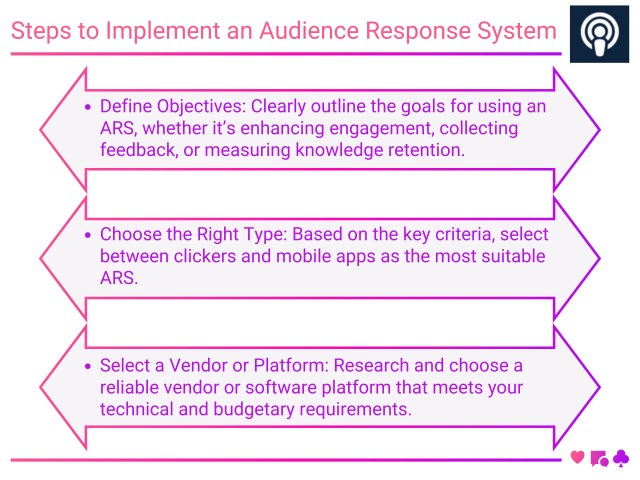
- Define Objectives: Clearly outline the goals for using an ARS, whether it’s enhancing engagement, collecting feedback, or measuring knowledge retention.
- Choose the Right Type: Based on the key criteria, select between clickers and mobile apps as the most suitable ARS.
- Select a Vendor or Platform: Research and choose a reliable vendor or software platform that meets your technical and budgetary requirements.
- Test and Configure: Conduct a pilot test to ensure the system functions correctly in the intended environment. Configure any necessary settings or integrations.
- Train Users: Provide training sessions for both presenters and participants to familiarize them with the system.
- Deploy and Monitor: Implement the ARS during your event, continuously monitoring performance and collecting data for analysis.
- Evaluate and Optimize: After the event, review the collected data and feedback to assess the system’s effectiveness and make necessary adjustments for future use.
Types of Audience Response Systems: Clickers vs. Mobile Apps Summary
Choosing the right Audience Response System depends on various factors such as audience size, budget, venue, and desired features. Clickers are reliable, secure, and easy to use, making them suitable for offline environments with strict security needs. On the other hand, mobile app-based ARS offers versatility, scalability, and advanced features for dynamic and tech-savvy audiences. Understanding the key differences and specific use cases of each system will help organizations make informed decisions to enhance their event engagement and achieve their objectives.
By evaluating these factors carefully, organizations can ensure they select an Audience Response System that maximizes participation, engagement, and data-driven decision-making.
Academic Reference On Types of Audience Response Systems: Clickers vs. Mobile Apps
- [PDF] Replacement of a clicker system by a mobile device audience response system
- Audience response systems: Using “clickers” to enhance BSW education
- Evidence-based clicker use: audience response systems for rehabilitation nurses
- Clickers versus pickers: comparing two audience response systems in a smartphone-free teaching environment
- A meta-analysis of the effects of audience response systems (clicker-based technologies) on cognition and affect
- Audience response systems reimagined
- [PDF] Audience Response Systems in higher education courses: A critical review of the literature
- Applications of an Online Audience Response System in Different Academic Settings: An Empirical Study
- The advantages of combining mobile technology and audience response systems
- Tips for using mobile audience response systems in medical education

