Kygo world tour adopts Sennheiser Spectera for hybrid in-ear monitoring
Background and context
In-ear monitoring has become a critical part of modern live production, particularly for stadium and arena tours that place heavy demands on RF spectrum, routing flexibility, and low-latency monitoring. As productions grow more complex, engineers are looking for systems that combine robust RF performance with the flexibility of digital audio networks.
Norwegian DJ and producer Kygo is currently on a world tour with a large-scale stage and multimedia show. The production relies on advanced monitoring to keep performers in sync with timecode-driven lighting, video, and playback elements. This tour is one of the first high-profile deployments of Spectera, a new in-ear monitoring solution from Sennheiser that aims to bridge traditional RF workflows and IP-based audio.
Spectera is positioned as a hybrid system that keeps the established RF transmission on the artist side while introducing modern networking on the infrastructure side. For touring audio teams, this is intended to reduce complexity and cabling while offering more flexible routing and control.
Key announcement
Sennheiser has confirmed that Kygo’s world tour is using its Spectera system as the central in-ear monitoring platform for artists and crew. According to the manufacturer, the production is running a multi-channel setup that integrates with the tour’s existing Dante network and digital consoles.
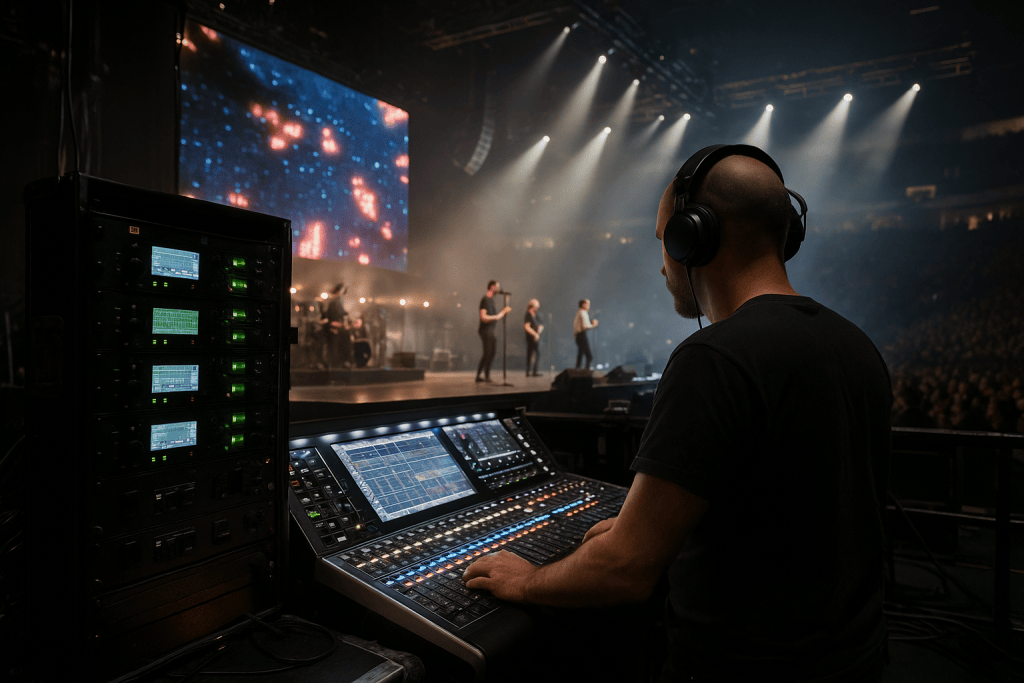
In this configuration, audio is routed from the consoles into the IP-based backbone, then into the Spectera transmit system, and finally over RF to performers’ bodypacks. The system is designed to support high channel counts, which is increasingly important on large productions where multiple musicians, playback rigs, and click tracks all require independent monitor mixes.
The tour’s monitoring team reportedly selected Spectera for its ability to consolidate what would otherwise be separate analogue and digital signal paths. By using a networked approach, engineers can adjust mixes, reassign channels, and manage frequencies from a central control point, while still delivering RF in-ears that performers are familiar with.
Industry impact
Hybrid solutions like Spectera reflect a broader shift in live sound, where many systems are moving to IP-based infrastructures without fully abandoning RF for stage monitoring. For touring engineers, this kind of system architecture can streamline load-in, reduce cabling, and make it easier to scale shows across different venue sizes.
For venues and rental companies, a move toward network-centric in-ear monitoring may simplify integration with existing Dante or other audio-over-IP deployments. It also opens possibilities for centralized control rooms and remote diagnostics, which are increasingly relevant for large festivals and multi-stage events.
The Kygo tour provides a real-world test environment under demanding conditions: long travel schedules, varying RF conditions, and complex show design. Successful use on such a tour may accelerate adoption among other touring acts and production companies seeking similar workflows.
Why this matters
For the event technology and live sound community, the adoption of Sennheiser Spectera on a major world tour highlights how in-ear monitoring is evolving. Rather than a complete break from existing RF practices, the system demonstrates a transitional model that connects IP audio infrastructure with familiar RF endpoints.
Monitoring workflows are often a bottleneck in show design; they require coordination across consoles, RF coordination, and production planning. Systems that reduce physical complexity and offer flexible routing can help crews adapt more quickly to last-minute changes in setlists, guest performers, or stage layouts.
As more productions incorporate time-synced video, immersive lighting, and complex playback, reliable and adaptable in-ear monitoring becomes essential. Solutions like Spectera, as described on Sennheiser’s official product information pages at sennheiser.com, indicate where the market is heading: toward networked, scalable systems that still accommodate the realities of RF on stage.
For event professionals, following these developments can inform investment decisions in touring rigs, venue upgrades, and rental inventories, especially as IP-based workflows continue to expand across the live events sector.