The Impact of Deep Learning on Zero-Latency Simultaneous Interpretation
Introduction
Global conferences, multinational corporate meetings, government summits, trade exhibitions, and hybrid events increasingly bring together participants who speak different languages. Simultaneous interpretation has long been the preferred solution for overcoming language barriers, traditionally relying on highly skilled human interpreters working from soundproof booths with specialized audio equipment. While this approach continues to provide exceptional linguistic accuracy, scaling interpretation across dozens of languages, multiple sessions, and distributed audiences remains expensive and operationally complex.
Recent advances in deep learning have fundamentally changed the landscape of multilingual event communication. Neural speech recognition, transformer-based language models, neural machine translation (NMT), and AI-powered speech synthesis now enable interpretation pipelines capable of translating spoken language in near real time. Although truly zero-latency interpretation is constrained by the natural timing of human speech and computational processing, modern AI systems have reduced delays to the point where conversations can flow with minimal interruption, significantly improving multilingual participation in live events.
For event technology professionals, deep learning is not replacing interpreters entirely. Instead, it is creating intelligent interpretation ecosystems that combine AI-driven automation with human oversight to improve scalability, accessibility, and audience engagement across increasingly global event environments.
Why Traditional Simultaneous Interpretation Faces New Challenges
Conventional interpretation workflows require extensive logistical planning.
A typical multilingual conference involves:
- Professional interpreters
- Interpretation booths
- Audio consoles
- Language distribution systems
- Wireless receivers
- Technical operators
- Dedicated audio channels
As events expand internationally, supporting additional languages requires proportional increases in personnel and equipment.
Hybrid events further complicate operations because remote participants expect interpretation quality comparable to onsite attendees. Coordinating interpreters across physical venues and virtual platforms introduces additional latency, synchronization, and scheduling challenges.
Deep learning helps automate portions of this workflow while reducing operational complexity.
Understanding the Deep Learning Interpretation Pipeline
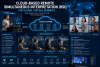
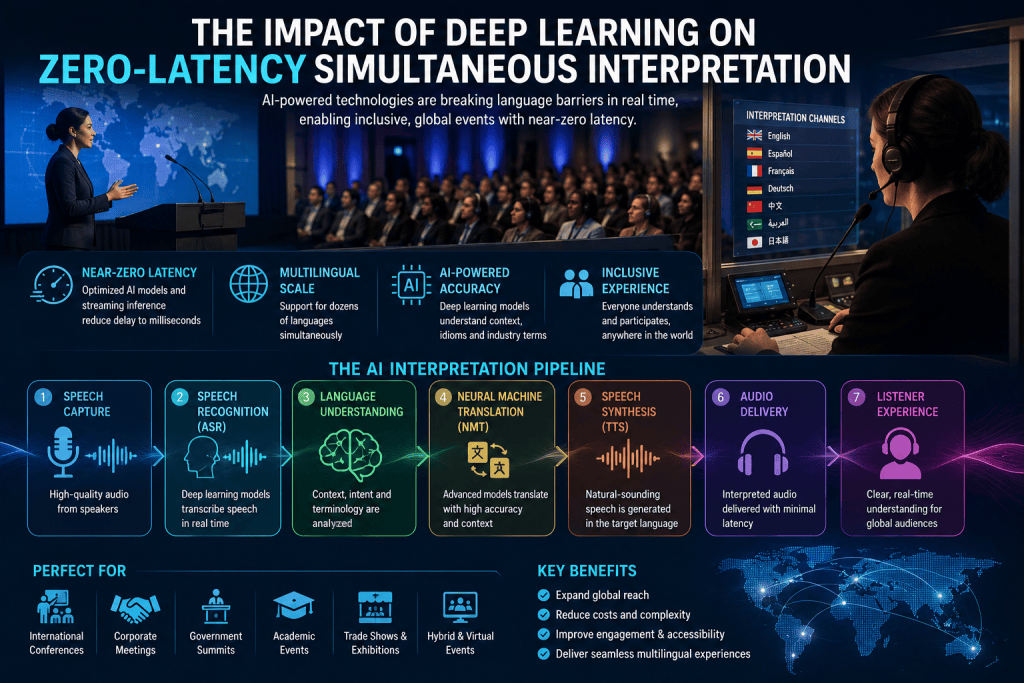
Modern AI interpretation systems rely on multiple neural networks working together rather than a single translation model.
A typical processing pipeline includes:
- Automatic speech recognition (ASR)
- Speaker segmentation
- Language identification
- Neural machine translation
- Context optimization
- Speech synthesis
- Audio distribution
Each stage contributes to producing intelligible multilingual audio with minimal delay.
Rather than translating isolated words, modern architectures process linguistic context to preserve meaning, grammar, and conversational intent.
Automatic Speech Recognition
Accurate transcription forms the foundation of AI interpretation.
Deep learning models trained on extensive multilingual speech datasets recognize spoken language while accounting for:
- Regional accents
- Speaking speed
- Background noise
- Multiple speakers
- Technical terminology
- Industry-specific vocabulary
Transformer-based ASR systems significantly outperform earlier statistical approaches by modeling long-range linguistic relationships across complete utterances.
Improved transcription directly increases downstream translation quality.
Neural Machine Translation
Once speech has been transcribed, Neural Machine Translation converts text into the target language.
Unlike phrase-based translation systems that processed language in small fragments, deep learning models evaluate complete sentence context.
Modern transformer architectures provide improvements in:
- Grammatical accuracy
- Context preservation
- Terminology consistency
- Idiomatic expression handling
- Domain adaptation
- Multilingual scalability
For technical conferences, translation models can also incorporate custom terminology dictionaries covering product names, pharmaceutical compounds, engineering concepts, or legal terminology.
Neural Speech Synthesis
The final interpretation stage converts translated text into natural-sounding speech.
Recent advances in neural text-to-speech (TTS) generate voices with improved:
- Pronunciation
- Intonation
- Rhythm
- Emotional expression
- Speaker consistency
- Listening comfort
These improvements reduce listener fatigue compared with earlier robotic synthetic voices.
Some platforms also preserve speaker characteristics such as pacing and emphasis, creating more natural multilingual experiences.
Achieving Near-Zero Latency
Although “zero latency” is an aspirational term, modern systems minimize delay through several optimization techniques.
Incremental Processing
Rather than waiting for complete sentences, AI systems begin processing partial speech segments as they are spoken.
Translation continuously updates as additional context becomes available.
Streaming Neural Inference
Optimized inference engines execute deep learning models continuously on streaming audio instead of processing recordings after completion.
GPU acceleration, edge AI hardware, and optimized transformer architectures significantly reduce computational delays.
Predictive Language Modeling
Deep learning models anticipate probable sentence continuations using contextual prediction.
When predictions prove correct, translated speech can begin even before speakers complete their statements.
Careful confidence thresholds remain essential to avoid introducing translation errors.
Integration with Event Technology Platforms
Deep learning interpretation systems deliver maximum value when integrated into broader event ecosystems.
Hybrid Event Platforms
Remote attendees select preferred languages through virtual event interfaces.
AI interpretation streams synchronize automatically with live presentations, minimizing manual configuration.
Mobile Event Applications
Participants access multilingual audio through smartphones using Wi-Fi or cellular networks, reducing dependence on dedicated interpretation receivers.
Captioning Systems
Speech recognition outputs simultaneously generate multilingual captions displayed on venue screens and livestream interfaces.
This improves accessibility for participants who prefer reading translations rather than listening.
Event Analytics
Interpretation platforms provide valuable operational insights, including:
- Language selection trends
- Listening duration
- Translation quality metrics
- Session popularity by region
- Caption usage
- Audience engagement
These analytics support future localization strategies and resource planning.
Operational Benefits
Deep learning significantly expands multilingual event capabilities.
Greater Language Coverage
Organizations can support more languages without requiring proportional increases in interpreter staffing.
Faster Deployment
Cloud-based AI services reduce infrastructure requirements while enabling multilingual support for smaller events.
Improved Accessibility
Participants with hearing impairments benefit from synchronized multilingual captions alongside interpreted audio.
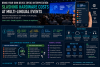
Lower Operational Costs
Although professional interpreters remain essential for many high-stakes events, AI reduces costs associated with routine multilingual communication and secondary language support.
Challenges and Limitations
Despite remarkable progress, deep learning interpretation remains imperfect.
Specialized terminology, humor, sarcasm, cultural references, and rapidly changing conversations continue to present challenges.
Speaker overlap, poor microphone quality, strong accents, and venue noise may also reduce recognition accuracy.
Latency itself cannot be eliminated entirely. Human speakers naturally produce information sequentially, requiring AI systems to balance translation speed with contextual accuracy.
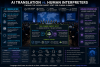
Consequently, many enterprise events adopt human-in-the-loop workflows where professional interpreters supervise or refine AI-generated translations during critical sessions.
Data privacy represents another important consideration. Cloud-based interpretation services process spoken conversations that may contain confidential business or government information.
Organizations should evaluate encryption, regional data residency, and regulatory compliance before selecting interpretation providers.
Future Trends
Deep learning continues advancing rapidly.
Future interpretation platforms are expected to integrate:
- Multimodal AI combining speech, gestures, and presentation content
- Personalized voice cloning with participant consent
- Emotion-aware speech synthesis
- Edge AI for offline interpretation
- Context-aware terminology adaptation
- AI-assisted interpreter support tools
Large Language Models (LLMs) may also improve long-form conversational understanding by maintaining context across entire meetings rather than individual sentences.
As inference hardware becomes faster and more energy efficient, interpretation delays will continue shrinking while maintaining higher linguistic accuracy.
Conclusion
Deep learning is transforming simultaneous interpretation from a resource-intensive service into an intelligent, scalable component of modern event technology platforms. By combining neural speech recognition, transformer-based machine translation, streaming inference, and advanced speech synthesis, AI-powered systems enable multilingual communication with increasingly low latency and high contextual accuracy. While professional human interpreters remain indispensable for diplomatic negotiations, legal proceedings, and other high-stakes discussions, deep learning dramatically expands multilingual accessibility for conferences, exhibitions, corporate events, and hybrid experiences. As AI models continue improving and integrate more deeply with event platforms, near-real-time interpretation will become an essential capability for organizations seeking to deliver truly global and inclusive events.