Spatial Audio Pods: Creating Private Networking Zones in Bustling Expo Halls
Introduction
Networking is one of the primary reasons professionals attend trade shows, exhibitions, corporate summits, and industry conferences. While keynote presentations and product demonstrations attract attendees, meaningful business relationships are often built through one-on-one conversations that take place throughout the exhibition floor. However, modern expo halls are inherently noisy environments. Simultaneous product demonstrations, public announcements, stage presentations, and thousands of conversations combine to create high ambient noise levels that make confidential discussions difficult.
Traditional meeting rooms provide privacy but remove participants from the dynamic exhibition environment, while open networking lounges rarely offer sufficient acoustic isolation for productive conversations. As organizations increasingly prioritize lead generation, partnership discussions, recruitment, and executive meetings during events, there is growing demand for flexible spaces that support private communication without sacrificing accessibility.
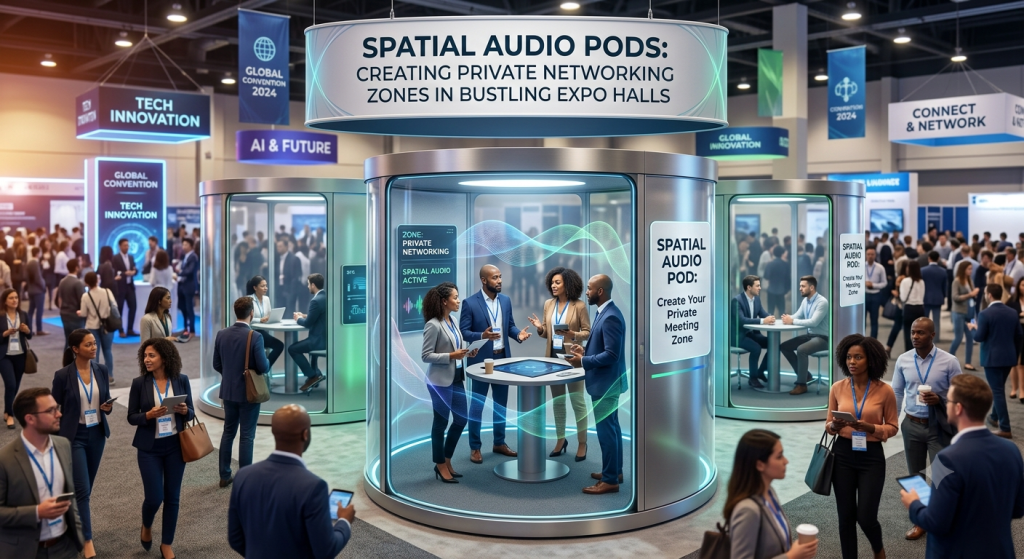
Spatial audio pods address this challenge by combining directional loudspeakers, beamforming technology, acoustic engineering, sound masking, and intelligent environmental sensing to create localized listening environments within otherwise crowded venues. Instead of enclosing participants inside permanent structures, these systems establish acoustic “bubbles” where conversations remain intelligible while minimizing sound leakage into surrounding areas.
For event technology professionals, spatial audio pods represent an innovative convergence of architectural acoustics, digital signal processing (DSP), artificial intelligence (AI), and immersive audio technologies that enhance networking experiences while maximizing valuable exhibition space.
The Networking Challenge in Modern Expo Halls
Large exhibition venues are designed to accommodate thousands of attendees moving continuously between exhibitor booths, demonstration areas, presentation stages, and networking lounges.
Typical noise sources include:
- Product demonstrations
- Public address announcements
- Live presentation stages
- Video displays
- Booth conversations
- Catering services
- Equipment operation
- Crowd movement
Ambient sound levels commonly exceed the threshold where speech intelligibility begins to decline, forcing participants to raise their voices and repeat information. This not only creates communication barriers but also discourages confidential discussions involving contracts, investment opportunities, product roadmaps, or strategic partnerships.
Spatial audio pods provide an alternative that preserves accessibility while significantly improving conversational quality.
What Are Spatial Audio Pods?
Spatial audio pods are semi-open or open networking environments that use advanced audio technologies to create highly localized zones of clear communication.
Unlike traditional meeting booths that rely solely on physical walls, spatial audio pods combine multiple technologies, including:
- Directional loudspeakers
- Beamforming arrays
- Sound masking systems
- Acoustic panels
- Microphone arrays
- AI-powered environmental monitoring
- Digital signal processing
- Occupancy sensors
The objective is to maximize speech clarity for participants while minimizing the distance over which conversations remain audible.
Core Technology Architecture
Successful spatial audio pods rely on several integrated technology layers.
Beamforming Speaker Arrays
Beamforming directs sound toward specific listening areas rather than broadcasting audio uniformly throughout the environment.
Multiple synchronized speakers adjust phase and timing to concentrate sound energy precisely where participants are seated.
Benefits include:
- Improved speech clarity
- Reduced audio spill
- Lower overall sound levels
- Better privacy
- Enhanced listening comfort
This targeted approach allows multiple pods to operate within close proximity without significant interference.
Digital Signal Processing
DSP continuously optimizes audio quality by managing:
- Equalization
- Noise reduction
- Echo suppression
- Automatic gain control
- Feedback prevention
- Dynamic filtering
Real-time adjustments ensure consistent speech quality despite changing environmental conditions.
Environmental Sensors
Integrated sensors monitor:
- Ambient noise
- Occupancy
- Conversation levels
- Background activity
- Temperature
- Lighting conditions
These inputs allow the system to adapt automatically as the exhibition floor becomes busier throughout the day.
Sound Masking for Privacy
One of the most important features of spatial audio pods is intelligent sound masking.
Rather than attempting complete sound isolation—which is difficult in open environments—sound masking introduces carefully engineered background audio that reduces speech intelligibility outside the designated conversation area.
Modern masking systems use:
- Broadband noise
- Adaptive frequency shaping
- Dynamic volume adjustment
- AI-based environmental analysis
Participants inside the pod hear conversations clearly, while listeners outside perceive only indistinct background sound.
This significantly improves conversational privacy without creating uncomfortable listening conditions.
AI-Driven Acoustic Optimization
Artificial intelligence enhances spatial audio performance by continuously analyzing acoustic conditions.
Machine learning algorithms evaluate:
- Noise fluctuations
- Crowd density
- Speaker positioning
- Microphone performance
- Voice activity
- Reflection patterns
The system automatically adjusts beamforming parameters, gain levels, and sound masking intensity to maintain optimal communication quality throughout the event.
Predictive analytics may also anticipate periods of increased congestion, allowing proactive audio optimization before performance deteriorates.
Integration with Event Technology Platforms
Spatial audio pods become more valuable when connected to the broader event ecosystem.
Meeting Scheduling
Networking appointments scheduled through the event platform can automatically reserve available pods.
Attendees receive navigation guidance and occupancy notifications through the event mobile application.
Smart Access Control
RFID badges, NFC credentials, or mobile digital passes can unlock reserved pods, ensuring exclusive access during scheduled meeting times.
Usage records support operational reporting while preventing unauthorized occupancy.
Analytics Dashboards
Organizers gain insights into:
- Pod utilization
- Meeting duration
- Reservation trends
- Peak demand periods
- Geographic traffic patterns
- Networking activity
These metrics help optimize pod placement and resource allocation for future events.
CRM Integration
With appropriate participant consent, networking activity may synchronize with customer relationship management systems.
Completed meetings, exchanged digital business cards, and follow-up requests can automatically enrich lead records, simplifying post-event sales engagement.
User Experience Considerations
Effective pod design extends beyond acoustics.
Comfortable seating, appropriate lighting, wireless charging, reliable Wi-Fi, and integrated displays contribute to productive conversations.
Clear visual indicators should communicate pod availability while maintaining privacy for current occupants.
Accessibility also remains essential. Pod layouts should accommodate wheelchair users, assistive listening technologies, and participants with varying mobility requirements without compromising acoustic performance.
Operational Benefits
Spatial audio pods offer several advantages for organizers and exhibitors.
Higher Networking Quality
Participants can conduct detailed discussions without competing against exhibition noise.
Increased Space Efficiency
Unlike enclosed meeting rooms, pods require less floor space while remaining integrated with exhibition traffic.
Greater Exhibitor Value
Sponsors benefit from dedicated networking environments that support higher-quality lead generation and relationship building.
Improved Attendee Satisfaction
Attendees spend less time searching for quiet meeting locations and more time engaging with exhibitors, speakers, and potential business partners.
Implementation Challenges
Deploying spatial audio pods requires careful planning.
Speaker placement, beamforming calibration, and sound masking must account for changing exhibition layouts and crowd movement.
Pods located too closely together may experience acoustic overlap if not properly configured.
Network connectivity, power distribution, and equipment maintenance also require coordination with venue infrastructure.
Privacy expectations should be communicated clearly. While sound masking substantially reduces unintended eavesdropping, it should not be presented as complete soundproofing. Sensitive legal or governmental discussions may still require enclosed meeting facilities.
Routine acoustic testing before and during the event helps maintain consistent performance across all networking zones.
Future Trends
Spatial audio technologies are advancing rapidly alongside AI and immersive event platforms.
Future developments are expected to include:
- AI-generated acoustic tuning
- Personalized directional audio
- Voice recognition for meeting automation
- Adaptive spatial sound fields
- Digital twin acoustic simulations
- Integration with augmented reality navigation
- Occupancy prediction using computer vision
As hybrid events continue evolving, remote participants may eventually experience three-dimensional spatial audio environments that closely replicate the acoustics of in-person networking spaces.
These innovations will make conversations feel increasingly natural while further improving privacy, accessibility, and collaboration across global event audiences.
Conclusion
Spatial audio pods are redefining networking within busy expo halls by creating localized environments where meaningful conversations can occur without requiring fully enclosed meeting rooms. Through the integration of beamforming speaker arrays, digital signal processing, AI-driven acoustic optimization, intelligent sound masking, environmental sensing, and seamless event platform connectivity, these systems significantly improve speech intelligibility, privacy, and attendee comfort. Although successful deployment requires careful acoustic planning and operational management, spatial audio pods offer a scalable solution for maximizing networking opportunities while preserving valuable exhibition space. As event technology continues embracing intelligent and immersive environments, spatial audio will become an increasingly important component of modern conference and exhibition design.