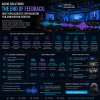
Algorithmic Acoustic Optimization: Tackling Echo in Challenging Event Venues

Introduction
Excellent audio quality is fundamental to successful live events. Whether hosting an international conference, government summit, product launch, convention, concert, or hybrid meeting, attendees expect clear, intelligible sound regardless of where they are seated. However, many event venues were not designed with modern audiovisual requirements in mind. Exhibition halls, convention centers, heritage buildings, stadiums, warehouses, and industrial spaces often present significant acoustic challenges that degrade speech clarity and diminish the attendee experience.
Among these challenges, reverberation and echo remain the most difficult to manage. Sound reflecting repeatedly from walls, ceilings, glass surfaces, and floors creates delayed audio that interferes with direct speech, making presentations difficult to understand and increasing listener fatigue.
Recent advances in digital signal processing (DSP), artificial intelligence (AI), and real-time acoustic modeling have enabled algorithmic acoustic optimization systems capable of adapting dynamically to changing venue conditions. Rather than relying solely on physical acoustic treatment or manual sound engineering, these intelligent systems continuously analyze audio behavior and automatically optimize sound reinforcement throughout an event.
For event technology professionals, algorithmic acoustic optimization represents a shift toward data-driven audio engineering that improves speech intelligibility, audience experience, and operational efficiency across even the most acoustically demanding environments.
Understanding Echo and Reverberation
Echo occurs when reflected sound reaches listeners after a sufficiently noticeable delay from the original source. Reverberation, by contrast, consists of numerous overlapping reflections that gradually decay over time.
Although both phenomena originate from sound reflections, they affect events differently.
Common causes include:
- High ceilings
- Concrete walls
- Glass architecture
- Metal structures
- Large exhibition spaces
- Empty venues during setup
- Reflective flooring
- Irregular room geometry
As attendee numbers fluctuate throughout an event, acoustic characteristics also change because audiences absorb significant amounts of sound energy.
Static audio configurations often struggle to maintain consistent performance under these dynamic conditions.
Limitations of Traditional Acoustic Management
Conventional venue optimization typically involves:
- Manual loudspeaker placement
- Equalization adjustments
- Delay configuration
- Physical acoustic panels
- Sound absorption materials
- Microphone positioning
While these methods remain important, they are generally configured before an event begins and may not adapt effectively as room occupancy, stage layouts, or environmental conditions evolve.
Large conferences with multiple presentation spaces often require ongoing manual intervention from experienced sound engineers, increasing operational complexity.
Algorithmic optimization complements traditional engineering by continuously adapting audio parameters in real time.
Core Components of Algorithmic Acoustic Optimization
Modern intelligent audio systems combine several technologies into an integrated optimization framework.
Acoustic Measurement Network
Distributed microphones throughout the venue continuously capture acoustic characteristics.
Measurements include:
- Reverberation time (RT60)
- Signal-to-noise ratio
- Sound pressure levels
- Reflection timing
- Frequency response
- Ambient noise
- Speech intelligibility metrics
This continuous feedback provides the data required for automated optimization.
Digital Signal Processing
DSP engines perform rapid audio adjustments using algorithms that modify sound before it reaches loudspeakers.
Common processing functions include:
- Equalization
- Dynamic compression
- Delay alignment
- Phase correction
- Beamforming
- Feedback suppression
- Echo cancellation
These calculations occur within milliseconds, allowing continuous adaptation without noticeable interruptions.
AI-Based Acoustic Modeling
Machine learning enhances traditional DSP by recognizing acoustic patterns that static rules cannot easily address.
AI models analyze historical and real-time venue data to predict:
- Reflection behavior
- Audience absorption changes
- Noise fluctuations
- Speaker movement
- Microphone positioning
- Stage reconfigurations
Rather than reacting solely after problems occur, predictive optimization allows systems to anticipate changing conditions.
Adaptive Beamforming
One of the most significant advances in event audio technology is adaptive beamforming.
Instead of broadcasting sound uniformly throughout the venue, beamforming directs audio energy toward intended audience areas while minimizing reflections from walls and ceilings.
Advantages include:
- Improved speech clarity
- Reduced reverberation
- Lower feedback risk
- More consistent audience coverage
- Reduced sound spill between adjacent spaces
Beamforming becomes particularly valuable in conference centers hosting multiple simultaneous presentations.
Real-Time Echo Cancellation
Echo cancellation algorithms continuously compare transmitted and received audio signals.
By identifying delayed reflections, systems subtract unwanted echoes before amplification.
Modern implementations use adaptive filtering techniques that update continuously as environmental conditions change.
Hybrid events benefit especially from these capabilities because remote participants are often more sensitive to echo than attendees inside the venue.
Intelligent Loudspeaker Optimization
Large venues frequently deploy dozens or even hundreds of loudspeakers.
Algorithmic optimization coordinates these systems through:
- Automatic delay calibration
- Phase synchronization
- Coverage balancing
- Frequency optimization
- Output level adjustments
Rather than requiring extensive manual tuning, software continuously maintains alignment across distributed audio zones.
This becomes especially valuable during multi-day conferences where room configurations change frequently.
Integration with Event Technology Infrastructure
Acoustic optimization systems increasingly integrate with broader event technology ecosystems.
Venue Management Systems
Event schedules can automatically adjust audio profiles for keynote presentations, breakout sessions, networking areas, and entertainment performances.
Occupancy Sensors
People-counting technologies help estimate audience absorption characteristics.
As attendance increases or decreases, optimization algorithms modify equalization and amplification parameters accordingly.
Building Management Systems
Environmental factors such as HVAC noise, movable partitions, and room configuration changes influence acoustic performance.
Integration enables coordinated responses across multiple facility systems.
Event Analytics
Historical acoustic performance supports continuous improvement by identifying:
- Frequently problematic venues
- Equipment effectiveness
- Noise patterns
- Audience satisfaction trends
- Technical intervention frequency
These insights inform future venue selection and system design decisions.
Measuring Success
Objective performance metrics are essential when evaluating optimization systems.
Common indicators include:
- Speech Transmission Index (STI)
- Reverberation Time (RT60)
- Clarity Index (C50/C80)
- Signal-to-noise ratio
- Audience intelligibility scores
- Audio latency
- Technical incident frequency
Combining objective measurements with attendee feedback provides a comprehensive understanding of acoustic performance.
Implementation Challenges
Although algorithmic optimization offers significant benefits, successful deployment requires careful planning.
Microphone placement must avoid introducing additional feedback while capturing representative acoustic conditions.
AI models also require high-quality calibration data to produce reliable optimization recommendations.
Complex architectural spaces containing balconies, irregular ceilings, or reflective decorative materials may require customized acoustic modeling beyond generic optimization algorithms.
Cost remains another consideration. Large distributed sensing networks and advanced DSP infrastructure may require substantial investment, although these costs continue decreasing as intelligent audio technologies mature.
Importantly, automated optimization should augment—not replace—the expertise of professional audio engineers. Human oversight remains essential for creative sound design, troubleshooting, and adapting systems to unique event requirements.
Future Trends
Acoustic optimization is becoming increasingly intelligent through artificial intelligence and spatial computing.
Emerging systems are expected to incorporate:
- Digital twin acoustic simulations
- AI-generated loudspeaker configurations
- Autonomous system calibration
- Edge AI processing
- Immersive spatial audio optimization
- Personalized listening zones
- Predictive equipment maintenance
Machine learning models trained on thousands of venue profiles may eventually recommend complete audio system designs before physical installation begins.
As hybrid events continue expanding, optimization algorithms will also coordinate audio quality simultaneously for in-person audiences, livestream viewers, and virtual participants, ensuring consistent experiences across every participation format.
Conclusion
Algorithmic acoustic optimization is transforming how event professionals address echo, reverberation, and speech intelligibility in acoustically challenging venues. By combining distributed sensing, digital signal processing, adaptive beamforming, AI-driven acoustic modeling, and intelligent system integration, these frameworks enable continuous real-time optimization that extends well beyond traditional manual sound engineering. While successful implementation still depends on thoughtful venue planning and experienced technical oversight, algorithmic approaches provide the flexibility and precision needed for today’s complex conferences, exhibitions, hybrid events, and large-scale corporate gatherings. As event technology continues evolving toward intelligent, self-optimizing environments, acoustic optimization will play an increasingly vital role in delivering clear, immersive, and reliable audio experiences for every attendee.