How Closed-Loop Cashless Systems Are Reshaping Festivals
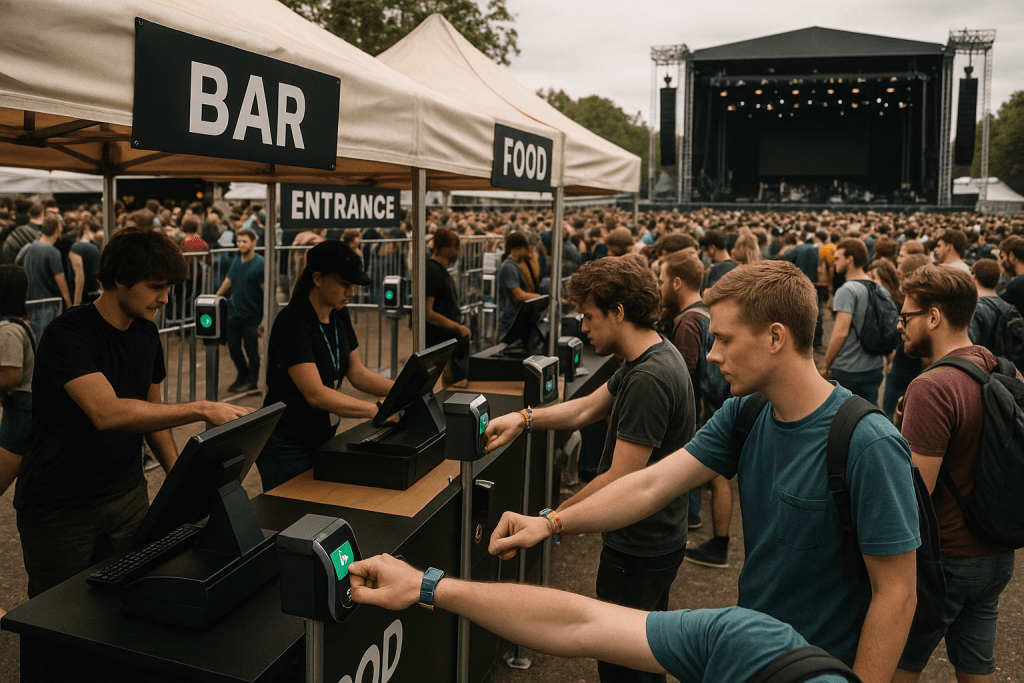
Cashless payment infrastructure has moved from experimental to essential at many large-scale festivals and outdoor events. As organisers look to reduce queues, limit theft and gather clearer audience insight, closed-loop systems using NFC wristbands and integrated ticketing are becoming a core part of the event technology stack.
Vendors in this space are building platforms that combine access control, on-site payments and data reporting in a single ecosystem, often designed to operate reliably even when connectivity fails. Alongside this, new layers of analytics and emerging AI tools are beginning to help organisers translate on-site activity into usable intelligence for future planning.
Background: why festivals are going cashless
Festival and live event operators have been steadily shifting away from cash for more than a decade. Card terminals and open-loop contactless payments were the first step, but many organisers have since moved to closed-loop environments where spend is managed entirely within the event’s own infrastructure.
In a closed-loop cashless model, attendees load credit onto an event-issued medium – typically an NFC wristband or card – and use it for all on-site purchases. This gives organisers and vendors a controlled environment that is less exposed to network outages, bank issues or fluctuating transaction fees, and that can be optimised around specific operational needs, from bar throughput to access control.
For multi-day festivals and large outdoor productions in locations with fragile connectivity, the ability to keep payments flowing offline is particularly strategic. Rather than relying on mobile networks that may be overloaded once tens of thousands of visitors arrive, closed-loop systems can be configured to store and sync transactions locally, then update central servers when connectivity is restored.
Key developments in cashless festival technology
Recent deployments highlight several trends in how cashless technology is being implemented and integrated.
NFC wristbands at the centre of the experience
NFC-enabled wristbands are now the standard interface for many closed-loop environments. A single wearable can serve as the attendee’s ticket, access credential and payment method. Guests typically create or are assigned a profile before the event, then top up funds in advance or on site.
This consolidation allows security and operations teams to manage permissions at a granular level – VIP zones, backstage, artist compounds, camping areas or age-restricted bars can all be controlled and logged via the same credential used for spending at bars and food stalls.
Unified ticketing, access control and payments
Technology providers are increasingly offering platforms that span the entire audience journey, from ticket purchase to on-site spending. By linking ticketing, accreditation and point-of-sale systems, organisers can avoid fragmented data silos and reduce the number of different systems staff need to manage.
A unified system can validate tickets at gates, encode access permissions onto wristbands and immediately activate payment accounts. This reduces friction at entry points, simplifies the on-boarding of staff and traders, and can support more fluid crowd management, as capacity and flow can be observed in near real time.
Offline-first operation and reduced theft
A critical design element of many closed-loop platforms is the ability to function offline. Terminals at bars and vendor stands can authorise transactions locally, then synchronise with central servers as connectivity permits. This protects the event from payment blackouts caused by overloaded mobile networks or temporary power interruptions.
Removing cash from site also changes the risk profile for organisers and traders. With fewer physical notes to handle or store, opportunities for theft and shrinkage decline. Organisers have clearer oversight of vendor turnover, while traders gain more predictable settlement processes and reduced need for on-site cash management logistics.
Live reporting, data ownership and AI-assisted insight
One of the most significant shifts has been the maturation of reporting and analytics built into cashless infrastructures. Because every transaction and entry scan is digital, organisers gain a detailed, timestamped record of how attendees move and spend throughout the event.
Live dashboards can show bar performance by location, peak transaction times, uptake of specific food concepts, or the impact of programming decisions on on-site spending. This enables operational decisions during the event itself, such as redeploying staff, opening additional sales points or adjusting product ranges in response to real demand.
Control over data has become a priority for many organisers. Closed-loop systems can be configured so that event owners retain ownership of the underlying audience and transaction data, allowing them to build long-term profiles and inform marketing, programming and sponsorship strategies across multiple editions.
Some providers are now layering in AI tools to process this data more efficiently. While still in the early stages, these capabilities may include automated pattern detection in sales trends, predictive forecasts for stock levels, or segmentation models that surface distinct audience cohorts based on spending behaviour and movement patterns.
Industry impact for festivals and large events
The move toward closed-loop cashless and unified access systems is reshaping workflows across the festival value chain.
- Organisers gain clearer financial visibility and better control of site-wide operations, with less dependency on network infrastructure.
- Vendors and caterers benefit from faster service speeds, simplified reconciliation, and removal of day-to-day cash handling tasks.
- Security and crowd management teams can work from a single data set for access control, capacity monitoring and incident response.
- Sponsors and partners can be offered more detailed reporting on engagement and sales uplift linked to specific activations or zones.
For audiences, the experience is typically defined by shorter queues, easier top-ups and reduced concern about carrying wallets or losing cards. However, this also raises ongoing questions around transparency of fees, data privacy and the balance between frictionless experiences and responsible data use.
Why this matters for event professionals and technology providers
For event organisers evaluating technology roadmaps, cashless infrastructure is no longer a niche add-on but a consideration that touches ticketing, operations, finance, security and marketing. Decisions made about closed-loop versus open-loop systems, data control and integrations can shape both attendee experience and long-term commercial strategy.
Technology providers, meanwhile, are under pressure to deliver platforms that are robust in challenging field conditions, interoperable with existing ticketing tools, and transparent in how they handle and surface event data. The emergence of AI-assisted analytics adds another layer of potential differentiation, but also responsibility, as predictive tools increasingly inform operational and commercial decisions.
Both sides must balance innovation with resilience. Features such as offline operation, clear refund processes, straightforward vendor onboarding and rigorous data protection are likely to matter as much as advanced analytics or new user-facing capabilities.
Conclusion
Closed-loop cashless payment systems, NFC wristbands and unified access solutions are becoming foundational elements of modern festival infrastructure. By enabling offline operations, reducing reliance on cash and consolidating ticketing, access and payments into a single ecosystem, these technologies are reshaping how large events are planned, delivered and evaluated.
As live reporting, data ownership strategies and AI-enhanced analytics evolve, event professionals will have increasing scope to turn operational data into actionable insight. Those who can align their payment and access control choices with broader objectives around audience experience, security and commercial performance are likely to be best positioned as cashless models continue to spread across the festival and live events landscape.