HYRISS spatial audio anchors immersive ‘Momentarium’ at WOW!house 2026
Background and context
WOW!house, the annual showcase of interior design at Design Centre Chelsea Harbour in London, has opened its 2026 edition with 22 rooms created by invited designers and architects. The event targets a professional audience that includes interior designers, architects, hoteliers, yacht designers, and high-end residential specifiers, alongside design enthusiasts and media.
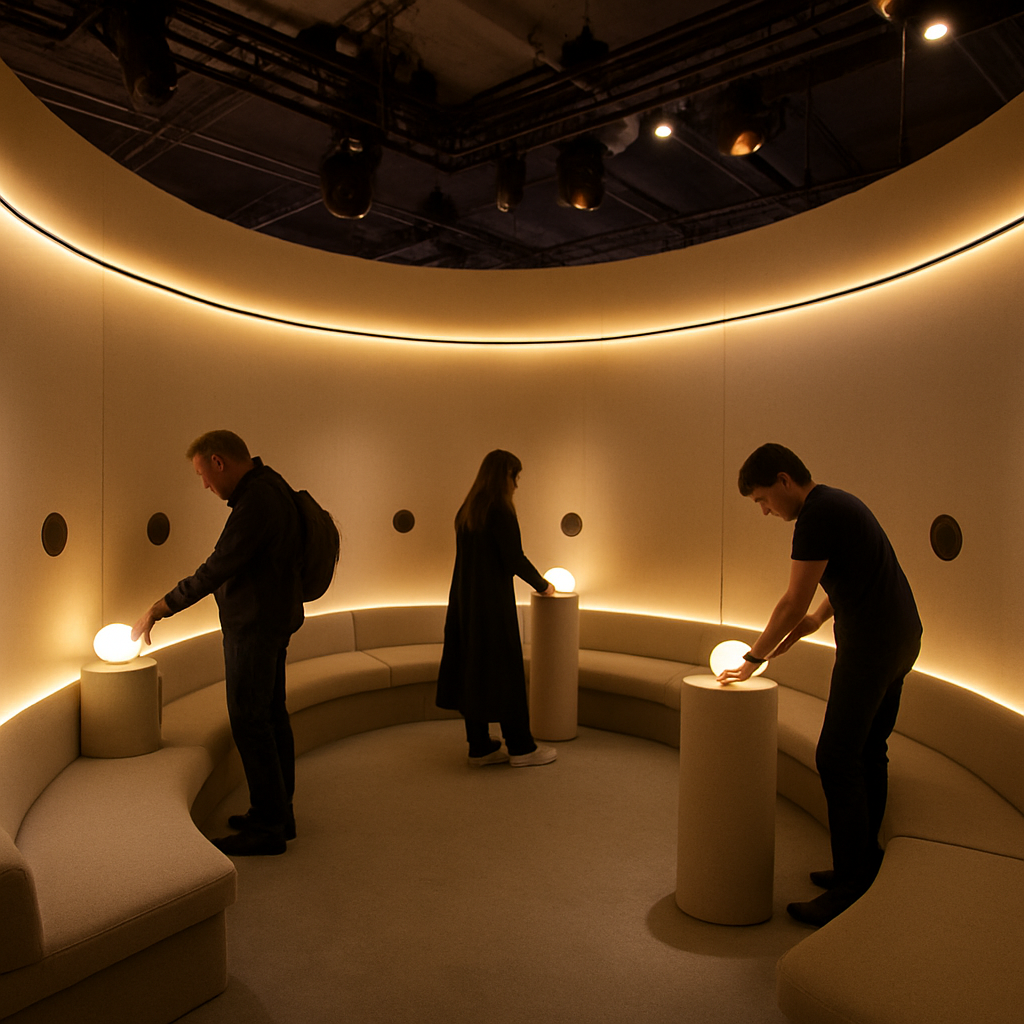
Running from 2 June to 2 July 2026, WOW!house positions technology as one element within a broader conversation about materials, space, and experience. The final stop on the visitor route this year is The Nucleus Immersive Room by Russell Sage Studio, a circular space built as a sensory installation that places audio at the centre of the design brief.
Key announcement
The Nucleus Immersive Room, also referred to as the “Momentarium”, marks the first deployment of L-Acoustics HYRISS in a designer showhouse setting. UK residential AV integrator Nucleus specified the system after working with more conventional cinema formats at WOW!house 2025 and wanting to explore a more flexible spatial audio approach.
HYRISS (Hyperreal Immersive Sound Space) is L-Acoustics’ platform that combines object-based audio (via L-ISA), room acoustic processing (Ambiance), and the Anima engine within the L-ISA Processor II to adapt content to the space in real time. The solution is aimed at residential, hospitality, workplace, and marine environments where immersive sound needs to be integrated architecturally rather than presented as a visible AV installation. Further technical details are available on the L-Acoustics HYRISS product page at l-acoustics.com.
For WOW!house, HYRISS underpins an interactive narrative concept developed by Russell Sage Studio and Nucleus around memory and storytelling. Visitors sit on a curved banquette in a cocoon-like room and handle objects such as letters and photographs stored in custom cabinetry. Lifting each object triggers different combinations of sound, light, and visual content, with two original musical works created in L-ISA Studio specifically for the installation.
Industry impact
The installation demonstrates how immersive audio, more commonly associated with live events and large-scale experiences, is moving into residential and hospitality design workflows. Instead of traditional 5.1 or 7.1 setups that rely on fixed channels, object-based spatial audio allows sound sources to move around the listener and respond dynamically to interaction.
In the Momentarium, 17 compact coaxial loudspeakers and 12 subwoofers are concealed behind acoustically transparent fabric to preserve the interior designer’s vision. System control and integration with lighting, shading, and video are handled through a Crestron platform, allowing a single action—such as opening a drawer—to alter the room’s entire soundscape and ambience.
The technical backbone includes two amplified controllers, an LC16D and LS10 network switches for signal distribution, and an L-ISA Processor II working alongside a P1 processor running Ambiance. The configuration enables rapid switching between cinema-style playback, ambient soundscapes, music listening, and more experimental sound design without changing hardware.
Why this matters
For the AV and event technology sector, the project illustrates how spatial audio is being adopted by interior designers and specifiers as a foundational design element rather than an add-on. By embedding HYRISS into a highly visible design showcase, L-Acoustics and its partners are targeting decision-makers who influence the next generation of premium residential, hospitality, and experiential spaces.
WOW!house visitors encounter the Momentarium as the culmination of the exhibition, positioning immersive sound as part of a complete multi-sensory environment that also includes architectural lighting, video, and scent. For integrators and event technologists, the room offers a case study in how tools developed for complex live and cultural venues are being repurposed for more intimate, design-led contexts.
With guided tours running twice daily throughout the month-long event, the installation provides an extended live demonstration of object-based audio and environmental control to an audience that regularly commissions high-value projects. As expectations for experiential environments continue to rise, projects like this suggest that spatial sound will increasingly play a central role in both temporary and permanent spaces.