Integrating Seamless E-Commerce into Live Product Demonstrations
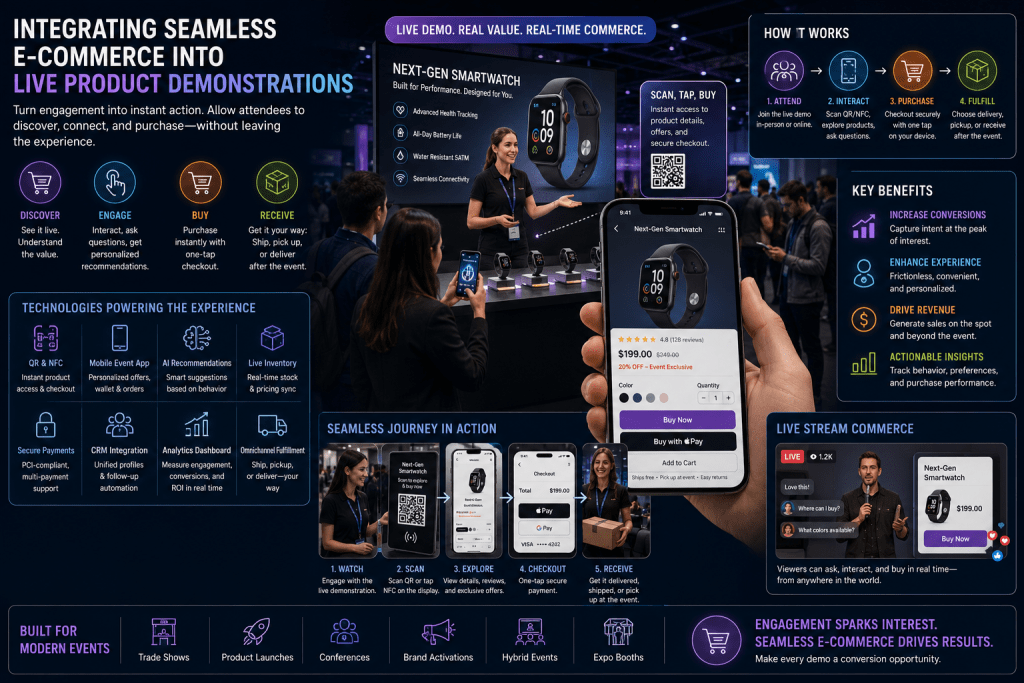
The boundaries between live events, digital engagement, and online commerce are rapidly disappearing. Across trade shows, product launches, brand activations, livestreamed conferences, and experiential marketing events, organizations are increasingly transforming passive product demonstrations into real-time transactional environments where attendees can instantly purchase featured products without disrupting the experience.
This evolution is being driven by advances in event technology, mobile commerce platforms, AI-powered personalization, RFID systems, livestream integrations, digital payment infrastructure, and connected attendee experiences. Rather than separating product discovery from purchasing workflows, modern event ecosystems are integrating commerce directly into the engagement journey.
For event organizers and exhibitors, seamless e-commerce integration represents more than a convenience feature. It fundamentally changes how live demonstrations generate measurable revenue, capture buyer intent, and extend engagement beyond the physical venue.
Traditional product demonstrations often created strong interest but weak transactional continuity. Attendees might observe a demonstration, collect marketing material, and later attempt to locate products online after the event. In many cases, purchase intent declined before conversion occurred.
Integrated event commerce systems are solving this gap by enabling immediate, frictionless purchasing directly within the live event environment.
Why Live Demonstrations Are Becoming Commerce Platforms
Modern consumers increasingly expect transactional immediacy.
Digital commerce platforms have conditioned audiences to expect:
- Instant purchasing access
- Personalized recommendations
- One-click checkout
- Mobile payment flexibility
- Real-time product information
- Seamless omnichannel experiences
These expectations now extend into live events.
At the same time, exhibitors are under pressure to generate more measurable ROI from physical activations. Traditional metrics such as booth traffic and lead scans are no longer sufficient for many brands seeking direct revenue attribution.
As a result, live demonstrations are evolving into hybrid engagement-commerce ecosystems where product interaction and purchasing occur simultaneously.
Several event sectors are accelerating this shift:
- Consumer electronics expos
- Beauty and cosmetics events
- Automotive showcases
- Fashion activations
- Sports and fitness expos
- Food and beverage experiences
- Home technology demonstrations
In these environments, reducing friction between product interest and purchase conversion is becoming a major competitive advantage.
The Technology Infrastructure Behind Event Commerce Integration
Seamless event commerce depends on multiple interconnected technologies working together in real time.
Typical infrastructure components include:
- Mobile event applications
- RFID and NFC systems
- QR commerce integrations
- Real-time inventory platforms
- Digital payment gateways
- AI recommendation engines
- CRM and CDP integration
- Livestream commerce platforms
- Smart signage systems
These technologies collectively transform demonstrations into interactive transactional experiences.
QR and NFC-Based Instant Purchasing
One of the most common approaches involves QR and NFC-enabled purchasing systems.
Smart Product Tags
Products featured during demonstrations may include:
- Dynamic QR codes
- NFC touchpoints
- RFID-enabled displays
- Smart shelves
Attendees can instantly access:
- Product specifications
- Pricing information
- Availability status
- Personalized offers
- Checkout workflows
through their smartphones without requiring assistance from booth staff.
This significantly reduces transactional friction.
One-Tap Mobile Commerce
NFC integrations allow attendees to tap devices against product displays or demo stations to launch pre-configured purchasing environments.
These systems often integrate with:
- Apple Pay
- Google Pay
- Digital wallets
- Event payment platforms
- Loyalty programs
The objective is minimizing the number of steps between engagement and purchase completion.
AI-Driven Personalized Commerce Experiences
Artificial intelligence is increasingly central to live event commerce systems.
Behavioral Recommendation Engines
AI systems analyze attendee behavior in real time, including:
- Booth visits
- Session attendance
- Product interactions
- Dwell time
- Purchase history
- Mobile app engagement
Based on these signals, recommendation engines can personalize:
- Product suggestions
- Promotional offers
- Bundled purchases
- Demo invitations
- Upsell opportunities
For example, an attendee interacting extensively with smart fitness devices may receive personalized recommendations for related accessories or premium subscription services.
Dynamic Pricing and Offer Optimization
Some event commerce platforms use AI to adjust promotional offers dynamically based on:
- Inventory levels
- Demand patterns
- Attendee segmentation
- Engagement intensity
- Time-sensitive campaigns
This enables more adaptive revenue optimization during live events.
Livestream Commerce and Hybrid Demonstrations
Hybrid event models have significantly expanded the role of integrated e-commerce.
Interactive Livestream Shopping
Livestream commerce combines product demonstrations with embedded purchasing functionality.
Viewers can:
- Watch demonstrations in real time
- Interact through live chat
- Ask product questions
- Access instant checkout links
- Purchase products without leaving the stream
This model has become particularly influential in sectors such as beauty, fashion, electronics, and consumer technology.
Synchronized Commerce Infrastructure
Modern livestream commerce systems integrate:
- Real-time inventory synchronization
- Multi-region payment processing
- AI moderation systems
- Audience analytics
- Recommendation engines
This allows physical and virtual attendees to participate in unified purchasing experiences simultaneously.
Shoppable Video Environments
Some advanced event platforms now support clickable video overlays where products demonstrated on-screen become immediately purchasable through embedded commerce interfaces.
This transforms passive viewing into interactive transactional engagement.
RFID and Smart Badge Commerce Integration
Wearable event technologies are increasingly supporting frictionless purchasing.
Smart Badge Transactions
RFID-enabled attendee badges can support:
- Cashless payments
- Product purchases
- Loyalty point accumulation
- Personalized checkout workflows
This removes the need for repeated payment authentication during events.
Personalized Commerce Journeys
Because badges are linked to attendee profiles, commerce systems can personalize offers based on:
- Registration data
- Behavioral activity
- Professional interests
- Previous interactions
This creates more contextual purchasing experiences.
Real-Time Inventory and Fulfillment Integration
Successful event commerce requires accurate operational coordination.
Inventory Synchronization
Integrated commerce systems connect directly with:
- Warehouse management platforms
- Retail inventory systems
- Fulfillment networks
- Distribution centers
This ensures real-time product availability visibility during demonstrations.
Flexible Fulfillment Models
Attendees increasingly expect multiple fulfillment options, including:
- Direct shipping
- Venue pickup
- Local same-day delivery
- Post-event fulfillment
Integrated systems help exhibitors manage these workflows efficiently without disrupting live experiences.
Operational and Business Benefits
The integration of e-commerce into live demonstrations creates several measurable advantages.
Higher Conversion Rates
Reducing friction between product discovery and purchasing significantly improves conversion potential.
Immediate transactional access prevents purchase intent decay after demonstrations conclude.
Improved ROI Attribution
Integrated commerce systems allow exhibitors to measure:
- Revenue generated per activation
- Conversion rates by demo type
- Product engagement performance
- Buyer journey analytics
This creates more precise ROI visibility.
Enhanced Attendee Experience
Attendees benefit from:
- Faster purchasing workflows
- Personalized recommendations
- Reduced checkout friction
- Unified digital experiences
This improves satisfaction and engagement quality.
Richer Behavioral Analytics
Commerce-integrated events generate valuable data regarding:
- Product interest trends
- Purchase behavior
- Audience segmentation
- Engagement pathways
This improves future marketing and event strategy.
Challenges and Considerations
Despite its advantages, event commerce integration introduces operational complexities.
Connectivity Dependence
Real-time commerce environments rely heavily on stable:
- Wireless infrastructure
- Payment gateways
- Cloud synchronization
- Inventory connectivity
Network instability can disrupt purchasing workflows significantly.
Cybersecurity and Payment Protection
Commerce-enabled events handle sensitive financial data, requiring strong:
- Payment encryption
- Identity verification
- Fraud prevention systems
- PCI compliance
- Data protection governance
Security failures can severely damage attendee trust.
Operational Coordination Complexity
Successful integration requires synchronization between:
- Event technology providers
- Retail systems
- Payment processors
- Inventory management platforms
- Fulfillment networks
Fragmented infrastructure can create inconsistent user experiences.
Attendee Experience Balance
Over-commercialization risks reducing the authenticity of live experiences.
Successful implementations balance transactional efficiency with meaningful engagement rather than overwhelming attendees with aggressive sales mechanisms.
The Future of Commerce-Driven Events
The next generation of event commerce systems is expected to become increasingly immersive and automated.
Emerging developments include:
- AI-powered conversational shopping assistants
- AR-enabled product visualization
- Voice commerce integrations
- Biometric payment authentication
- Personalized digital storefronts
- Autonomous checkout environments
- Spatial commerce experiences in mixed reality
As physical and digital commerce ecosystems continue converging, live events may increasingly function as interactive retail environments integrated directly into broader omnichannel commerce strategies.
Conclusion
The integration of seamless e-commerce into live product demonstrations is fundamentally changing how events generate engagement and revenue. By combining real-time purchasing infrastructure with immersive demonstrations, AI personalization, mobile payment systems, and hybrid event technologies, organizers and exhibitors are transforming live experiences into fully connected commerce ecosystems.
This evolution improves attendee convenience, strengthens conversion performance, enhances ROI visibility, and creates more measurable engagement outcomes for brands and organizers alike.
Most importantly, it reflects a larger transformation within the event industry where physical experiences, digital interaction, and transactional commerce are becoming increasingly unified. In the future, the distinction between experiencing a product and purchasing it may continue to disappear entirely within modern event environments.