E-Ink Smart Badges: The Sustainable, High-Tech Evolution of Personalized Event Credentials
Event badges have historically served a simple operational purpose: attendee identification. For decades, conferences, exhibitions, corporate summits, and trade shows relied on printed paper or plastic credentials containing static information such as names, access levels, and company affiliations. While functional, traditional badges offer limited flexibility, generate significant material waste, and provide minimal integration with modern digital event ecosystems.
As the event industry becomes increasingly data-driven, sustainability-focused, and experience-oriented, attendee credentialing is undergoing a major technological transformation. One of the most important developments in this space is the rise of E-Ink smart badges.
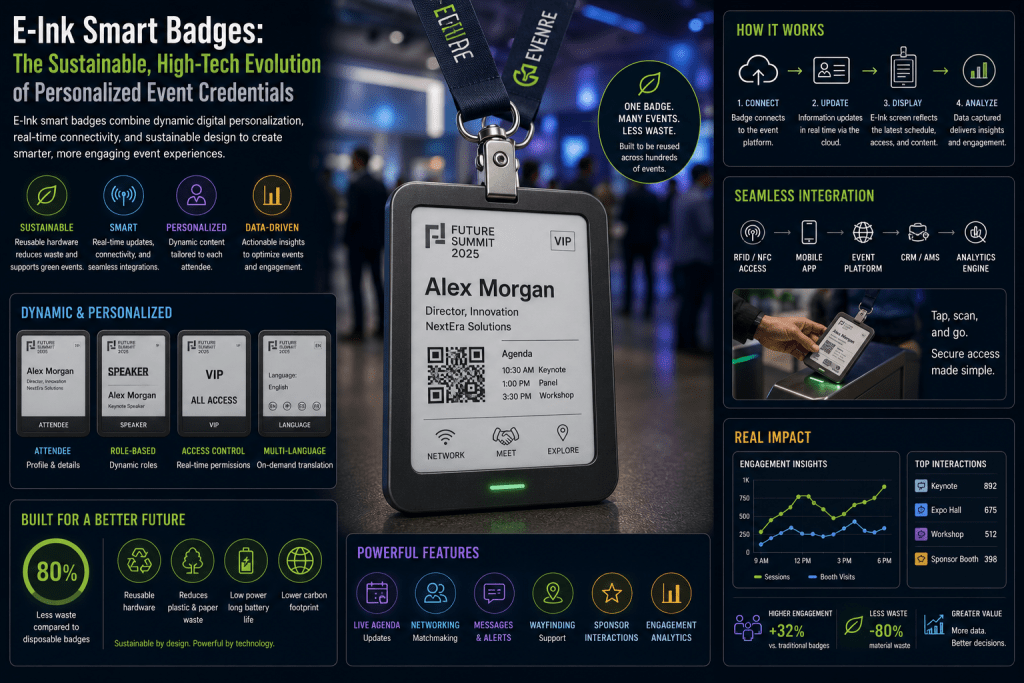
Powered by low-energy electronic paper display technology, E-Ink badges combine dynamic digital personalization with reusable hardware, wireless connectivity, and real-time event integration. These devices are evolving beyond simple identification tools into interactive event interfaces capable of supporting networking, access control, attendee engagement, wayfinding, analytics, and sustainability initiatives simultaneously.
For event organizers, E-Ink smart badges represent a convergence of three growing priorities:
- Operational digitization
- Environmental sustainability
- Personalized attendee experiences
As venues and organizers search for scalable alternatives to disposable credentials, E-Ink technology is emerging as a serious infrastructure layer within next-generation event ecosystems.
Why Traditional Event Badges Are Becoming Obsolete
Conventional event badges create several operational limitations that are increasingly incompatible with modern event environments.
Static Information Architecture
Traditional printed badges cannot adapt dynamically once produced. Any attendee changes involving:
- Session access
- VIP upgrades
- Schedule modifications
- Networking preferences
- Role adjustments
typically require manual badge replacement.
This creates operational inefficiencies and increased staffing requirements at registration areas.
Sustainability Challenges
Large-scale events generate enormous quantities of credential waste.
Most disposable badges involve combinations of:
- Plastic holders
- Laminated materials
- PVC cards
- Printed inserts
- Single-use lanyards
These materials are often difficult to recycle and frequently discarded after short-term use.
As environmental accountability becomes more important in event management, organizers are under increasing pressure to reduce waste generated by registration infrastructure.
Limited Interactivity
Traditional badges offer minimal digital functionality beyond QR or barcode scanning.
This limits their ability to support:
- Personalized engagement
- Real-time networking
- Dynamic access management
- Live attendee communication
- Behavioral analytics
Modern event ecosystems require credentials capable of functioning as connected digital touchpoints rather than static identification cards.
How E-Ink Smart Badges Work
E-Ink smart badges use electronic paper display technology similar to that found in e-readers.
Unlike LCD or OLED screens, E-Ink displays consume power only when content changes. Once information is displayed, the screen maintains the image without continuous energy consumption.
This makes E-Ink particularly suitable for multi-day event environments where long battery life is essential.
A typical E-Ink badge system includes:
- Electronic paper display
- Low-power microcontroller
- Wireless communication module
- RFID or NFC integration
- Battery system
- Cloud-based management platform
These devices are usually managed through centralized event software that updates badge content dynamically throughout the event lifecycle.
Dynamic Personalization and Real-Time Updates
One of the most important advantages of E-Ink badges is their ability to support live content updates.
Adaptive Credential Information
Badge displays can change dynamically based on:
- Session participation
- Networking preferences
- Role transitions
- Language settings
- Sponsor interactions
- Event scheduling changes
For example, attendees entering VIP areas may automatically receive updated access credentials displayed directly on the badge screen.
Similarly, speakers can have badges automatically modified to reflect presentation schedules or stage assignments.
Personalized Networking Features
E-Ink badges are increasingly being used as intelligent networking tools.
Badges can display:
- Professional interests
- Industry categories
- Meeting availability
- Social media handles
- AI-generated networking recommendations
Some systems integrate with event matchmaking platforms to dynamically highlight recommended networking connections between nearby attendees.
This transforms badges into active engagement interfaces rather than passive identifiers.
Multi-Language Adaptation
At international events, E-Ink displays can switch languages dynamically based on attendee preferences or contextual interactions.
This improves accessibility and reduces the need for multiple printed credential variations.
Integration with Smart Event Infrastructure
E-Ink smart badges are most valuable when integrated into broader event technology ecosystems.
RFID and NFC Access Control
Many smart badges combine E-Ink displays with RFID or NFC chips for seamless access management.
These integrations support:
- Session entry validation
- VIP area access
- Cashless payment systems
- Smart check-in workflows
- Attendance tracking
Unlike traditional printed credentials, access permissions can be modified remotely in real time.
Real-Time Analytics and Behavioral Insights
Connected badge systems generate operational intelligence regarding attendee behavior and venue interaction patterns.
Organizers can analyze:
- Session attendance
- Dwell time
- Networking activity
- Traffic flow
- Engagement hotspots
- Sponsor interaction frequency
This data improves both operational visibility and post-event analytics.
Wayfinding and Navigation Support
Some advanced E-Ink badges integrate with indoor positioning systems and event applications to provide dynamic navigation guidance.
Badges may display:
- Room directions
- Session reminders
- Personalized schedules
- Queue notifications
- Emergency alerts
This reduces attendee confusion while improving venue flow management.
Sustainability Advantages
Sustainability is one of the strongest drivers behind E-Ink badge adoption.
Reusability
Unlike disposable printed badges, E-Ink devices are designed for repeated use across multiple events.
Badge content can be remotely erased and reprogrammed between deployments, significantly reducing material waste.
Reduced Printing Requirements
Dynamic displays eliminate much of the large-scale printing associated with event credential production.
This reduces:
- Paper consumption
- Ink usage
- Plastic waste
- Shipping materials
- Production waste
Lower Carbon Impact
While E-Ink devices involve electronic manufacturing, reusable badge programs can substantially reduce the long-term environmental footprint of event credentialing compared to repeated single-use production cycles.
Some event organizers are now incorporating smart badges into broader circular event infrastructure initiatives.
Operational and Business Benefits
Beyond sustainability, E-Ink smart badges create several operational advantages.
Faster Registration Operations
Dynamic badge provisioning reduces manual reprinting and improves registration flexibility during last-minute attendee changes.
This helps reduce queues and staffing pressure.
Improved Security
Digital badge management improves credential security through:
- Remote deactivation
- Dynamic authentication
- Real-time permission updates
- Encrypted access systems
This is particularly important for high-security corporate or government events.
Enhanced Sponsorship Opportunities
E-Ink displays create new sponsor activation opportunities through:
- Dynamic branding zones
- Contextual advertising
- Interactive promotions
- Personalized sponsor messaging
Because badge content can update in real time, sponsorship inventory becomes more flexible and measurable.
Better Attendee Engagement
Smart badges function as continuous digital touchpoints throughout the attendee journey.
This enables more personalized event experiences while improving communication efficiency.
Challenges and Adoption Barriers
Despite growing interest, several challenges still affect widespread deployment.
Hardware Costs
E-Ink badges remain significantly more expensive than traditional printed credentials.
Large-scale deployment requires investment in:
- Hardware inventory
- Charging infrastructure
- Software platforms
- Wireless management systems
- Logistics operations
Battery and Connectivity Management
Although E-Ink technology is highly energy-efficient, devices still require reliable battery management and connectivity infrastructure during multi-day events.
Device Recovery Logistics
Reusable badge programs depend on effective post-event collection processes.
Loss rates can significantly affect ROI if recovery operations are poorly managed.
Privacy Considerations
Smart badges generate behavioral and location analytics that raise important privacy concerns involving:
- Attendee tracking
- Data collection transparency
- Consent management
- Data retention policies
Organizers must establish clear governance frameworks to maintain attendee trust.
The Future of Smart Credentialing
The next generation of E-Ink badge systems is expected to become increasingly intelligent and integrated.
Emerging developments include:
- AI-driven networking recommendations
- Biometric authentication integration
- Digital business card exchange
- Personalized content delivery
- Health and wellness monitoring
- Smart translation features
- Integration with digital twins and smart venues
As event environments become more connected, badges may evolve into fully interactive identity platforms linking physical and digital attendee experiences.
Conclusion
E-Ink smart badges are redefining the role of event credentials within modern event ecosystems. By combining dynamic digital displays, real-time connectivity, reusable hardware, and smart infrastructure integration, these systems offer a more sustainable and intelligent alternative to traditional printed badges.
Their value extends far beyond attendee identification. Smart badges support operational efficiency, personalized networking, adaptive access control, real-time analytics, and sustainability initiatives simultaneously.
As event organizers continue balancing digital transformation goals with environmental responsibility, E-Ink technology is positioned to become an increasingly important component of future event infrastructure.
The evolution of event credentials reflects a larger industry shift toward connected, data-driven, and experience-focused event design — where even the attendee badge becomes an active participant in the event ecosystem.