Introduction
In the modern event industry, visual storytelling has become the heartbeat of audience engagement. Whether it’s a corporate presentation, live concert, festival, product launch, or immersive exhibition, Event Visuals & Projection Technologies play a critical role in captivating audiences and delivering unforgettable experiences.
By blending high-resolution projection, LED screens, holographic visuals, and interactive technologies, event planners and AV professionals are redefining what’s possible on stage and beyond. As we move through 2025, these technologies continue to evolve rapidly—shaping how we see, feel, and connect at events.
What Are Event Visuals & Projection Technologies?
Event Visuals & Projection Technologies refer to the use of advanced digital systems to display dynamic imagery, video, and effects that enhance an event’s visual impact. This includes everything from traditional projectors and LED walls to 3D mapping, augmented reality (AR), and immersive visual displays.
These tools are designed to transform physical spaces into visually engaging environments that communicate a brand’s story or evoke emotion through synchronized sound, light, and motion.
The Core Components of Modern Event Visuals & Projection Systems
To understand how events come to life visually, it’s important to explore the main components behind the technology.
1. High–Definition Projectors
Projectors remain one of the most flexible and powerful visual tools in event production. With advancements in laser projection, event designers can now achieve ultra-bright and color-accurate displays even in challenging lighting conditions.
-
Laser projectors: Offer longevity, brightness, and energy efficiency.
-
Short-throw projectors: Ideal for smaller venues or tight spaces.
-
4K and 8K projectors: Deliver cinematic quality visuals for large-scale events.
These systems are widely used for mapping visuals onto buildings, cars, and even stage sets—bringing static objects to life.
2. LED Video Walls
LED technology has revolutionized the live event space. Compared to traditional projection, LED video solutions deliver vibrant colors, deeper contrast, and higher brightness—making them perfect for outdoor or large-scale indoor settings.
Modern LED panels are modular, lightweight, and scalable, allowing for custom configurations and creative designs. Whether it’s a curved display, floor LED, or 360-degree wraparound screen, LED technology offers limitless possibilities for immersive event visuals.
3. 3D Projection Mapping
Perhaps one of the most exciting developments in Event Visuals & Projection Technologies is 3D projection mapping. This technique uses projectors to map visuals onto irregular surfaces such as buildings, vehicles, or sculptures, creating stunning visual illusions.
Projection mapping transforms ordinary objects into dynamic storytelling canvases, often synchronized with music and lighting effects. From global sporting ceremonies to museum exhibitions, it adds depth and motion to storytelling in a way that captures audience imagination.
4. Augmented Reality (AR) & Mixed Reality (MR)
The rise of AR and MR has opened a new frontier in event visuals. With the integration of digital overlays in real-world environments, event attendees can interact with 3D visuals, virtual hosts, and gamified experiences.
For instance, an automotive brand can project a car hologram in mid-air during a launch, or a concert can feature a virtual artist performing alongside real musicians. AR technology bridges digital storytelling with real-world engagement, offering memorable experiences that blur the line between reality and imagination.
5. Holographic Displays
Holographic projection has evolved from novelty to a professional-grade visual solution. Through holographic screens or transparent LED film, event organizers can create floating visuals or life-sized holograms of people, objects, or animations.
Holographic visuals are now being used for keynote presentations, fashion shows, and trade exhibitions, delivering futuristic and interactive experiences without the need for physical props.
6. Immersive and 360-Degree Visual Environments
As audience expectations grow, event planners are leveraging immersive domes, panoramic screens, and 360-degree projection systems to transport attendees into entirely new worlds.
These environments use synchronized multi-projector rental and spatial audio to create a fully immersive experience, perfect for brand storytelling, product simulations, or artistic showcases.
The Role of Event Visuals in Audience Engagement
The power of Event Visuals & Projection Technologies lies not just in the hardware, but in how they influence emotion, perception, and connection.
1. Creating Emotional Impact
Visual storytelling triggers emotion faster than words. Through color, movement, and imagery, projection and visual display systems can inspire excitement, curiosity, or nostalgia—making messages more memorable.
2. Enhancing Brand Storytelling
For brands, visuals are a direct communication tool. From logo reveals to thematic backgrounds, projection technologies help brands express their identity and values dynamically, ensuring audiences remember the experience long after the event ends.
3. Boosting Interactivity
With touch-responsive displays, gesture recognition, and AV integrations, audiences can now participate in visuals instead of just watching them. This interactivity increases engagement, particularly in exhibitions and experiential marketing campaigns.
Sustainability and Efficiency in Modern Visual Technologies
Sustainability is an increasingly vital consideration in event production. Modern Event Visuals & Projection Technologies are designed with energy efficiency and longevity in mind.
-
Laser projectors consume less power and have longer lifespans.
-
LED panels are more durable and require minimal maintenance.
-
Modular setups allow reusability across events, reducing waste.
As events worldwide shift toward greener operations, choosing sustainable AV equipment not only reduces carbon footprints but also aligns with audience values.
Applications of Event Visuals & Projection Technologies
1. Corporate Events & Conferences
From large-scale conferences to product launches, projection technologies transform presentations into compelling visual journeys. 3D projection mapping and motion graphics help brands communicate complex information visually and memorably.
2. Concerts & Festivals
Music events are fertile ground for creative visual design. Projection mapping, LED backdrops, and synchronized lighting create electrifying atmospheres that complement live performances.
3. Exhibitions & Trade Shows
Exhibitors use visual display technologies to showcase products dynamically. Interactive walls, holograms, and AR demos attract attention and encourage audience engagement.
4. Sporting & Public Events
From opening ceremonies to fan zones, projection technologies amplify crowd energy with large-scale visuals and live feeds. They also provide branding opportunities for sponsors and organizers.
5. Virtual & Hybrid Events
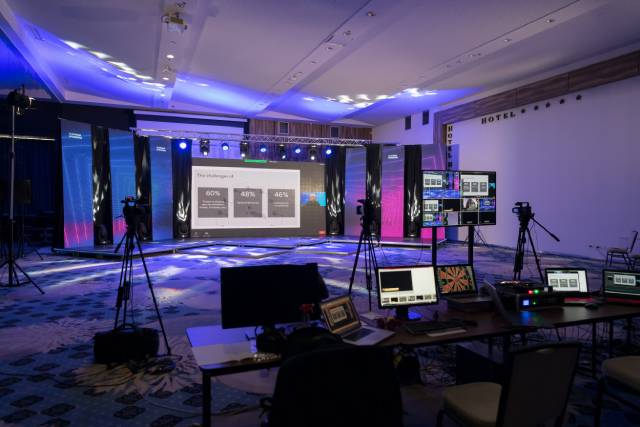
Even in digital environments, Event Visuals & Projection Technologies enhance the experience. Virtual backgrounds, 3D animations, and virtual studios create professional-quality streams and hybrid event spaces.
The Future of Event Visuals & Projection Technologies
The future of event visuals lies at the intersection of creativity and technology. Here are key trends shaping the next generation of live visual experiences:
-
AI-Driven Visual Content: Artificial Intelligence can now generate real-time visuals that respond to audience movement or music beats.
-
Volumetric Displays: These displays create 3D visuals visible from multiple angles without special glasses.
-
Interactive Projection Surfaces: Floors and walls that react to touch or motion are becoming increasingly popular for experiential events.
-
Cloud-Based Visual Control Systems: Event managers can now control and sync visuals across multiple venues from a single platform.
-
Metaverse Integration: As virtual worlds grow, projection and visual display systems will bridge physical and digital experiences seamlessly.
Choosing the Right Visual Partner for Your Event
Implementing advanced Event Visuals & Projection Technologies requires expertise in both design and execution. When choosing an AV or production partner, consider:
-
Technical experience with projection mapping, LED, and AR setups.
-
Creative design capabilities for custom content creation.
-
On-site support for seamless integration with sound and lighting systems.
-
Scalability to adapt solutions to venue size and budget.
A trusted AV partner ensures that the technology doesn’t just function—but enhances the overall storytelling and emotional impact of your event.
Summary of Event Visuals & Projection Technologies
As the line between physical and digital worlds continues to blur, Event Visuals & Projection Technologies have become the cornerstone of immersive and emotionally resonant experiences.
From 3D projection mapping and LED video walls to holograms and AR, these innovations empower event creators to design spaces that inspire, engage, and connect with audiences in extraordinary ways.
In 2025 and beyond, the fusion of creativity, technology, and sustainability will define the next chapter in live event storytelling—making every event not just seen, but felt.