Disney Upfront 2026 Delivers Four Show Formats On L-ISA System
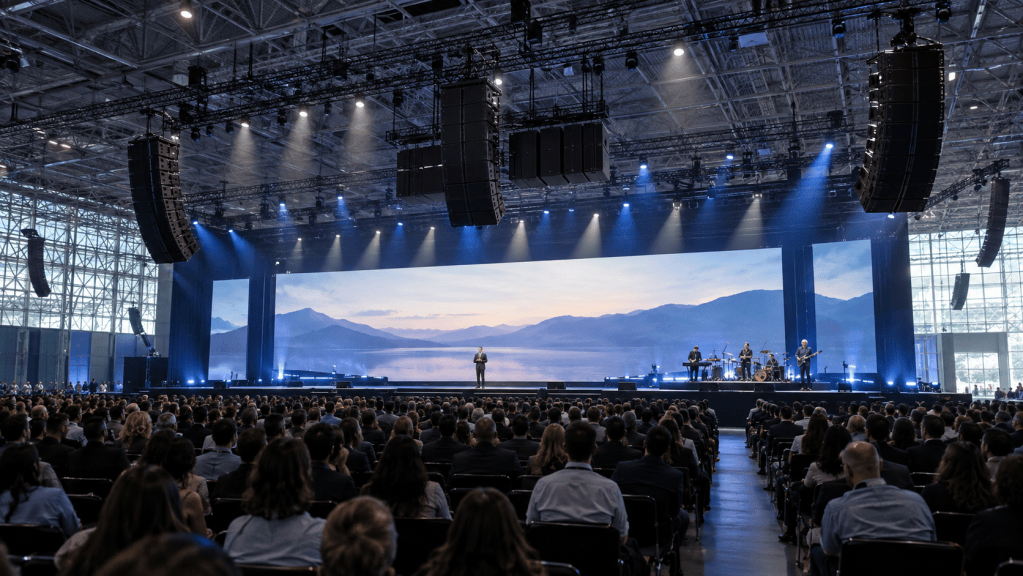
Disney turned its 2026 Upfront into a large scale demonstration of immersive audio, using a full surround L-Acoustics L-ISA Immersive Hyperreal system to run four fundamentally different show formats in a single, notoriously challenging hall at New York City’s North Javits Center.
Staged on May 12, the Upfront moved seamlessly from a corporate presentation fronted by Anne Hathaway and new CEO Josh D’Amaro, to a live ESPN college football desk, to cinema level trailers and finally a full concert set by Olivia Rodrigo. NMR Events supplied and operated the audio system, designing an L-ISA deployment that treated each content type with consistent spatial imaging while addressing the venue’s heavy reverberance and speech intelligibility issues.
North Javits Venue Challenge And Audio Brief
The North Javits space is known among New York event producers for its width, height and hard surfaces, all of which contribute to long reverb times and muddy speech. Previous Upfronts have added acoustic dampening, but with limited impact.
Nick Sarlo, Head of Audio at NMR Events, notes that reverberance remained a central obstacle, especially for dialogue driven segments that underpin advertiser presentations. Lead Audio Design Engineer Bob McGlinchey, working his fourth Disney Upfront, defined the requirement as delivering movie theater sound quality for content while preserving crystal clear speech in every seat.
According to McGlinchey, the team needed to combine a large format theater system capable of cinematic impact with a highly intelligible presentation public address, all within one coherent design.
Immersive L-ISA System Design For Wide Stage Coverage
NMR Events collaborated with the L-Acoustics Application team to create a full surround L-ISA configuration tailored to the hall’s geometry. After a demonstration for Disney executives at the L-Acoustics Westlake Village facility in California, the concept was approved as the first L-ISA deployment at a Disney Upfront.
The width of the stage ruled out traditional repeated stereo hangs, which can flatten the image and disconnect sound sources from their onstage positions. L-Acoustics Global Application Lead, Spatial Systems Oscar Sturup proposed a very wide frontal L-ISA layout, allowing each object in the mix to be localized accurately to its position on stage.
This approach proved particularly impactful for the ESPN college football segment. With the broadcast desk positioned house left, the associated audio was also localized house left, so that the sound appeared to emanate naturally from where the presenters were seated. For film and series trailers, centrally flown subwoofers beneath the middle Scene array kept low frequency content time aligned, ensuring the cinematic material translated evenly across the hall instead of building up in discrete pockets.
Scene Array Architecture And Surround Layer
Drawing on NMR Events’ L-Acoustics inventory, the L-ISA Scene system comprised seven arrays of eight Kara II loudspeakers flown across the front of the wide stage. Extension arrays of eight Kara II each were deployed further to the far left and right to extend horizontal coverage.
Low frequency reinforcement came from two centrally flown adjacent hangs of four KS28 subwoofers in cardioid configuration, combined with three additional KS28 in a ground stacked line at the front of center stage. This arrangement provided tight, controlled low end while minimizing unwanted energy spilling onto stage and reflective surfaces.
Out fill coverage was handled by arrays of eight Kara II per side, flown between the Scene and Extension systems, while smaller delay arrays of six Kara II were positioned further out in the room to support far side seating. A full rear surround layer comprised six arrays of six Kara II each, wrapping the audience in immersive content when required.
Spatialized front fill was provided by eleven L-Acoustics X8 coaxial loudspeakers in an arc along the stage lip, augmented by six more X8 as mono front fills placed three per side outboard. System power was delivered by LA12X amplified controllers, with a pair of LA7.16 units dedicated to the spatialized front fills. An L-ISA Processor II managed the object based mix and rendered sources across the multi array system.
Single L-ISA Configuration For Multiple Show Formats
The Upfront format spans several genres at once, combining corporate presentations, product announcements, broadcast style segments, theatrical trailer playback and concert performance. For 2026, the audio system had to accommodate all these styles without the sonic character of the room appearing to change between segments.
NMR Events brought in L-ISA systems engineer Adrian D. Rivas to tune the deployment for a natural, enveloping experience throughout the entire running order. A key objective was fidelity to original mixes. Content created in 5.1 for cinema or broadcast was reproduced in the hall in 5.1 through the L-ISA engine, rather than being folded down into a simpler format, preserving creative intent and spatial detail.
The design also targeted consistency of listening position. Regardless of where attendees sat, the goal was a fifth row center perspective, with sources perceived from their true positions on stage. This consistent spatial mapping contributed to a listening experience that Rivas describes as more natural than conventional reinforcement, and in certain moments moved beyond immersive sound into fully immersive audience experiences.
L-ISA Localization As Acoustic Mitigation Tool
Beyond creative possibilities, source localization in L-ISA played a practical role in taming the hall’s reverb. By constraining spoken voice to a focused center image rather than spreading it across multiple arrays with different arrival times, the system reduced the comb filtering and overlapping reflections that typically undermine clarity in North Javits.
McGlinchey highlights that being able to anchor vocals to a single, localized image removed the need to fight conflicting arrivals across the room. Once the show transitioned into Olivia Rodrigo’s musical set, the same coherent timing across the large number of loudspeakers allowed the system to scale up for high impact music without generating a wash of competing reflections.
He notes that this localization capability alone addressed the majority of the venue’s reverberance challenges, turning an acoustically unforgiving convention hall into a controlled environment for both speech and music.
Planning Future Upfront Productions Around Immersive Sound
The 2026 Upfront concluded with Jimmy Kimmel and his daughter Jane introducing Olivia Rodrigo for the final performance, closing a show that had blended corporate messaging, sports broadcasting, cinematic storytelling and pop concert energy in one continuous flow.
On the strength of the sonic results, Sarlo reports that internal conversations for the next Disney Upfront have already shifted. Rather than simply inserting a show into an immersive processing chain, future editions are being discussed in terms of designing the entire production around immersive sound from the outset.
Ideas on the table include pre mapping sequences in L-ISA Studio at L-Acoustics Westlake or on a scaled system at NMR Events’ New Jersey warehouse, allowing creative teams to build staging and content in tandem with spatial audio design. For producers and technical directors working in large, reflective convention centers and exhibition halls, the 2026 Disney Upfront offers a high profile case study of how object based immersive systems can unify diverse show formats while solving core intelligibility issues.
Beyond the main hall, L-Acoustics Syva colinear loudspeakers were also deployed in the Javits Center lobby to support various promotional displays, extending the branded audio environment across the wider event footprint.