Sennheiser Spotlights Wireless Microphone Innovation for Live Event Production
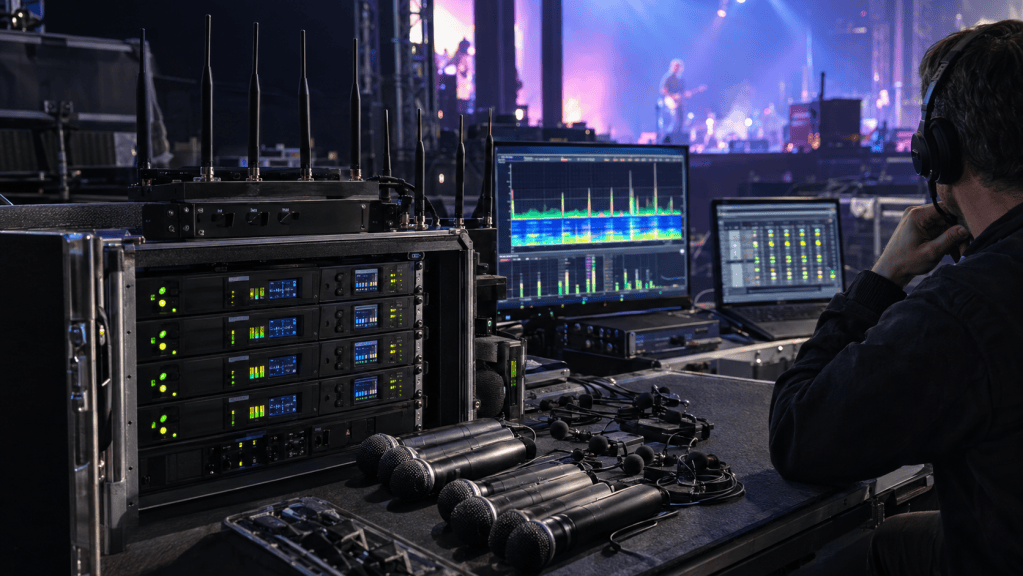
Sennheiser Wireless Microphone Innovation Reshapes Live Event Workflow
Sennheiser is underscoring a shift in how production teams, broadcasters, and live sound professionals approach wireless microphone technology, describing it as “a different way of thinking about wireless.” The focus is on using spectrum more efficiently, simplifying operation in demanding environments, and aligning radio systems more closely with contemporary production workflows.
As live events, conferences, exhibitions, and broadcast productions rely on ever larger channel counts and denser RF environments, wireless systems are expected to deliver both rock-solid reliability and flexible deployment. Sennheiser is positioning its latest generation of wireless solutions to address these pressures, emphasizing smarter frequency management, networked control, and streamlined setup for production crews.
Key Challenge Of Spectrum And Channel Density In Live Event Production
Across touring, corporate events, and installed venues, one of the biggest challenges is fitting more wireless channels into increasingly crowded spectrum. Regulatory changes and the growth of competing wireless services have tightened the available bands, forcing engineers to think more strategically about planning and managing RF.
Sennheiser highlights that the traditional model of simply assigning open frequencies is no longer sufficient for many productions. Instead, event and broadcast teams need systems that help them understand spectrum in real time, automatically coordinate frequencies, and maintain stability even when conditions change during a show or conference.
This perspective is particularly relevant for:
-
Large multi-room conferences where many breakout sessions run simultaneously
-
Complex live productions combining in-person, hybrid, and broadcast elements
-
Venues that must support multiple productions or incoming touring shows in the same RF environment
Core Benefit Of Modern Wireless Microphone System Design
The new mindset around wireless, as Sennheiser presents it, centers on making RF complexity more manageable without sacrificing performance. Modern wireless system design aims to improve daily workflows for RF coordinators, audio engineers, and integrators, rather than only focusing on raw technical specifications.
Key elements of this approach include:
-
Smarter spectrum use that allows higher channel density in limited bandwidth
-
Networked monitoring so engineers can oversee large systems from a central location
-
More intuitive tools that reduce setup time for visiting productions and rental partners
By aligning wireless technology more closely with actual show workflows, Sennheiser seeks to help teams focus on content and audience experience instead of troubleshooting RF throughout an event day.
Impact On Conference, Corporate, And Touring Audio Workflow
For conference and corporate environments, the described way of thinking about wireless translates into more predictable system behavior across multiple rooms and event formats. Rental companies and in-house venue teams benefit from the ability to scale systems quickly, adjust to last-minute room changes, and keep spoken word intelligibility stable despite challenging RF conditions.
In touring and live music, the same principles support higher channel counts and more redundant signal paths for critical applications such as headsets, in-ear monitoring, and handheld microphones. This allows production teams to adapt to different venues while maintaining consistent performance night after night.
For hybrid productions that blend on-site audiences with streaming or broadcast, robust wireless infrastructure is a core reliability layer. The Sennheiser perspective emphasizes designing RF systems that can be centrally managed alongside audio-over-IP and other networked technologies.
Relevance For Venue Technology And System Integration
The shift in thinking around wireless also affects long-term planning for venues and integrators. Instead of specifying systems purely on channel counts, design teams are increasingly evaluating how wireless platforms integrate with control networks, monitoring tools, and existing IT infrastructure.
Sennheiser is steering attention toward solutions that fit into broader AV-over-IP and networked audio strategies. This includes:
-
Allowing technicians to monitor RF status from control rooms and backstage
-
Supporting repeatable presets for recurring event formats in the same venue
-
Creating clearer handover processes between in-house teams and external production partners
For exhibition centers, convention venues, and multipurpose arenas, this mindset helps ensure that wireless systems remain flexible enough for a wide variety of guest productions while retaining central oversight and control.
Future Direction Of Wireless Microphone Workflow
While Sennheiser does not tie its message to a single product or specification, the company frames its latest developments as part of an ongoing evolution in RF strategy for professional audio. The emphasis on “a different way of thinking about wireless” points toward systems that are more aware of their environment, easier to coordinate across large sites, and better integrated into wider event technology ecosystems.
For event organizers, technical directors, and AV providers, this direction underlines the need to treat wireless infrastructure as a strategic asset rather than a last-minute technical checkbox. As channel requirements grow and spectrum becomes more competitive, Sennheiser’s focus on workflow-centric wireless design aims to support more resilient and scalable live productions.