Primavera Sound Extends K Series Coverage Across 182 Metres
Festival audience field drives large scale sound system design
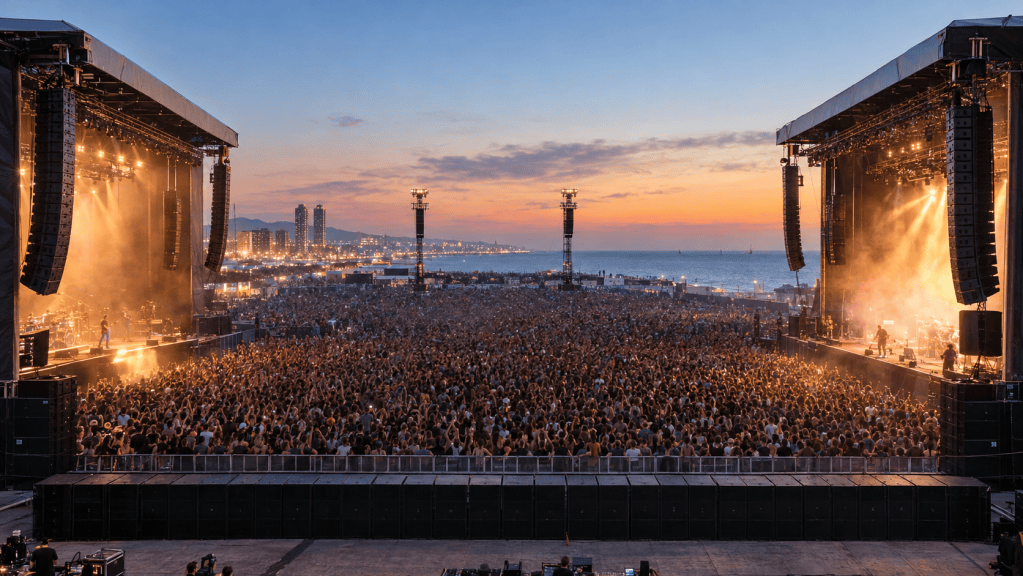
Primavera Sound has pushed large scale festival sound system design at its 24th edition in Barcelona, working with long term partner Twincam Pro International and L-Acoustics to deliver consistent coverage across a 182 metre audience field at Parc del Fòrum, while keeping sound away from neighbouring stages and the nearby residential city.
The 2026 edition of Primavera Sound again took place on the seafront site on the edge of Barcelona, with twin main stages Estrella Damm and Revolut sharing a single audience field and alternating performances from mid afternoon into the early hours. Headliners including The Cure, Gorillaz, Doja Cat, The xx, Skrillex and My Bloody Valentine played to crowds of 70,000 to 75,000 people in front of the main stages.
With the sea on one side, apartments and the wider city on the other, plus six additional stages around the perimeter, the technical brief for sound reinforcement placed a premium on even audience experience and strict noise control. Primavera Sound Audio, Video and Broadcast Manager Pedri González defined success in terms of tonal consistency and directivity, rather than maximum level alone, with the goal that the mix and artistic content would be perceived similarly wherever audience members stood.
Parc del Fòrum terrain and noise limits shape system approach
The Parc del Fòrum site presents several acoustic and logistical challenges. The terrain is irregular, and site constraints allow just a single delay speaker location, positioned 88 metres from the twin stages behind the front of house control position. A 10 metre high wall closes the field at around 220 metres and can reflect energy back into the audience. A VIP grandstand sits to one side, a further festival stage is located roughly 230 metres behind the rear right of the field, and the urban area begins just beyond the perimeter fence.
Weather adds further complexity. Being on the water, the site experiences significant shifts in temperature and humidity between afternoon and night, and the wind blows in off the sea throughout the three festival days. These variables increase the importance of precise system modelling, coverage control and real time optimisation.
Twincam Pro International, formerly Twincam Audio, has supported Primavera Sound since 2004 and supplies L-Acoustics systems to the Estrella Damm and Revolut stages, the Plenitude stage and the Cupra Pulse stage. Fellow L-Acoustics partners Ara So and TST reinforce the wider site, with Ara So handling the Cupra stage and TST providing systems for the Schwarzkopf and Port stages.
Soundvision modelling defines coverage and delay strategy
System design begins around six months before each edition, when Twincam Pro International System Engineer Josep María Riera reopens the previous year’s configuration in L-Acoustics Soundvision and reviews updated site drawings. At the same time he coordinates with local authorities overseeing environmental noise control around the Fòrum.
Because there is only one delay position available, the main arrays must cover more distance than is typical for a festival of this scale. The long throw section at the top of each L-Acoustics K1 array is tasked with reaching 116 metres, and the full main system extends coverage to 125 metres. Two K2 delay towers at 88 metres overlap the lower portion of the main arrays across roughly 8 metres, and together the systems provide coverage to 182 metres while deliberately stopping short of the rear wall so that it is not excited.
According to the measurements achieved on site, sound pressure level drift between the barricade and a listener at 160 metres is held to less than 3 dB, and to less than 6 dB for listeners at 180 metres. The aim is to maintain tonal balance and level stability from front to back, in line with the festival’s brief.
Main system layout uses K1, K2 and Kara II
Each of the two main stages flies left and right arrays of 16 K1 over four K2, with eight K1-SB subwoofers flown directly behind every main hang for extended low frequency control. Ground stacked low frequency reinforcement is provided by 99 KS28 subwoofers, deployed as 33 stacks of three in a single line spanning nearly 70 metres across the front of both stages.
On the Estrella Damm stage, an L-shaped out fill comprising eight K1 over eight K2 covers the lateral VIP grandstand at distances of up to 120 metres. On the Revolut stage, where the priority is to minimise spill towards the city and a neighbouring stage, the out fill is deliberately smaller, using eight K2.
Front fill for the shared barricade line is handled by 37 Kara II enclosures arranged across 17 positions. Each stage has seven pairs along its portion of the barricade, a decoupled cluster of three enclosures sits between the two stages, and another cluster of three is placed at each outer corner of the overall stage structure. Behind front of house, the two delay towers each fly 16 K2 to complete the long throw coverage.
In total the twin main stages field 304 L-Acoustics enclosures. System drive comes from 113 LA12X amplified controllers housed in 38 LA-RAK II touring racks. Six P1 processors form a redundant Milan AVB network, backed by an analogue fallback loop. A Luminex GigaCore core and a pair of L-Acoustics LS10 switches in each rack distribute Milan streams, with LA Network Manager used for monitoring and control.
Cardioid subwoofer design keeps low frequency energy inside
The KS28 line across the front of the stages is configured in cardioid mode to reduce rear radiation towards the city and the adjoining stages. Each three box stack runs two cabinets facing forward and one facing back on the KS28_C preset, a two to one ratio chosen for rear cancellation performance relative to forward output. Ground coupling reinforces the pattern and contributes to the overall cardioid behaviour of the line.
No electronic arc delay is applied across the KS28 line because the number of active stacks changes between performances. When only one stage is in use, engineers may enable a subset of the line, while a headliner across the full field can call on all 33 stacks. With nearly 70 metres of physical length, the line achieves the required coverage without delay shading.
In the air, the eight K1-SB behind each main hang are run parallel to the top eight K1, extending controlled low frequency response to long distances and further improving rear rejection. The combination of flown subs and the ground based cardioid array gives the design team fine control over the low end footprint.
Asymmetric out fills reduce spill towards the city
The differing scale of the two out fill systems illustrates the project’s emphasis on environmental control. Sixteen enclosures face the sea, where coverage is required for the VIP grandstand and there is minimal risk of residential disturbance. Eight enclosures face the city, where every decibel leaving the site risks entering nearby homes and where an additional festival stage stands 230 metres behind the audience.
This asymmetric strategy is applied across other coverage zones, with the final day on site dedicated to measuring environmental noise inside and outside the festival perimeter. González notes that Primavera Sound has seen clear improvements in acoustic impact management towards the city and between stages, crediting better system optimisation, directivity control and precise level management for the reduced spill while maintaining audience impact inside the venue.
Unified system control supports twin stage operation
Because Estrella Damm and Revolut share a single audience field, the reinforcement system must behave as one. Both front of house consoles feed a unified master control, enabling the team to decide which parts of the overall rig are active for each performance and to scale coverage according to the size and distribution of the audience in front of the stages.
This approach simplifies changeovers, with Riera reporting that transitions between acts do not create operational issues at system level. Real time optimisation is further supported by the Autoclimate function in LA Network Manager, which reads temperature and humidity data from sensors on the P1 processors and automatically adjusts air compensation filters zone by zone as conditions evolve from day into night. While wind off the sea remains an ongoing challenge, the automation helps stabilise tonal balance across the field.
Manufacturer support and engineer feedback validate design choices
L-Acoustics staff supported Twincam Pro International during pre production and across the live days. Technical liaison Andy Carrington acted as a contact point for headliners’ front of house and systems engineers, while Eva Argandoña provided commercial support and Tom Laveuf and Rafael Pereira offered technical field assistance during deployment and operation.
Riera highlights the importance of this collaboration, pointing to streamlined communication with visiting engineer teams and smoother integration between festival infrastructure and artist requirements. He characterises successful system design as achieving what he calls the success of indifference, where no one comments on the sound because it simply works.
At Primavera Sound 2026, however, the main system drew explicit praise. Systems engineers and front of house operators for headliners including The Cure reported that the system sounded excellent across the field and required minimal adjustment. For González, the perceived midrange clarity and punch, particularly in conditions where wind can easily disrupt that frequency band, underline why Primavera Sound continues to specify the L-Acoustics platform as an international standard that is dependable, straightforward to tune and well received by artists.
With demand for major outdoor events continuing to rise alongside tighter environmental regulations, the Primavera Sound deployment at Parc del Fòrum demonstrates how large format systems, detailed modelling and networked control can be combined to deliver both audience impact and urban sound containment.