Sennheiser Shifts Wireless Microphone Strategy With d:note Program
Sennheiser Wireless Microphone Strategy Emphasizes System Flexibility
Sennheiser is promoting a different way of thinking about wireless microphone systems, focusing less on individual devices and more on long term system design, scalability, and spectrum efficiency for event and venue environments. Under this approach, wireless audio is treated as core infrastructure that has to be planned strategically across rooms, productions, and entire facilities, rather than as a standalone purchase for a single stage or meeting.
The perspective reflects how wireless demand in live events, corporate spaces, education, and broadcast continues to grow while usable spectrum remains limited. Sennheiser is encouraging audio professionals, integrators, and venue operators to think in terms of frequency planning, coordination, and interoperability across multiple systems and locations.
d:note Program supports Wireless Microphone Planning
At the center of this mindset shift is Sennheiser’s d:note program, which is designed to support more robust planning and deployment of wireless microphone solutions. The program is positioned as a structured way for professionals to evaluate current and future needs, looking at channel counts, coverage areas, interference risks, and the long term evolution of wireless use in a building or campus.
d:note encourages teams to consider how different spaces and event formats share wireless resources over time. Instead of specifying wireless channels room by room in isolation, the program promotes a holistic view that optimizes frequency allocations and equipment configurations across all applications, from conference rooms and lecture halls to performance stages and hybrid event setups.
Program emphasis on Spectrum Management and Coordination
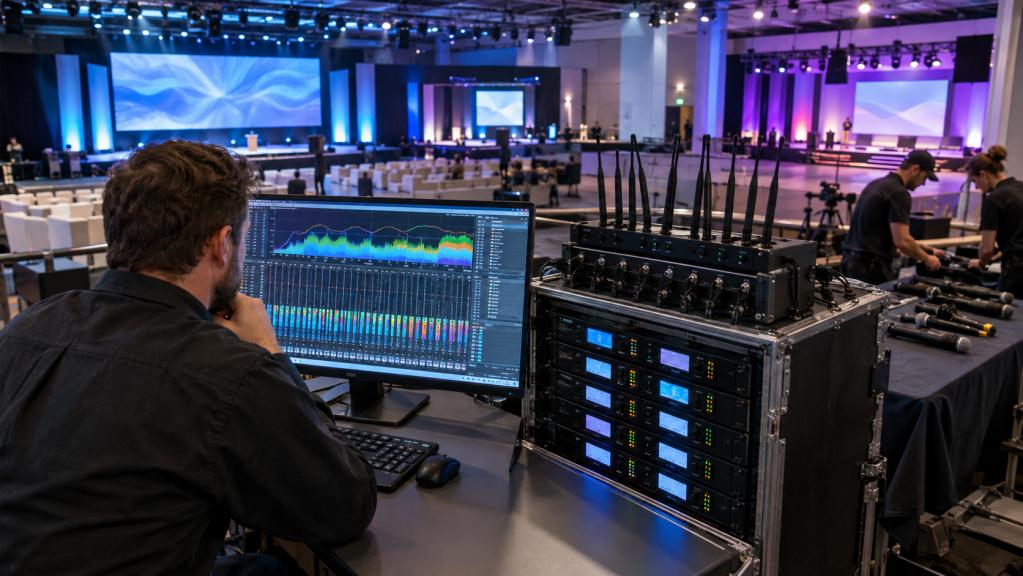
A key element of the d:note concept is coordinated spectrum management. As more microphones, in ear monitors, and other RF devices compete for space, Sennheiser underlines the importance of careful frequency coordination to avoid dropouts and interference. The program framework encourages early assessment of local spectrum conditions and expected growth in wireless demand.
This approach is particularly relevant for venues that host multiple events simultaneously, touring productions, or hybrid conferences with additional RF requirements for streaming and translation systems. By addressing spectrum constraints at the planning stage, the d:note methodology aims to reduce the risk of last minute changes and on site troubleshooting.
Impact on Event Production and Venue Technology Strategy
For event production teams and venue technology managers, the shift in perspective affects how wireless is specified, purchased, and maintained. Instead of building systems around individual shows or tenants, Sennheiser’s messaging around d:note supports lifecycle planning that looks at how equipment will serve multiple productions over years, not just a single season.
This can influence decisions about platform compatibility, networked control, redundancy, and the balance between fixed and portable inventory. It also encourages collaboration between technical directors, IT departments, and external rental or production partners to ensure that wireless infrastructure can flex with changing event formats, from traditional conferences to immersive and experiential activations.
Relevance for Integrators and Rental Companies
Systems integrators and rental companies are another focus of the d:note driven approach. By planning wireless capacity and coverage more strategically, service providers can design solutions that scale more predictably, support repeat clients across multiple venues, and reduce the complexity of ad hoc deployments.
This may include standardizing on certain frequency ranges, anticipating regional regulatory changes, and building templates for commonly used configurations in corporate, education, worship, and entertainment environments. The overarching goal is to offer wireless solutions that are resilient, adaptable, and easier to manage across the full lifecycle of events.
Outlook for Wireless Audio in Live and Hybrid Events
The framing of wireless as a strategic infrastructure resource aligns with broader trends in live and hybrid events, where audio systems are increasingly networked and centrally managed. While individual products and technical specifications remain important, Sennheiser is highlighting that success in complex RF environments often depends on planning, coordination, and long term thinking as much as on any single device.
As demand for flexible, high quality wireless audio continues to increase in conferences, exhibitions, performance venues, and corporate campuses, approaches like the d:note program are intended to help event professionals and venue operators navigate spectrum limitations, scale more confidently, and maintain consistent audio reliability across diverse productions.