Inspectorate urges UK review of event public safety rules
Public safety arrangements at events across the UK should be reviewed by government to address inconsistencies and emerging risks, a new report from His Majesty’s Inspectorate of Constabulary and Fire & Rescue Services (HMICFRS) has recommended.
The inspectorate’s findings recognise significant advances in safety at designated sports grounds in recent decades, but conclude that wider event environments are governed by a more fragmented framework, leaving potential vulnerabilities in planning, oversight and accountability.
Background and industry context
HMICFRS is responsible for assessing the effectiveness and efficiency of police forces and fire and rescue services in England and Wales. Its work increasingly touches on how these services collaborate with local authorities, emergency responders and event organisers to manage large crowds at sporting events, concerts, festivals, fan zones and other public gatherings.
Safety at sports venues has historically been shaped by high-profile disasters and subsequent legislative reforms, including the introduction of safety certification regimes and national guidance for football and other stadium-based events. As a result, many professional sports grounds operate under clear licensing frameworks, detailed safety management plans and regular inspection regimes.
In contrast, public safety for non-sporting events and temporary venues is often governed by a mix of local authority licensing processes, event-specific risk assessments and advisory group oversight. While many organisers follow strong professional standards and established guidance, the inspectorate notes that the regulatory environment outside sports grounds can be less consistent and relies heavily on local interpretation and available expertise.
Key developments and recommendations
The new HMICFRS report calls on central government to conduct a comprehensive review of how public safety at events is organised, coordinated and regulated. The inspectorate points to the progress achieved at sports grounds as evidence that a more structured and coherent approach can reduce risks and improve outcomes for attendees, staff and communities.
Among its central observations, the report highlights:
- Clearer national expectations: While sports grounds often operate under specific safety legislation and guidance, many other event types are subject to a patchwork of rules, codes and voluntary standards. The inspectorate suggests that a government-led review could consider whether more unified expectations are needed.
- Consistency in local practice: Safety Advisory Groups (SAGs), multi-agency forums used by many local authorities to review event plans, are not mandated or operated in a uniform way. The report indicates that this variability may result in differing levels of scrutiny and expertise from region to region.
- Defined roles and responsibilities: The inspectorate notes that police, fire services, local authorities and organisers can sometimes have differing views on their respective responsibilities, particularly for events held in public spaces or in venues without formal certification regimes.
- Evolving risk landscape: Changes in crowd behaviour, new event formats, hybrid and dispersed event models, and ongoing concerns around terrorism and serious crime are reshaping the risk profile for public gatherings. The report argues that safety arrangements should reflect these shifts.
HMICFRS does not propose a single prescriptive model but urges ministers and policymakers to consider whether existing legislation, guidance and multi-agency arrangements remain fit for purpose against current and future event patterns.
Potential impact on the events ecosystem
If government takes forward the recommendation for a review, event organisers, venue operators and technology providers can expect closer scrutiny of how they contribute to risk assessment, crowd management and incident response.
Areas of potential impact include:
- Licensing and compliance: Local authorities may be encouraged to adopt more standardised approaches to reviewing event safety plans, potentially increasing the need for detailed documentation and demonstrable mitigation measures.
- Multi-agency planning: Stronger expectations around collaboration between police, fire services, medical providers and organisers could formalise processes that are currently advisory in nature.
- Data and technology: There may be a greater focus on evidence-based decision-making, using data, digital tools and analytics to understand crowd flows, capacity thresholds and emergency egress options.
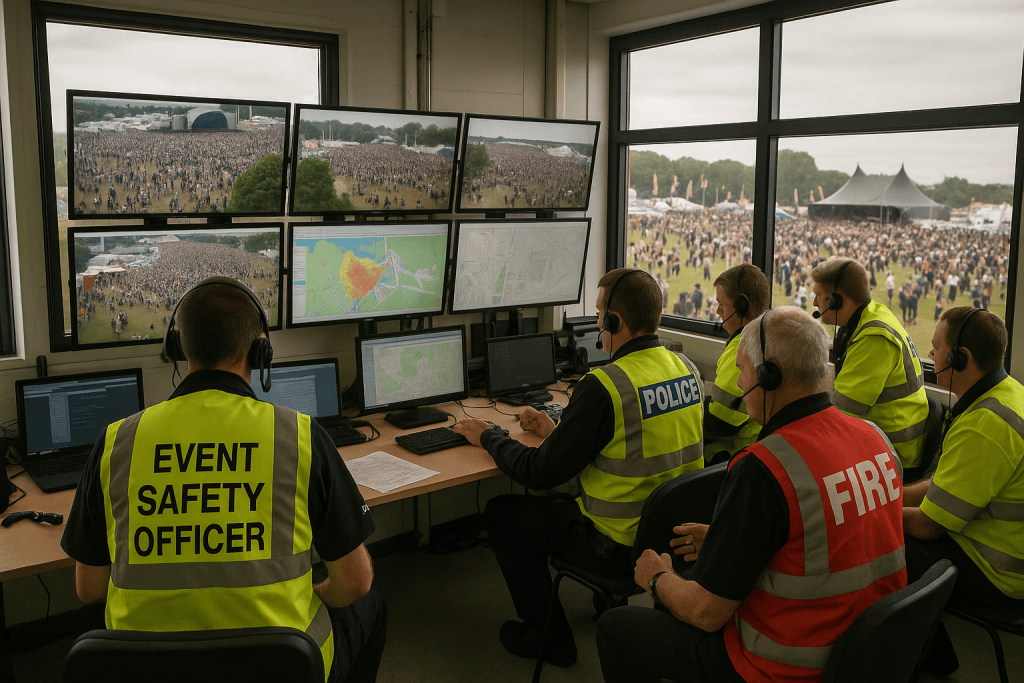
- Training and competence: A tighter framework could place more emphasis on formal training and accreditation for safety officers, control room teams and other key personnel involved in event operations.
For the sports sector, the report largely confirms that existing safety regimes have driven measurable improvements. However, it also signals that the expectations placed on established stadiums could increasingly be extended or adapted to festivals, city-centre gatherings, fan zones, exhibitions and hybrid events that bring together physical and digital audiences.
Why this matters for event professionals and technology providers
The inspectorate’s call for a government review comes at a time when the events industry is balancing recovery, innovation and risk management. Organisers are experimenting with new formats, higher-frequency events and more complex site layouts, while attendee expectations on safety, information and accessibility continue to rise.
For event professionals, any move towards clearer national standards would likely require closer alignment between operational planning and formal safety frameworks. This could mean:
- Earlier integration of safety and security specialists into event design.
- More structured use of risk modelling, capacity calculations and scenario planning.
- Enhanced documentation of command structures, communication protocols and escalation procedures.
For technology vendors, the report underlines a growing demand for tools that support transparent, auditable and collaborative safety planning and operations, such as:
- Crowd intelligence and real-time monitoring platforms.
- Incident management and logging systems shared across agencies.
- Access control, ticketing and digital identity solutions that feed live occupancy data.
- Simulation and digital twin tools for testing site layouts and evacuation plans.
As public sector stakeholders review their expectations, suppliers that can demonstrate compliance support, data security and interoperability with emergency services systems are likely to be better positioned in procurement processes and partnership discussions.
Conclusion
The HMICFRS report marks a further step in the ongoing evolution of public safety arrangements at events, reflecting both lessons learned from the sports sector and the changing nature of large-scale gatherings. By urging the UK government to reassess how responsibilities, standards and oversight are organised, the inspectorate is signalling that current approaches may not fully match today’s risk environment.
For organisers, venues and technology companies, the direction of travel is towards more structured, data-informed and collaborative models of safety management. While any future regulatory changes would take time to develop and implement, the themes highlighted in the report suggest that proactive investment in safety planning, training and technology will become an increasingly important part of event strategy and procurement decisions.