
Isla report exposes high waste costs from single-use event materials
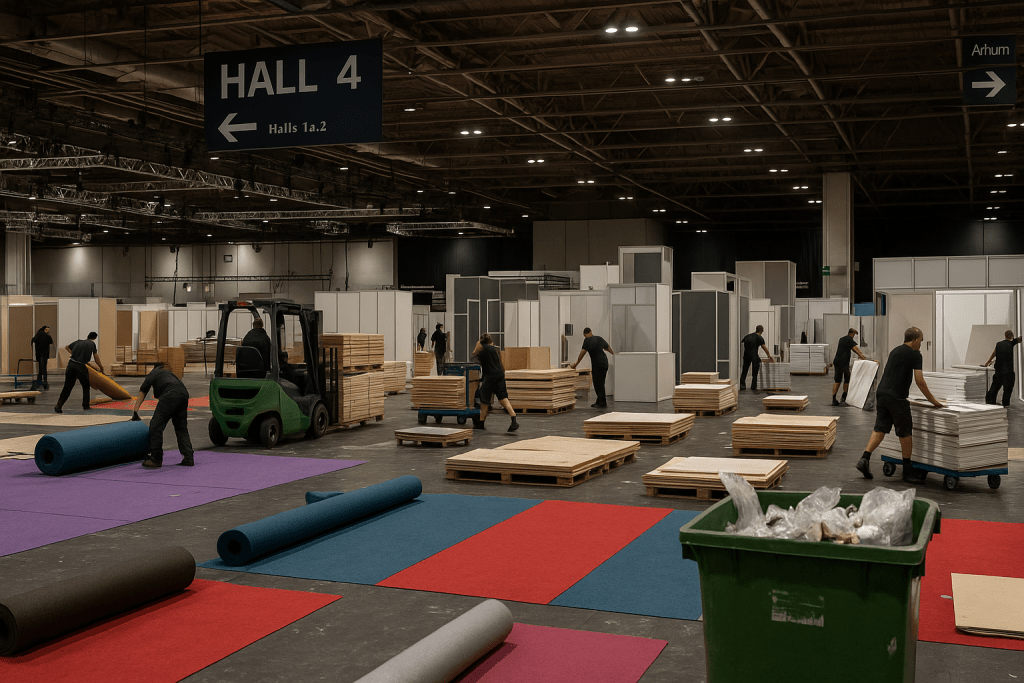
Event sustainability body isla has published new data that quantifies the financial and environmental impact of single-use materials in event production, highlighting a significant opportunity for cost savings and carbon reduction across the sector.
The report, the first in isla’s new “A Closer Look” series, examines how materials are specified, used and disposed of in live events. It finds that the industry remains heavily reliant on virgin materials and single-use builds, with flooring materials, particularly carpet, emerging as a major source of emissions and waste disposal costs.
Background and industry context
As brands, agencies and venues face growing pressure to demonstrate credible sustainability strategies, event materials are moving up the agenda. Stands, stages, signage, set dressing and flooring are all high-visibility elements for attendees, but often have short lifespans and complex recycling routes. Historically, many of these components have been designed for one-off use, then sent to landfill or energy-from-waste.
Regulatory scrutiny is also increasing. Extended Producer Responsibility (EPR) frameworks, waste reporting requirements and corporate ESG targets are prompting organisers and suppliers to re-evaluate what they build with, how long it is used and what happens at end-of-life. Despite this, consistent data on material flows in events has been limited, making it difficult for organisations to benchmark performance or make informed design decisions.
Isla’s latest work aims to address that gap by providing measurable insight into how event materials contribute to both emissions and operational expenditure, and where practical interventions could have the greatest effect.
Key findings from the new isla report
The data-led report surfaces several headline statistics that underline how entrenched single-use practices remain in event production:
- 84% of event materials are virgin: The vast majority of materials used in event builds come directly from primary resources rather than recycled or reused stock. This has implications for embodied carbon and supply chain resilience.
- 42% of build materials are used only once: Nearly half of the materials going into stands and structures are discarded after a single deployment, creating a large volume of waste and redundant spend.
- Carpet is the highest-emitting material in event builds: Flooring, especially carpet used as a default option, is identified as the top emitting material category in the builds assessed. Its short lifespan and limited reuse contribute disproportionately to event footprints.
Isla’s analysis indicates that single-use disposal of event materials is already costing the industry close to half a million pounds in measured cases alone. As the organisation notes, this figure only reflects the projects that have been tracked, suggesting the true cost across the wider market is likely to be substantially higher.
The report underscores that material choices are not only an environmental issue but also a budgetary one. Items that are designed, printed, built and transported for limited use before disposal represent sunk cost that brings no ongoing value once an event closes.
Industry impact and operational implications
The findings are likely to resonate across exhibition organisers, production houses, agencies, venues and suppliers who are under pressure to reduce both carbon and costs. The evidence that such a high proportion of build elements are single-use may prompt organisations to reassess procurement practices, build specifications and creative briefs.
Carpet’s position as the leading emitting material type in event builds is particularly significant for large exhibitions and trade shows, where hall-wide carpeting remains a standard feature. For organisers managing multiple events or portfolios, the cumulative impact of this one material choice can be substantial.
Suppliers that have already invested in modular systems, rental stock, reusable walling and alternative flooring options may find increasing demand as organisers look for practical pathways to improve material circularity. Equally, design teams may be encouraged to prioritise modularity, standard dimensions and ease of disassembly to enable reuse and reduce waste handling at the end of each event.
From a reporting perspective, more granular data on materials gives organisers a clearer route to integrating build-related emissions into event carbon calculations. As brands seek to align activations with corporate sustainability commitments, the ability to evidence improvements in material efficiency and reuse rates could become a competitive differentiator.
Why this matters for event professionals and technology providers
For event professionals, the report reinforces that material decisions made during planning and design stages can have as much impact on footprint as decisions around travel or catering. It suggests that teams should scrutinise assumptions such as default carpeting, bespoke one-off structures and printed elements that cannot be repurposed.
In practice, this may mean closer collaboration between sustainability leads, production managers, designers and procurement to ensure that circularity is embedded at brief stage, rather than as a post-event waste management exercise. Contracting models may also evolve to incorporate reuse targets, take-back schemes or incentives for lower-waste builds.
Technology providers have a distinct role to play. Digital tools that track material inventories, manage asset lifecycles, and support carbon and cost modelling can help organisers compare scenarios and make more informed choices. Platforms that capture data on how often items are redeployed, where they are stored and how they are transported can highlight underutilised assets and support sharing or rental models.
In addition, event tech that enables hybrid or digital-first experiences can, in some cases, reduce the need for physical builds and printed collateral. However, the report’s focus on material flows at in-person events confirms that physical infrastructure is likely to remain central, making optimisation rather than elimination the priority for most organisers.
For venues and exhibition centres, the data suggests an opportunity to revisit standard fit-out packages and contractor frameworks. Offering alternative flooring systems, modular walling, or centralised pools of reusable assets could help anchor more circular approaches across multiple tenant events.
Conclusion
Isla’s new analysis puts numbers behind what many event professionals have long suspected: that single-use materials, particularly flooring, are a major drain on both sustainability performance and budgets. With 84% of materials still virgin and 42% of build components used once before disposal in the measured sample, the report indicates a sizeable gap between current practice and the sector’s stated sustainability ambitions.
For organisers, agencies, venues and suppliers, the findings provide a data-backed rationale to accelerate the shift towards reusable systems, smarter material selection and better tracking. As the industry continues to refine its approach to net zero and circularity, the cost and carbon tied up in one-off builds is likely to come under increasing scrutiny.
The report also signals that greater transparency around materials can unlock practical, near-term improvements that do not rely on breakthrough technologies. By addressing the fundamentals of what is built, how often it is used and how it is managed at end-of-life, event professionals have a clear opportunity to cut waste, reduce emissions and improve the financial efficiency of their productions.


