Bluetooth Low Energy (BLE) Beacons: The Ultimate Tool for Hyper-Local Sponsor Nudges
The modern event industry has entered an era where attendee engagement is increasingly driven by context rather than mass communication. Generic push notifications, untargeted promotional emails, and broad digital advertising are losing effectiveness as attendees expect experiences that are timely, relevant, and personalized. Sponsors, meanwhile, want measurable engagement that goes beyond logo placement and booth impressions.
Bluetooth Low Energy (BLE) beacon technology is helping bridge these expectations. By enabling precise indoor location awareness, BLE beacons allow event organizers to deliver hyper-local content based on an attendee’s real-time position within a venue. Instead of sending identical messages to every participant, organizers can trigger personalized sponsor offers, educational content, navigation assistance, networking opportunities, and interactive experiences exactly when they are most relevant.
In 2026, BLE beacons have evolved beyond simple proximity marketing tools. Integrated with artificial intelligence, event mobile apps, customer relationship management (CRM) platforms, digital twins, and real-time analytics, they are becoming one of the most powerful technologies for creating personalized attendee journeys while maximizing sponsor return on investment.
For conferences, exhibitions, trade shows, and corporate events, BLE beacons are redefining location-based engagement.
Understanding Bluetooth Low Energy Beacons
Bluetooth Low Energy is a wireless communication technology designed to transmit small amounts of data while consuming minimal power.
BLE beacons are compact transmitters that continuously broadcast unique identifiers.
Nearby smartphones or wearable devices running an event application detect these signals and determine proximity to individual beacon locations.
Unlike GPS, which performs poorly indoors, BLE provides reliable indoor positioning throughout exhibition halls, convention centers, and event venues.
Because beacons operate with extremely low power consumption, batteries can often last several years without replacement.
Why Hyper-Local Engagement Matters
Traditional event communication typically relies on scheduled notifications or broad audience segmentation.
These approaches often ignore an attendee’s immediate context.
For example:
- A lunch promotion may be delivered after an attendee has already left the food court.
- A sponsor message may reach attendees who are nowhere near the exhibitor’s booth.
- Session reminders may arrive after presentation rooms have reached capacity.
BLE technology solves this problem by adding location awareness.
Communications are delivered precisely when attendees enter defined physical areas.
This significantly increases relevance while reducing notification fatigue.
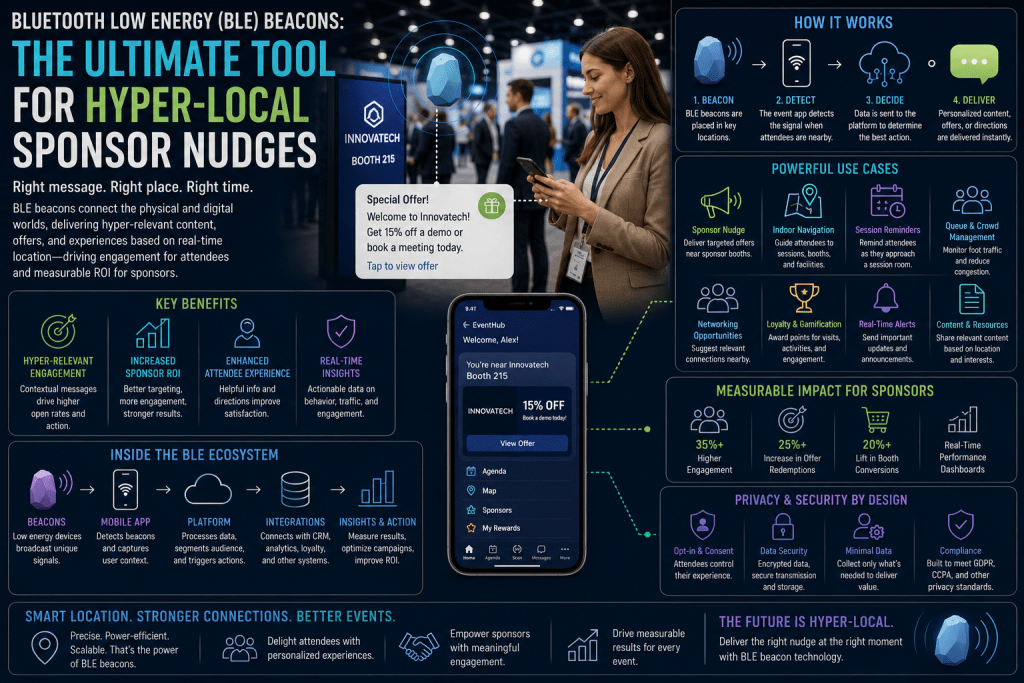
How BLE Beacon Systems Work
A typical beacon deployment consists of several integrated components.
Beacon Infrastructure
Small BLE transmitters are installed throughout strategic venue locations including:
- Exhibit booths
- Session rooms
- Registration areas
- Networking lounges
- Food courts
- VIP zones
- Product demonstration spaces
Each beacon broadcasts a unique identifier.
Mobile Event Application
The official event app detects nearby beacons after attendees grant Bluetooth and location permissions.
The application interprets beacon proximity and determines which actions should occur.
Cloud-Based Decision Engine
Backend platforms evaluate:
- Attendee profile
- Schedule
- Preferences
- Sponsor campaigns
- Loyalty status
- Real-time location
Artificial intelligence determines which message or action is most appropriate.
Delivering Hyper-Local Sponsor Nudges
BLE beacons enable sponsors to engage attendees at precisely the right moment.
Booth Proximity Notifications
When an attendee approaches an exhibitor’s booth, the event app can automatically deliver:
- Product demonstrations
- Meeting invitations
- Exclusive discounts
- Educational resources
- Appointment reminders
The interaction feels timely rather than intrusive.
Personalized Product Recommendations
AI combines location data with attendee interests.
Rather than promoting every product equally, sponsors can recommend solutions aligned with:
- Industry
- Job role
- Previous interactions
- Session attendance
- Purchase intent
This improves both engagement and lead quality.
Time-Sensitive Promotions
Sponsors can launch limited-time offers triggered only within specific physical locations.
Examples include:
- Free product samples
- VIP demonstrations
- Flash discounts
- Exclusive networking invitations
These campaigns encourage immediate action.
Enhancing the Attendee Journey
BLE technology supports far more than sponsor marketing.
Indoor Navigation
Beacons guide attendees through complex venues using turn-by-turn indoor navigation.
Visitors can easily locate:
- Session rooms
- Exhibitor booths
- Meeting spaces
- Food areas
- Restrooms
- Emergency exits
This improves overall event accessibility.
Session Assistance
As attendees approach presentation rooms, applications can provide:
- Agenda reminders
- Speaker biographies
- Presentation materials
- Seating availability
This creates a smoother educational experience.
Networking Opportunities
Location awareness enables intelligent networking suggestions.
When attendees with shared interests enter similar areas, applications can recommend potential professional connections.
AI-Powered Personalization
Artificial intelligence dramatically expands beacon capabilities.
Behavioral Intelligence
Machine learning continuously evaluates:
- Walking patterns
- Session attendance
- Purchase behavior
- Booth interactions
- Content engagement
These insights improve message relevance throughout the event.
Predictive Engagement
AI can identify attendees likely to disengage and trigger personalized incentives designed to increase participation.
Examples include:
- Coffee vouchers
- Session recommendations
- Sponsor rewards
- Networking invitations
Adaptive Campaign Optimization
Campaign performance is analyzed continuously.
The system automatically adjusts notification timing, messaging, and targeting to improve engagement rates.
Sponsor Analytics and ROI Measurement
BLE systems generate detailed engagement metrics.
Sponsors can measure:
- Booth visits
- Dwell time
- Repeat interactions
- Conversion rates
- Offer redemption
- Navigation paths
These analytics provide a far more comprehensive understanding of attendee behavior than traditional lead retrieval systems.
This supports more accurate ROI calculations.
Integration with Smart Event Platforms
BLE beacons are increasingly integrated with broader event technology ecosystems.
Customer Relationship Management
Beacon interactions synchronize directly with CRM platforms.
Sales teams receive richer engagement histories before following up with prospects.
Loyalty Programs
Location-based activities can automatically earn attendees:
- Reward points
- Digital badges
- Prize entries
- VIP upgrades
This encourages greater participation across the venue.
Digital Twins
Digital twin platforms combine beacon data with virtual venue models.
Organizers gain live visibility into:
- Crowd movement
- Congestion areas
- Popular exhibits
- Traffic patterns
This improves operational decision-making.
Privacy and Data Governance
Location-aware technologies require responsible implementation.
User Consent
Attendees should explicitly choose whether to enable location-based services.
Participation should remain voluntary.
Transparent Data Policies
Organizers should clearly explain:
- What information is collected
- How location data is used
- Data retention periods
- Sharing policies
Transparency builds attendee trust.
Secure Data Processing
BLE platforms should implement:
- Encryption
- Secure authentication
- Role-based access controls
- Compliance with applicable privacy regulations
to protect participant information.
Challenges and Deployment Considerations
Successful beacon deployments require careful planning.
Signal Calibration
Beacon placement affects positioning accuracy.
Improper installation can create overlapping signals or inconsistent detection.
Mobile Adoption
Hyper-local experiences depend on attendees:
- Downloading the event app
- Enabling Bluetooth
- Granting permissions
Clear communication improves participation rates.
Notification Fatigue
Sending excessive messages reduces effectiveness.
Successful deployments prioritize relevance over frequency.
The Future of BLE in Live Events
BLE technology continues evolving alongside broader event innovation.
Emerging developments include:
- AI-generated engagement journeys
- Integration with augmented reality experiences
- Smart wearable connectivity
- Predictive crowd management
- Autonomous marketing optimization
- Real-time digital twin synchronization
- Context-aware voice assistants
These capabilities will make location-based engagement increasingly intelligent and personalized.
Conclusion
Bluetooth Low Energy beacons have become one of the most valuable technologies for delivering hyper-local engagement at modern events. By combining precise indoor positioning with AI-driven personalization, organizers can provide attendees with timely information, seamless navigation, and relevant sponsor interactions that feel helpful rather than disruptive.
For sponsors, BLE beacons transform proximity into measurable engagement through targeted promotions, behavioral insights, and higher-quality lead generation. For organizers, they improve attendee satisfaction, optimize venue operations, and unlock powerful analytics that support future event planning.
As event technology ecosystems become increasingly connected, BLE beacons will continue evolving from simple location transmitters into intelligent engagement platforms that connect attendees, exhibitors, sponsors, and venues in real time. The future of event marketing is no longer defined by reaching the largest audience—it is defined by reaching the right attendee at exactly the right place and moment.