Les Escales Music Festival Links Greener Power Use With Immersive L-Acoustics Sound
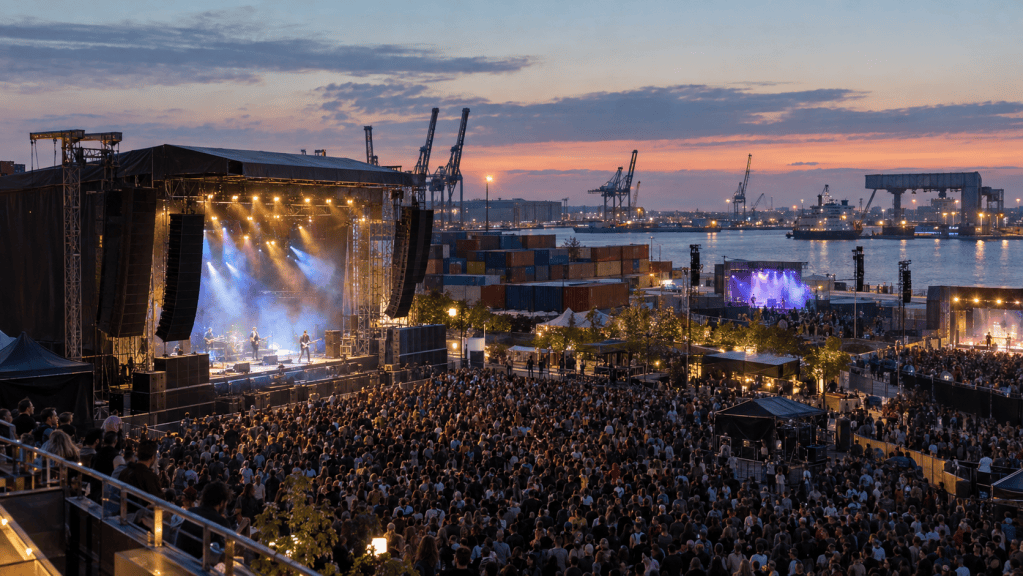
Festival Audience And Energy Footprint Share Headline At Les Escales
Les Escales music festival in Saint-Nazaire, France, has turned its compact portside site into both a live showcase for immersive sound and a test bed for lower-impact audio production. For the 34th edition in July 2026, non-profit organiser Les Escales teamed with long-term audio partner B Live and manufacturer L-Acoustics to deploy different sound systems on three stages while measuring exactly how much energy the main stage drew from the grid.
The festival, which occupies the industrial Île du Petit Maroc and programmes everything from pop and rock to rap and electro, welcomed artists including Archive, Gaël Faye and Benjamin Biolay, and opened with a private evening for 6,000 local shipyard workers. Behind the scenes, the team used L-Acoustics L2, L-ISA and L-Acoustics DJ to balance visiting artist expectations, audience experience, sound containment and a sharply controlled power budget.
Main Stage System Uses L2 To Cut Amplifier Channel Count
Certified Provider B Live, based near Nantes, has supported Les Escales with L-Acoustics systems since the festival’s early years and now partners with Saint-Nazaire company Altis on the Club 360 stage. For 2026, B Live technical director Samuel Birais worked with Les Escales technical director Julien Potin and the L-Acoustics team to re-evaluate what each stage should deliver.
On Scène du Port, the main stage run by system engineer Laurent Pinet, the team chose the new L2 line source to achieve full coverage with fewer amplifier channels. The design flew two L2 over one L2D per side, with one L2 over one L2D per side as out-fill. Low-frequency energy came from 18 KS28 subwoofers in cardioid configuration distributed left, right and centre, while four Kara II per side covered the front rows. LA7.16 and LA12X amplified controllers powered the system, with Soundvision modelling used to compare flown and ground-stacked subwoofer options before the final layout was locked.
According to Birais, the L2 configuration provided the required headroom for headliners while aligning with the festival’s decision to run on local mains power instead of diesel generators. By focusing on system efficiency and realistic power draw instead of theoretical maximums, the team could support international riders without oversizing the electrical infrastructure.
Energy Monitoring Project Feeds National Touring Research Programme
To replace assumptions about consumption with data, L-Acoustics partnered with energy monitoring specialist Visu Énergie to log electrical use across the main stage for the full duration of the festival. The measurements feed into M.A.T.R.I.C.E., a three-year French research programme examining the environmental footprint of touring, led by live music union Ekhoscènes with partners including Live Nation and L-Acoustics and backed by the national France 2030 investment plan.
Les Escales provided that initiative with something difficult to reproduce in a lab: a real, multi-day festival site running full-scale shows. L-Acoustics CSR representative Axelle Meunier notes that the L2-based system consumed significantly less energy than expected and did so in a notably linear way. This kind of evidence helps promoters and production teams judge whether they need generators at all and how to size future grid connections.
Spatial Audio On Scène Estuaire With L-ISA Configuration
While the main stage focused on efficiency, Scène Estuaire showcased spatial audio using an L-ISA configuration. B Live system engineer Pierre Tranchant deployed a frontal layout of five arrays, each comprising two A15 Focus and one A15 Wide, supported by eight KS21 subwoofers. Two X12 loudspeakers provided out-fill, and seven X8 units acted as spatial in-fill, all powered by LA12X and LA4X amplified controllers.
An L-ISA stage demands a different approach from visiting engineers compared with a conventional stereo system, yet festival schedules leave little time for experimentation. To address this, B Live and La FabSonic briefed touring engineers ahead of the event so they arrived with a clear idea of how to build object-based mixes and exploit the additional spatial resolution.
The preparation paid off in practice. For example, the engineer for French rapper Georgio reworked the touring mix during soundcheck, rebuilding it object by object to take full advantage of L-ISA’s ability to place each instrument distinctly across the frontal field. For the audience, this translated into a clearer, more immersive second stage where individual elements retained definition without excessive level.
Club 360 Dance Floor Embraces L-Acoustics DJ Immersive Processing
Club 360, an open-air dance floor surrounded by shipping containers with the DJ at the centre, has served as an experimental platform for immersive formats at Les Escales for the past two years. In 2026, it moved to L-Acoustics DJ, a real-time spatial processing solution designed for club and festival environments.
Altis, led by technical director Wojtek Rola, equipped Club 360 with two L2D and KS28 as the main system, supplemented by six stacks of one A15 Focus over one A15 Wide mounted on custom structures above the containers to complete a full circle. Eight X8 loudspeakers around the central stage added detail, all driven by LA7.16 and LA12X amplified controllers.
DJs played from their familiar stereo decks, while L-Acoustics DJ automatically separated each track into stems such as vocals, synth, bass and drums in real time and distributed them around the dance floor. Rola introduced each artist to the system before their set, and performers including Tina Ardor and La Louuve adapted quickly, using the immersive environment to wrap the crowd in sound from all sides.
P1 processors and LS10 switches carried Milan-AVB networking across all three stages, with dedicated L-ISA processors managing spatial audio for Scène Estuaire and Club 360.
Soundvision And Lidar Data Manage Stage Interaction And Noise Spill
Les Escales packs several stages into a small waterfront island, making control of stage-to-stage interaction and off-site noise spill a critical design factor. B Live created a single Soundvision project encompassing all three principal stages, enabling the team to evaluate how each system behaved not only in front of its own audience but also in relation to neighbouring zones.
During the festival, L-Acoustics took the modelling further by capturing the entire site in a lidar scan. This data produced a detailed 3D model of quays, containers and surrounding buildings within Soundvision, allowing the team to study how sound propagated beyond the perimeter. The analysis will guide future stage placement and system orientation for the 2027 edition, helping the festival maintain sound quality for attendees while limiting impact on the port and nearby areas.
Combined System Design And Measurement Shape Future Festival Production
With L2 on the main stage, L-ISA on Scène Estuaire and L-Acoustics DJ in Club 360, Les Escales delivered three distinct listening experiences: a headliner-capable main stage, a spatially precise second stage and an immersive dance floor that actively surrounded festivalgoers with music. At the same time, the event captured a detailed log of the main stage’s energy draw and a high-resolution acoustic model of the site.
For B Live, L-Acoustics and the Les Escales association, this combination of audience focus, system innovation and hard data creates a reference point for future editions. The partners now have a clearer picture of the power required to run advanced sound systems on the local grid and a roadmap for refining stage layouts and coverage patterns.
The approach suggests a template other festivals can follow: pairing new immersive and line source technologies with precise planning tools and real-world monitoring to enhance audience experience while tightening control over environmental impact.