Agorà deploys L-Acoustics L1 system for record Ultimo concert
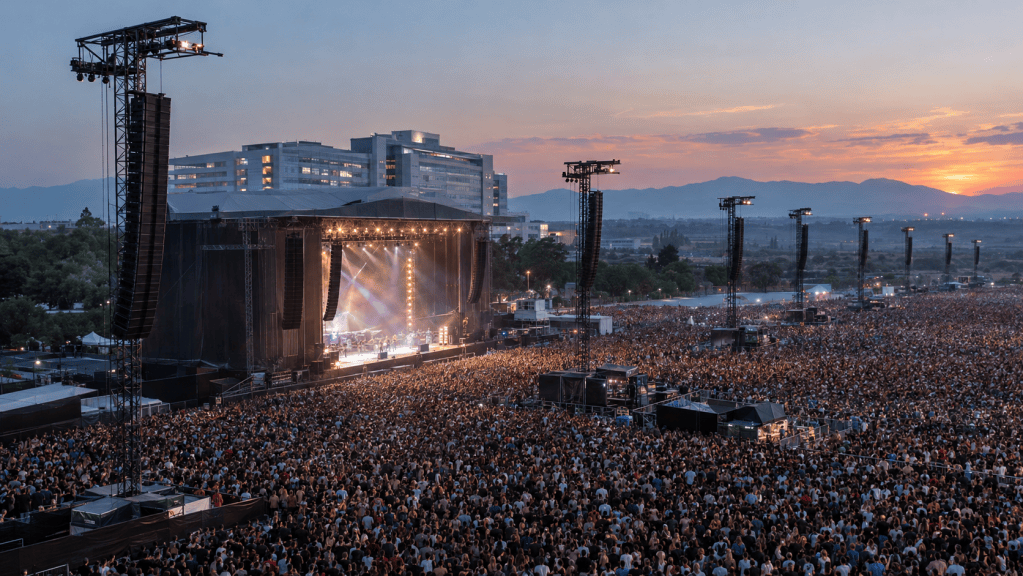
Italian production company Agorà has delivered the largest ticketed concert ever staged in Italy, deploying the new L-Acoustics L1 system alongside K1, K2 and V-DOSC for Ultimo’s La Favola per Sempre show at Tor Vergata in Rome. The one-off summer concert drew 250,000 fans to a bare site with no permanent event infrastructure and strict noise limits imposed by the Policlinico Tor Vergata teaching hospital directly behind the stage.
Record audience and challenging audience site
Ultimo, the stage name of Rome-born singer-songwriter Niccolò Moriconi, has seen a rapid ascent since releasing his debut single in 2017 and winning the newcomers category at Sanremo in 2018. By 2019 he was headlining Stadio Olimpico for more than 63,000 people, becoming the youngest Italian artist to headline a stadium at 23.
For the Tor Vergata show, held seven years to the day after his first stadium performance, the audience area was divided into six zones, each dedicated to one of his albums. The setlist ran to 29 songs, with a strong emphasis on impactful low-frequency content despite Ultimo’s primarily pop repertoire.
The open plain at Tor Vergata offered vast capacity but no built-in services. There was no power, no access roads and no standard load-in routes. The production team built a 140-metre stage supported by 34 towers reaching 33 metres high, installed 2,500 square metres of LED and erected a field of delay towers stepping back almost 600 metres through the crowd. All of this had to coexist with tight offsite noise constraints and a hospital facility directly behind the performance area.
Agorà combines three generations of L-Acoustics technology
FOH engineer Andrea Corsellini initially tasked L-Acoustics Certified Provider Agorà with creating a coverage preview for the site. The Italian company was then contracted to design and deliver the complete sound system, specifying three generations of L-Acoustics line source technology to meet coverage, impact and noise control targets.
The main system featured the newly launched L1 with CS1 subwoofers, supported by K1 and K2 on the nearer delay lines and legacy V-DOSC arrays at the far end of the site. Agorà, a long-term L-Acoustics partner since the V-DOSC era and part of the pilot phase for L1, took the opportunity to prove the new flagship in a real-world production on an exceptional scale.
Ultimo’s team placed unusually high priority on audio within the overall production budget and planning, which allowed Agorà to propose L1 not only for the main hangs but also for sidefills. Corsellini and the crew carried out system tests in Agorà’s warehouse ahead of the show before presenting the approach to artist management.
Alongside the production delivery, Agorà is collaborating with promoter Vivo Concerti and the University of Rome Tor Vergata on a research programme examining sound propagation and acoustic impact around major outdoor events of this size.
Cardioid low-frequency control protects hospital and perimeter
The sound brief set two apparently conflicting requirements. The PA needed to deliver stadium-level impact for a quarter of a million fans while strictly limiting sound pressure levels behind the stage, where the hospital sits, and at the site perimeter. Uniform tonality and level from the front of the crowd to the last delay tower were non-negotiable goals for Ultimo’s audio-focused team.
L1 and CS1’s inherent cardioid architecture was central to resolving this conflict. The system offers cardioid, supercardioid and side-rejection presets, providing up to 26 dB rejection onstage in the low-frequency range. This directional control supported both the noise mitigation strategy and the consistency of coverage across the wide and deep audience area.
Agorà FOH assistant Remo Scafati described the L1 main system as extremely powerful and good sounding, noting that the cardioid pattern, combined with CS1 subs, was a major asset in meeting noise-control targets around the site.
Beyond acoustics, the demanding site created significant logistical challenges. The absence of infrastructure, slow movement of heavy equipment across the terrain and volatile summer weather, from intense heat to sudden storms, all added complexity to design, deployment and system optimisation.
Soundvision maps coverage and spill across delay field
Agorà modelled the entire deployment in L-Acoustics Soundvision, from the main system to the farthest delay lines. With the hospital imposing a hard ceiling on rearward energy and the last delay tower positioned approximately 580 metres from the stage, accurate prediction of both coverage and spill was essential before any rigging began.
Delay-system designer and system engineer Antonio Paoluzi used Soundvision for geometry, SPL distribution and delay-time predictions, and complemented it with custom software he developed to recalculate delay times in response to changes in temperature and humidity. To manage the large number of amplified controllers, the design was split into two separate projects, staying within LA Network Manager session limits while still functioning as an integrated system.
Paoluzi highlighted Soundvision’s precision in predicting coverage and delay times across the site’s different audience zones, enabling the team to anticipate and correct potential problem areas in advance.
Main system and delay network design
The primary PA centred on four L1 hangs: two main arrays and two side arrays. Each hang combined flown CS1 subwoofers at the top with L1 elements and an L1D module at the bottom to serve the near field. An additional eight CS1 were flown centrally, while 63 KS28 subwoofers were ground-stacked in blocks of three in an arc across the stage front.
Front-fill was handled by Kara II and A15 cabinets distributed across the full width of the stage. An extra K1 hang extended coverage into one lateral area of the site, and an additional side system of 14 L1 units on stage right covered a large VIP grandstand. LA7.16 amplified controllers powered the system.
The delay network comprised nine positions stepping back from the stage. The nearest delay lines used combinations of K1 and K2, transitioning to K2 further into the field and then to V-DOSC arrays at approximately 460 metres and 520 metres. The final delay line at around 580 metres returned to K1 to complete coverage. KS28 subwoofers reinforced low end at each delay position, while Kara II addressed the grandstand areas.
Milan-AVB infrastructure and multi-layer redundancy
The entire system ran on a Milan-AVB backbone, with primary and secondary networks configured in a star topology using a Luminex infrastructure consisting of a central hub and ten primary and ten secondary nodes. Each tower housed an L-Acoustics LA-RAK II AVB and an LS10 switch.
An Optocore network delivered AES to the amplified controllers and provided an automatic fallback transport layer. Given the scale and criticality of the event, Agorà added an analogue distribution path as a third redundancy layer, delivering additional resilience for disaster recovery.
Agorà technical manager Valerio Motta described the delay system as the most demanding operational element, citing the vast site, tight work schedule and extreme heat as significant constraints. Nonetheless, the team reported that the final system performance justified the intense preparation and field effort.
Teamwork, Source Intelligence and audience response
System responsibilities were split between two Agorà engineers: Paoluzi oversaw the delay chain, while Luca Nobilini handled the main system. L-Acoustics regional application engineer for EMEA South, Tom Laveuf, supported the team through deployment, tuning and the show itself.
Corsellini credited the combination of L1, CS1 and experienced system engineering for achieving one of the best-sounding systems he has heard, emphasising the role of coordinated teamwork and deep technical knowledge in meeting the project’s ambitions.
The crew also highlighted L-Acoustics Source Intelligence as a significant factor in refining the mix. Feedback from Ultimo, his management and other professionals involved in the production praised the clarity, definition and impact of the sound across the entire audience field, cementing the concert as a landmark reference for large-scale outdoor sound reinforcement in Italy.