Allen & Heath dLive supports complex dual-stage setup at Woodstock der Blasmusik
Background and context
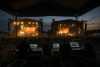
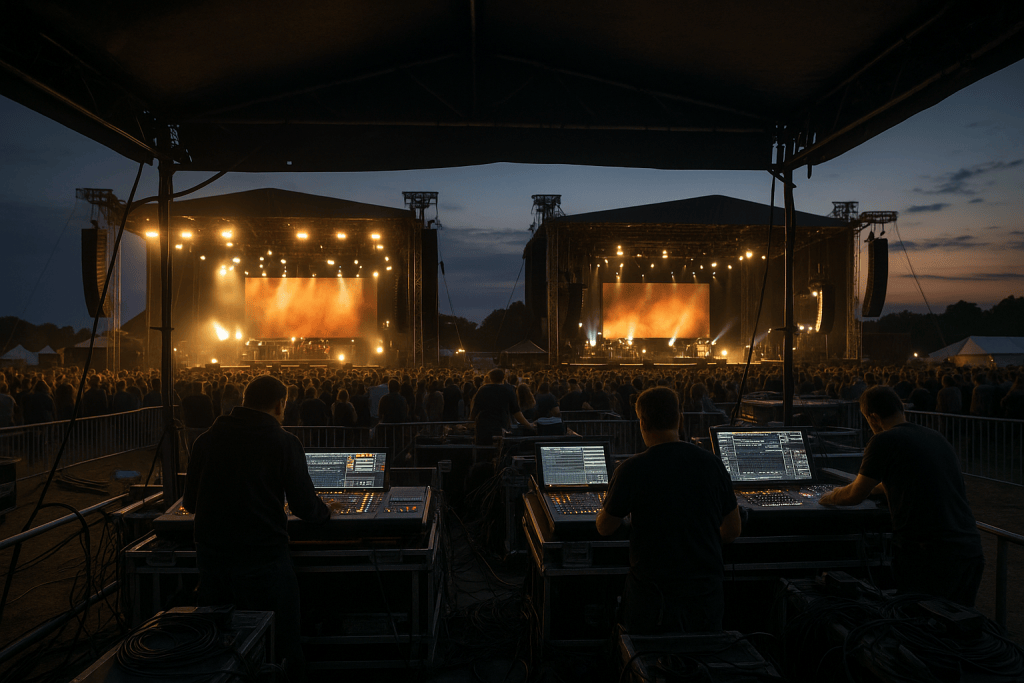
Woodstock der Blasmusik, also known as the Woodstock of Brass Music, returned to Ort im Innkreis, Austria, with a large-scale format featuring 110,000 visitors, more than 150 bands and two main stages operating in parallel.
German production company session pro GmbH has handled sound and lighting for the festival since 2012. This year, the company again supplied the complete audio infrastructure, opting for a fully networked digital console and stagebox setup to cope with the growing technical demands of the event.
The festival’s double-stage configuration, with continuous changeovers and overlapping performance schedules, places particular pressure on routing flexibility, channel sharing and reliability across front of house, monitors and broadcast.
Key announcement
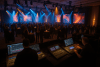
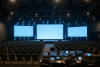
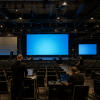
For the 2026 edition, session pro deployed an Allen & Heath dLive ecosystem as the core of the audio workflow. The system included DM64 MixRacks, two S7000 surfaces at front of house and two S3000 surfaces at monitors, as well as an SQ-Rack used for independent announcements.
With two FOH positions and two monitor positions, the production team needed the ability to share inputs and wireless channels between stages without repatching hardware. The dLive infrastructure allowed channels to be reassigned digitally between the two stages, enabling wireless systems from one stage to be used on the other as required.
- Two S7000 surfaces at FOH for the dual-stage layout
- Two S3000 surfaces for dedicated monitor mixes
- DM64 MixRacks as the central processing and I/O backbone
- An SQ-Rack configured as a standalone announcement console
Session pro’s Alexander Schad noted that visiting engineers were able to adapt quickly to the workflow, with minimal onboarding time between acts.
Industry impact
Beyond the main PA, the production highlighted several areas of interest for live and broadcast audio professionals. One was the integration of an outside broadcast (OB) truck with differing sample rate requirements.
According to Schad, a MADI card in the dLive system was split to feed both FOH and the OB truck. FOH ran at 96kHz while the truck operated at 48kHz, with the console handling the conversion internally. This avoided the need for additional external sample rate conversion hardware, simplifying the signal chain.
The independent announcement path, built around an SQ-Rack, ensured that festival communications could continue even during FOH reconfiguration or stage changeovers. This approach underlines a wider trend at large events toward more resilient, redundant communication and control paths.
On stage, the production also placed emphasis on low-latency signal processing, particularly for performers relying on in-ear monitoring. Schad pointed to latency as a factor that artists, especially in jazz and classical contexts, are highly sensitive to, even when sound quality is otherwise a matter of taste.
Why this matters
The Woodstock der Blasmusik deployment demonstrates how a single, scalable console platform can support a multi-stage festival, broadcast integration and show-critical communication from within one networked system.
For event technology providers, the project illustrates practical approaches to:
- Managing dual or multi-stage workflows with shared RF and I/O resources
- Accommodating mixed sample rate environments for live and broadcast
- Maintaining independent announcement and emergency communication paths
- Reducing perceived latency for performers using in-ear monitoring
Allen & Heath’s dLive series, detailed on the company’s official website at https://www.allen-heath.com, has been increasingly visible on festival and touring riders. The Woodstock der Blasmusik production offers a case study in how such systems are being applied to complex, multi-layered live environments where flexibility and speed of operation are central requirements.