How major brands turned fans into collaborators at San Diego Comic-Con 2026
Background and context
San Diego Comic-Con 2026 continued its evolution from a traditional fan convention into a large-scale testing ground for experiential marketing. Major entertainment and technology companies used the event to explore how physical spaces, live performance, and interactive technology can extend their stories beyond screens.
With tens of thousands of attendees on-site and global attention online, the convention offered brands a concentrated audience of highly engaged fans. This created an opportunity to experiment with formats that blur the line between audience and participant, while gathering real-time feedback on new concepts and story worlds.
Key announcement
At this year’s edition, brands such as HBO Max, FX, and Google Play focused on placing fans at the center of narrative-driven activations, rather than positioning them as passive viewers. Across downtown San Diego and inside the convention footprint, these companies built temporary environments that functioned as extensions of their IP, using scenography, live actors, and interactive tech.
HBO Max leaned heavily into immersive set recreations, allowing visitors to walk through spaces inspired by its series and interact with story elements in real time. FX emphasized atmospheric experiences built around mood, world-building, and character, often relying on lighting, sound design, and environmental storytelling to create tension and drama.
Google Play approached Comic-Con primarily through the lens of interactive entertainment and mobile experiences. Its installations highlighted game titles and app-based content, encouraging attendees to test features, unlock digital rewards, and share their achievements across social platforms. In many cases, physical actions—such as completing a challenge or navigating a themed environment—triggered digital bonuses or custom content.
Taken together, the activations showed a coordinated push toward formats where fans are encouraged to contribute choices, content, or performance, rather than simply consuming what brands present. More information about these companies’ consumer offerings can be found on their respective official sites, including Google Play’s product pages on play.google.com.
Industry impact
The 2026 Comic-Con executions reflect several broader shifts in live event and experiential strategy:
- A move from photo-first sets toward interactive sequences, in which guests complete tasks, follow storylines, or influence outcomes.
- A tighter integration of physical and digital experiences, with QR codes, app tie-ins, and game mechanics connecting on-site participation to ongoing engagement.
- An emphasis on data collection through opt-in interactions, allowing brands to understand fan preferences in more granular ways.
- Growing collaboration between production designers, game developers, and event technologists to deliver cohesive, story-led environments.
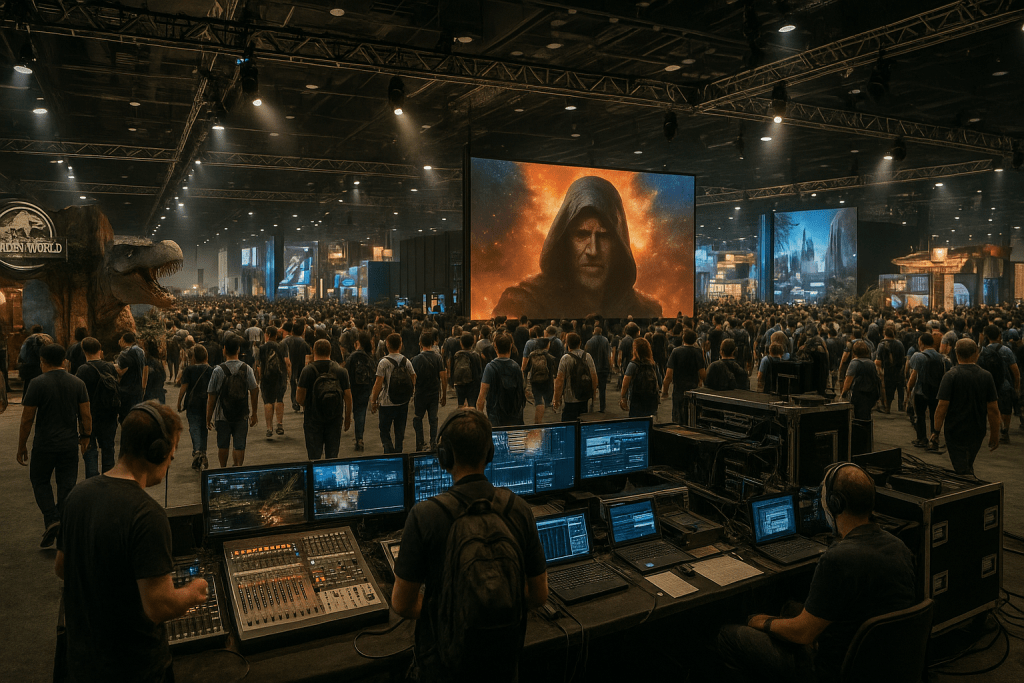
For AV and event technology providers, these trends translate into higher demand for responsive lighting, adaptable soundscapes, real-time content playback, and robust connectivity. Temporary builds at large conventions now function closer to small-scale theme park attractions, requiring careful integration of media servers, show control systems, and interactive interfaces.
Why this matters
San Diego Comic-Con has long been a bellwether for how entertainment brands communicate with their most dedicated audiences. The 2026 edition underscores that immersive, tech-enabled experiences are no longer an add-on, but a central part of franchise strategy.
For event professionals, the work by HBO Max, FX, and Google Play illustrates the growing expectation that attendees will participate in shaping the narrative, whether through gameplay, branching story paths, or user-generated content. Delivering on that expectation requires reliable infrastructure, flexible creative tools, and teams comfortable operating at the intersection of live production, interactive media, and fan communities.
As other conventions and festivals take cues from Comic-Con, the ability to build scalable, story-rich environments will likely become a core competitive factor for agencies, production companies, and venues alike.