Summer-themed brand activations highlight evolving experiential event strategies
Background and context
Summer continues to be a prime season for brands to experiment with experiential marketing, using outdoor events, pop-ups, and festival environments to reach audiences in more immersive ways. Warmer weather, longer days, and an active tourism period provide natural opportunities for live activations that go beyond traditional advertising.
In recent months, a range of consumer brands across travel, food and beverage, media, and lifestyle sectors have leaned into this seasonal window. Their aim has been to connect with audiences through in-person experiences that are visually distinctive, shareable on social platforms, and closely tied to core brand messages.
These initiatives offer useful insight for event professionals and agencies designing campaigns that must balance creativity, logistics, and measurable impact.
Key announcement
Several major consumer brands have rolled out summer-themed experiential campaigns built around interactive installations, pop-up environments, and destination-style events. Recent activity has included:
- Travel and airline brands using beach and vacation-inspired builds to highlight routes, loyalty programs, and seasonal offers, often integrating photo-friendly sets and lounge-style seating.
- Food and beverage companies creating temporary bars, tasting stations, and outdoor lounges that pair sampling with games, live music, or influencer-led appearances.
- Media and lifestyle brands hosting curated parties and content-driven experiences that double as live production environments for social and editorial coverage.
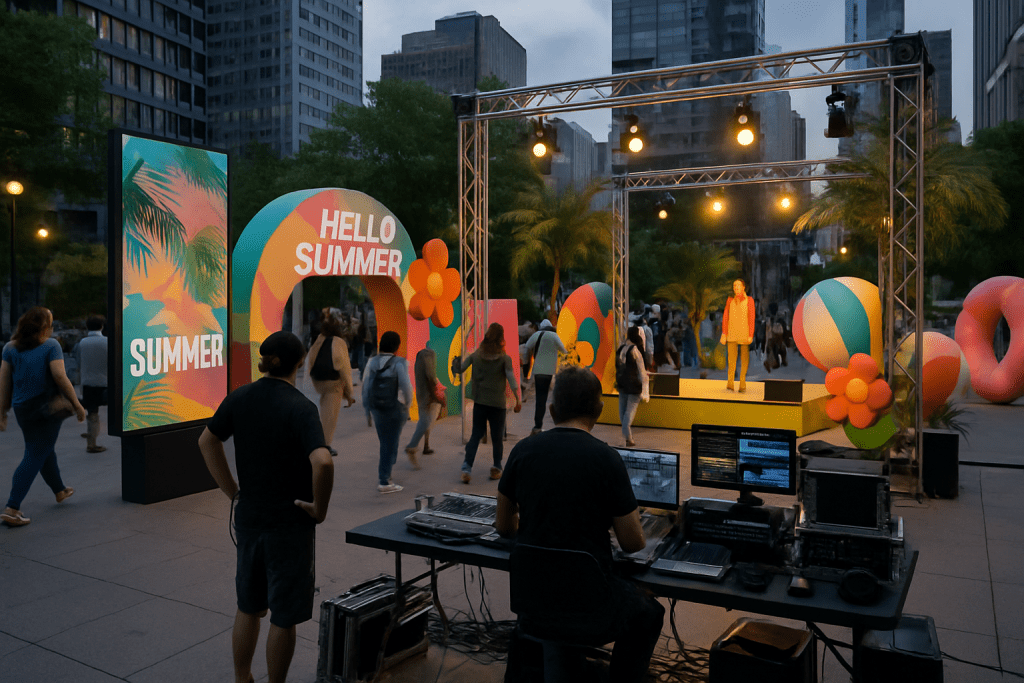
Across these activations, teams have relied on a mix of event technology tools, including LED displays, interactive photo moments, digital registration, and integrated social media workflows. Many builds were staged in high-traffic urban areas or near major summer events, such as music festivals or waterfront attractions, to capture existing footfall.
While each activation focused on a specific brand story, the underlying objective was similar: use live events to deepen engagement, collect data, and create content that extends the life of the experience well beyond the physical location.
Industry impact
The recent wave of summer activations underscores how experiential campaigns are becoming more production-heavy and technically sophisticated. Event teams are expected to deliver environments that function simultaneously as consumer experiences, content studios, and data touchpoints.
For AV and event technology providers, this translates into growing demand for:
- Scalable LED and projection solutions that perform well in bright outdoor conditions.
- Robust sound systems tailored to pop-up environments, from compact city footprints to larger waterfront or rooftop spaces.
- Integrated capture tools for photos and short-form video, often with on-site editing and branded templates for rapid posting.
- Lightweight infrastructure that can be installed and removed quickly to accommodate short-term permits and tight production schedules.
Agencies and technical partners are also being asked to connect on-site experiences with digital follow-ups, using QR codes, microsites, and opt-in mechanisms to extend audience interaction after the event has ended.
Why this matters
For event professionals, the latest round of summer-themed brand activations is less about individual brand names and more about the evolving playbook for experiential design. These projects show how seasonal concepts are being paired with technology to deliver measurable outcomes, from content generation to first-party data collection.
They also highlight rising expectations around visual impact. Attendees now assume that pop-ups and branded environments will be photogenic, interactive, and technically polished, even when built on temporary sites. That raises the bar for planning, AV integration, and coordination across creative, production, and digital teams.
As experiential budgets continue to shift toward live and hybrid executions, the techniques refined in these summer activations are likely to influence year-round campaigns. Event technology providers that can support rapid deployment, outdoor reliability, and seamless integration with social and CRM tools will be well positioned as brands look to repeat and scale these models in future seasons.
More information about experiential tools and approaches for seasonal campaigns can be found on leading event technology providers’ official product pages and solution overviews.