Introduction
In today’s digital-first corporate world, organisations are increasingly turning to virtual AGM solutions to support their annual general meetings (AGMs) in a way that is both secure and scalable. With advancements in streaming media, authentication technologies, and cloud-based infrastructure, virtual AGM platforms enable fiduciary and governance events to be conducted seamlessly across jurisdictions, devices, and stakeholder types. In this article, we explore the key architectural, security and scalability considerations for virtual AGM solutions, and provide a framework for how organisations can deploy them effectively.
The case for virtual AGMs
A virtual annual general meeting is a legally required corporate meeting — typically of shareholders or members — that is held entirely online, rather than in a physical location. From a governance perspective, it preserves the key elements of registration, notice, agenda, motions, proxies, voting, and Q&A in a digital environment.
There are several compelling drivers behind this shift:
- Geographic reach & accessibility: Remote attendees no longer need to travel; membership or shareholders in different time zones can participate.
- Cost-efficiency: Savings accrue from venue hire, travel, printed materials, and logistics.
- Business continuity: Especially in disruptive situations (pandemics, travel restrictions), virtual AGMs ensure the meeting can proceed.
- Regulatory evolution: Many jurisdictions are now enabling or permitting fully virtual or hybrid event formats.
- Data analytics & audit trail: Digital platforms enable fine-grained registration, tracking, voting analytics, and reporting.
Given these benefits, the selected virtual AGM solution must be robust in terms of security, scalability, and governance compliance.
Learn about AI Tools for Enhancing Virtual Event Production.
Architectural and infrastructure considerations
When selecting or designing a virtual AGM platform, several core technical building blocks must be considered.
1. Registration and access control
Critical to any AGM is verifying that only entitled persons (shareholders, proxies, members) attend and vote. The platform should provide registration workflows, invitation tracking, unique meeting links or tokens, and ideally two-factor authentication or strong identity verification.
Proxy event content management and voting weight calculation are also required for many AGMs. The system should allow nomination of proxies, principal/agent relationships, abstention instructions, and accurate vote weight computation.
2. Streaming and meeting delivery
The virtual AGM must deliver high-quality video, audio, and presentation materials to large numbers of participants, often globally. Key features include:
- Multi-device support (desktop, tablet, mobile) and browser compatibility.
- Scalable streaming architecture, perhaps via CDN or distributed servers to minimise latency and packet loss.
- Integration of live Q&A, chat, and hand-raise functionality to mimic the interaction of a physical meeting.
- Breakout or private virtual conference (for e.g., board discussions) if required by the agenda.
3. Voting, polling, and resolution execution
The essence of an AGM is decision-making via motions or resolutions, so the platform must support secure, auditable voting. Features to look for:
- Real-time weighting of shares or votes, aggregate results, breakdown by class or lot as required.
- Support for multiple question types: single-choice, multiple-choice, free-text input, and abstention options.
- Display of results during or after the meeting, integration into slide decks, or live dashboards.
- Full audit trail: registration metadata, votes cast, time stamps, export capability for scrutiny and regulatory compliance.
4. Security and compliance
In virtual AGMs, ensuring data integrity, confidentiality, and regulatory compliance is non-negotiable. Key measures include:
- End-to-end encryption of data in transit and at rest; HTTPS access with secure authentication.
- Role-based access control (e.g., chairperson, moderator, attendee, auditor) and session moderation to control speaker permissions.
- Distributed or redundant server architecture with DDoS protection and failover to ensure availability.
- Compliance with local legal frameworks on virtual meetings, especially regarding the definition of “place” in meeting law, quorum requirements, and shareholder rights.
5. Scalability and performance
A virtual AGM platform must handle hundreds to tens of thousands of participants, depending on the organisation. Key concerns:
- Load testing to ensure streaming and voting modules perform under peak concurrency.
- Optimised infrastructure (cloud-based or hybrid) with elastic scaling to ramp up for the event and scale down after.
- Multi-region distribution to reduce latency and deliver a consistent user experience across geographies.
- Monitoring dashboards pre-, during, and post-meeting to track attendance, connection quality, drop-outs, and vote activity.
Deployment lifecycle: From planning to reporting
Implementing a virtual AGM solution involves multiple phases — each with its own technical checkpoints.
1. Pre-meeting phase
- Platform selection & customisation: Choose a solution that offers branding (company logo, colours), a microsite for the meeting, and an integrated registration module.
- Invitation & registration workflow: Deploy email campaigns with unique tokens/links, track bounce/opens, enable self-service registration.
- Proxy and voting weight preparation: Ensure the shareholder register is up to date, proxies have been submitted, vote weights have been computed, and they have been uploaded into the system.
- Rehearsal and dress-run: Technical run-throughs for speakers, presenters, moderators; verify camera/audio, testing of voting/polling features.
- Security review: Validate authentication flows, encryption, access restrictions, and backup architecture.
- Communication to participants: Provide device/browser compatibility guidelines, connectivity requirements, meeting agenda, downloadable documents, and FAQs.
2. Live meeting execution
- Start meeting and ensure quorum: Verify attendance, apply proxy counts, and ensure quorum is met before the substantive agenda commences.
- Streaming and moderation: Launch live broadcast, monitor connectivity, support remote participants via chat/helpdesk, moderate Q&A sessions.
- Voting sessions and result computation: At the appropriate times, trigger polls/votes, tally results in real-time, display outcomes, handle proxy votes, and perform weighted calculations.
- Documentation: Record meeting, archive minutes, capture attendance logs, preserve audit trail (votes, times, participants).
- Contingency handling: Be ready for fallback streams, backup servers, and reconnection flows in case of disruptions.
3. Post-meeting and reporting
- Data export and audit: Extract registration, attendance, voting results, and Q&A logs for regulatory compliance and future reference.
- Shareholder follow-up: Distribute meeting outcomes, archived video, downloadable resolutions, and provide access to the meeting minutes.
- Metrics and analytics: Review participant drop-off rates, engagement levels, voting participation, and technical incidents to refine future meetings.
- Archival and compliance: Ensure meeting record retention in line with governance or jurisdictional requirements.
Key benefits realised
By deploying a mature virtual AGM solution, organisations gain distinct benefits:
- Enhanced shareholder participation: Removing physical barriers means higher attendance and engagement, greater inclusion across geographies.
- Improved transparency and auditability: Digital voting, log capture, and real-time reporting enhance trust in governance processes.
- Operational efficiency: Simplified logistics, lower overheads, and streamlined workflows lead to cost savings and faster execution.
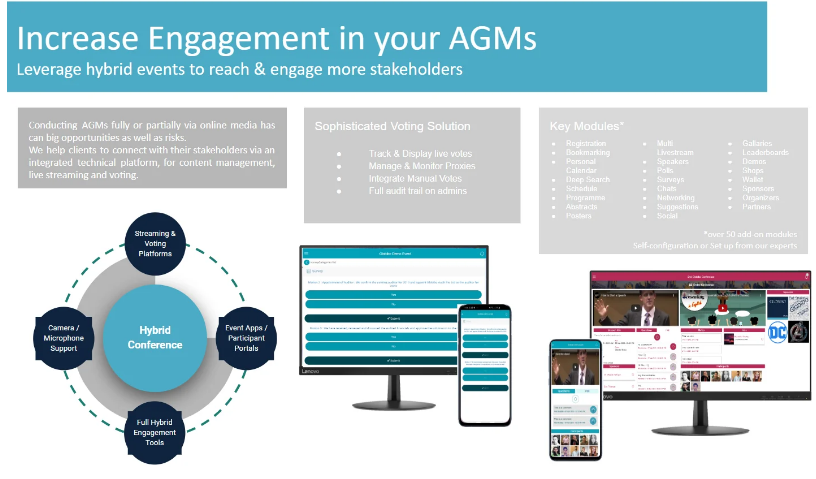
- Future-proof flexibility: Hybrid event studio architectures allow for both physical and remote attendees, adapting to evolving stakeholder needs.
- Data-driven insights: Platforms often include dashboards and analytics that help governance teams assess participation, monitor risk, and plan improvements.
Challenges and mitigations
While the case for virtual AGMs is compelling, technical and governance teams must mitigate certain risks:
- Connectivity and device variability: Participants may join from low-bandwidth regions or mobile devices. Mitigation: provide minimum device/browser specs; deliver adaptive bit-rate streaming; offer dial-in or fallback audio options.
- Security threats: Unauthorized access, vote manipulation, DDoS attacks. Mitigation: strong access controls, encryption, session monitoring, third-party security audits.
- Regulatory ambiguity: Some jurisdictions still have strict definitions of “location” for meetings, or may not fully recognise virtual formats. Mitigation: consult legal counsel, review articles of association, and adopt a hybrid mode if required.
- User-experience issues: Complex registration flows or an unfamiliar interface can degrade participation. Mitigation: user-friendly registration, pre-meeting training or tutorials, live helpdesk support during the event.
- Voting integrity: Ensuring votes are tied to eligible participants, weighted correctly, and auditable. Mitigation: robust proxy workflows, vote weight logic, independent audit trail, and encryption.
Best-practice checklist
Here is a condensed checklist for organisations implementing virtual AGM solutions:
- Ensure articles or bylaws permit a virtual & hybrid event format.
- Confirm device/browser compatibility and guide participants.
- Select a platform with registration & proxy management, streaming, polling/voting modules, audit trail, analytics, strong security.
- Conduct a full technical rehearsal, including speakers, voting, and Q&A.
- Define authentication and identity verification protocols (link-based, token, 2FA).
- Plan for scalability: test for peak concurrent users, validate multi-region delivery.
- Define contingency/resilience plan (backup streams, switching servers, manual voting fallback).
- Secure the meeting infrastructure: encryption, access control, session logs, DDoS protection.
- During the meeting: monitor connection/performance, manage Q&A moderation, verify quorum, run votes, record the session.
- Post-meeting: export and archive data, generate participant/voting reports, analyse participation metrics, store video/meeting minutes in compliance with regulations.
Summary of Virtual AGM Solutions
As organisations continue to adapt to an increasingly digital and distributed stakeholder environment, the adoption of robust virtual AGM solutions is not merely an optional convenience — it is a strategic imperative. By leveraging a platform that is secure, scalable and tailor-made for fiduciary events, companies can deliver inclusive, transparent, and efficient governance meetings, irrespective of geography or device. The virtue of a well-executed virtual AGM lies in its ability to replicate — and in many cases surpass — the effectiveness of a physical meeting, while delivering cost advantages, auditability, and greater reach. In short, the right virtual AGM solution becomes a mission-critical asset for the modern organisation.
YouTube Videos on Virtual AGM Solutions
Academic References for Virtual AGM Solutions
- [PDF] How to Break Virtual Shareholder Meetings: An Empirical Study
- Scalable solutions for secure group communications
- A virtual meeting system for the new age
- From technology to society: An overview of blockchain-based DAO
- [HTML] Static-analysis-based solutions to security challenges in cloud-native systems: Systematic mapping study
- Security analysis of mobile edge computing in virtualized small cell networks
- Deployment issues for the IP multicast service and architecture
- Edge-cloud architectures for hybrid energy management systems: A comprehensive review
- [PDF] AGM & Conference 2023
- Economic Security and Scalability in Decentralized Systems