Sennheiser spotlights Digital Wireless Mindset For Live Production
Sennheiser perspective on Digital Wireless Mindset
Sennheiser is underscoring a shift in how production teams think about wireless audio, framing digital wireless not just as a product category but as a different mindset for planning and operating live, broadcast, and installed systems.
The company positions modern wireless workflows as increasingly software driven and network aware, affecting everything from frequency coordination and spectrum efficiency to how engineers design redundancy and monitor systems in real time.
Key impact on Live Event Workflow and System design
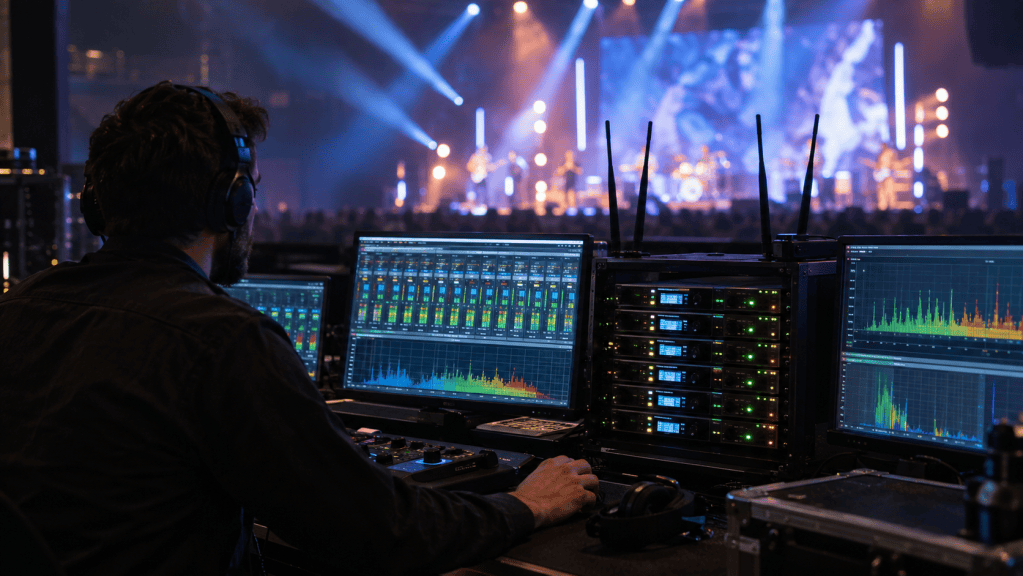
For live events and touring productions, the move toward digital wireless changes how audio teams approach system design. Instead of focusing only on individual radio channels and basic coordination, engineers are encouraged to think in terms of complete ecosystems that combine RF performance, IP networking, and control software.
This perspective emphasizes predictable performance in RF dense environments, integration with existing IT infrastructure, and centralized monitoring across stage, backstage, and front of house positions. As venues and productions grow more complex, the mindset shift supports more scalable and repeatable deployments.
Operational benefit for Production crew and Rental company
Production crews and rental companies can benefit from streamlined configuration and diagnostics when treating wireless systems as networked platforms. Centralized control, software assisted setup, and remote access capabilities can reduce on site setup time and help teams respond faster to RF issues during shows.
This approach is particularly relevant for tours, festivals, and multiroom venues where multiple productions or stages must share limited spectrum while maintaining clear and reliable audio.
Relevance for Broadcast environment and Installed venue
In broadcast environments, the digital wireless mindset supports tight integration with production control rooms and existing IP based infrastructure. Monitoring, routing, and troubleshooting can be centralized, allowing engineers to keep consistent standards across studios, remote productions, and hybrid workflows.
Installed venues and corporate facilities can also apply the same thinking. Treating wireless as part of the broader networked AV architecture allows integrators to plan for long term upgrades, manage devices across large campuses, and support a mix of events with varying RF demands.
Focus on Spectrum management and Reliability
Central to this shift is the way engineers handle spectrum management and reliability. By leveraging tools and capabilities associated with digital systems, operators can improve frequency planning, mitigate interference more effectively, and maintain higher channel counts in congested environments.
Sennheiser highlights that this is not simply about adding new hardware, but about adopting a planning first approach that aligns wireless strategy with venue design, show requirements, and regulatory conditions.
Implication for Future Event production Technology
The emphasis on a different way of thinking about wireless reflects broader trends in event technology, where audio, video, and control increasingly converge on IP networks. As this continues, audio teams, system integrators, and venue operators are expected to collaborate more closely with IT departments to ensure robust and secure deployments.
For event professionals, the message is that successful use of digital wireless will depend as much on process, training, and system design as on the specific transmitters and receivers in use. By approaching wireless as a strategic component of the overall production infrastructure, teams can build more reliable, scalable, and future ready systems.